


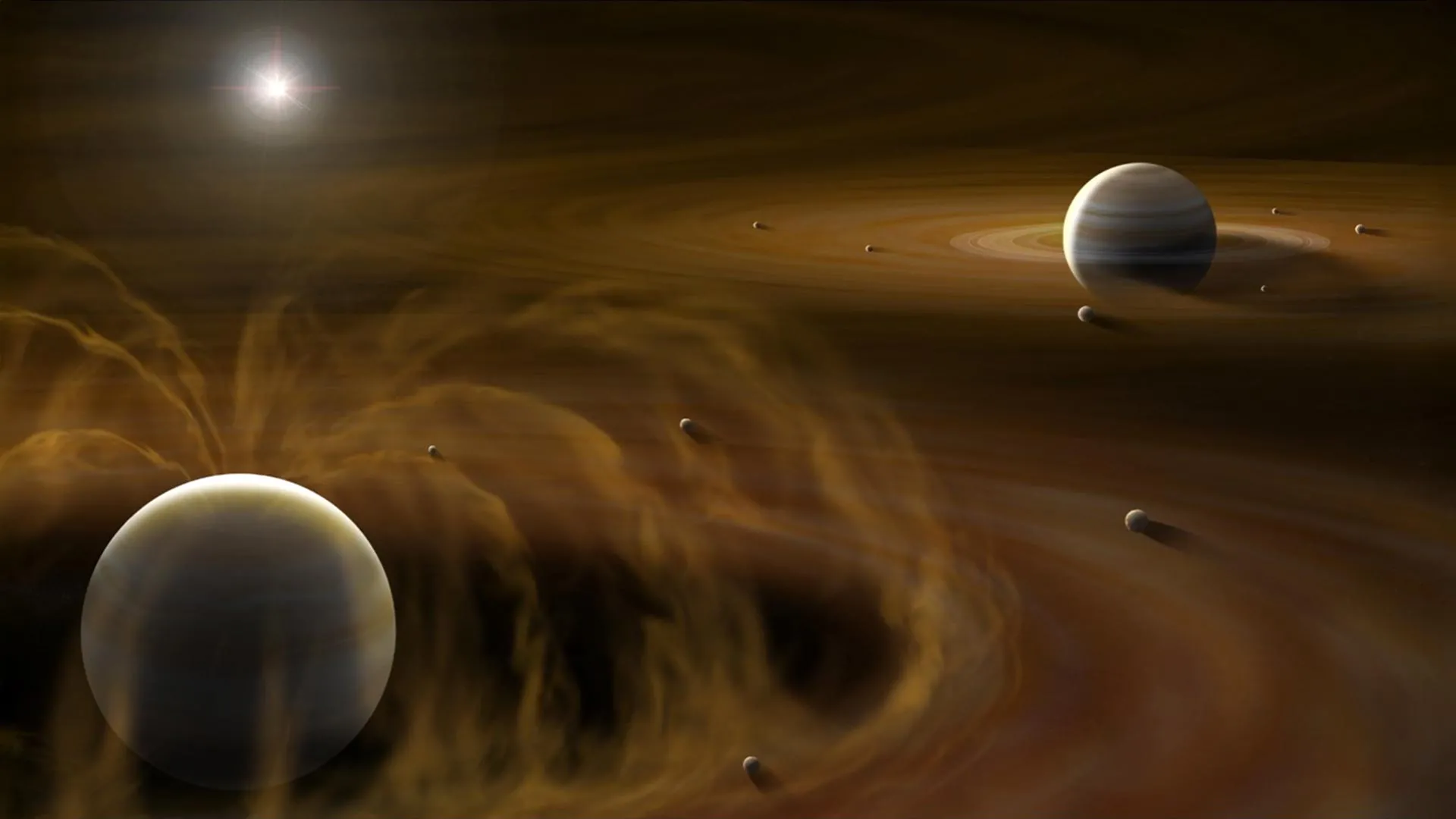
Jupiter and Saturn are the largest planets in the Solar System, and both are surrounded by vast systems of moons. Jupiter has more than 100 reported moons, while Saturn—famous for its spectacular rings—has more than 280 known moons.
Despite their similar status as gas giants, Jupiter and Saturn have remarkably different moon systems. Jupiter has four major moons, known as the Galilean moons, including Ganymede, the largest moon in the Solar System. Saturn’s satellite system is dominated by Titan, the second-largest moon in the Solar System.
A Longstanding Mystery in Moon Formation
Astronomers have long questioned why the major moons of Jupiter and Saturn formed so differently. Existing models of satellite formation offer several explanations, but new research into planetary magnetic fields suggests that the strength and evolution of those fields may have played a more important role than previously thought.
One key question concerns magnetic accretion and the formation of moons. Scientists have debated whether Jupiter’s circumplanetary disk—a rotating disk of gas and dust surrounding a young planet—could have developed an empty inner region where satellites could not form or survive.
A single, physically consistent model that explains both the Jupiter and Saturn moon systems could also improve scientists’ understanding of planets and moons beyond the Solar System. To investigate this possibility, researchers from Japan and China, including Kyoto University, developed a new moon-formation model.
“Testing planet formation theory is somewhat difficult because we have only our Solar System for reference, but there are multiple satellite systems close to us whose detailed characteristics we can observe,” says first author Yuri I. Fujii.
Simulating the Early Evolution of Jupiter and Saturn
The researchers used numerical simulations to study the internal structures and thermal evolution of Jupiter and Saturn during their early histories. These calculations helped estimate how the magnetic fields of the two young gas giants may have developed and changed over time.
The team also modeled the circumplanetary disks around both planets. Using N-body simulations, they tracked how moons formed, migrated through the disks, and gradually settled into their final orbits. The calculations were performed on the PC cluster at the Center for Computational Astrophysics, National Astronomical Observatory of Japan.
Jupiter’s Magnetic Field May Have Protected Its Major Moons
The simulations suggest that the different moon systems of Jupiter and Saturn resulted from differences in their circumplanetary disks. Those disk structures appear to have been shaped by the strength of each planet’s magnetic field during its early evolution.
Young Jupiter possessed a strong magnetic field that created a magnetospheric cavity, or inner gap, within its circumplanetary disk. This protected region may have helped Io, Europa, and Ganymede avoid destructive inward migration and remain in stable orbits around Jupiter.
Saturn’s early magnetic field was apparently too weak to produce a comparable cavity. Without this protected inner zone, migrating moons may not have survived within Saturn’s circumplanetary disk, potentially explaining why Saturn developed a different population of major satellites.
What the Model Predicts for Exomoons
These findings could help astronomers interpret future observations of exomoons and the disks surrounding young gas-giant planets. The model predicts that planets with masses similar to or greater than Jupiter may tend to form compact systems containing several moons.
Gas giants closer in size to Saturn, on the other hand, may be more likely to develop only one or two surviving moons.
The researchers plan to test their theory against additional moons in the Solar System and investigate whether similar magnetic-field effects could shape exomoon systems orbiting distant planets.
Source: www.sciencedaily.com