


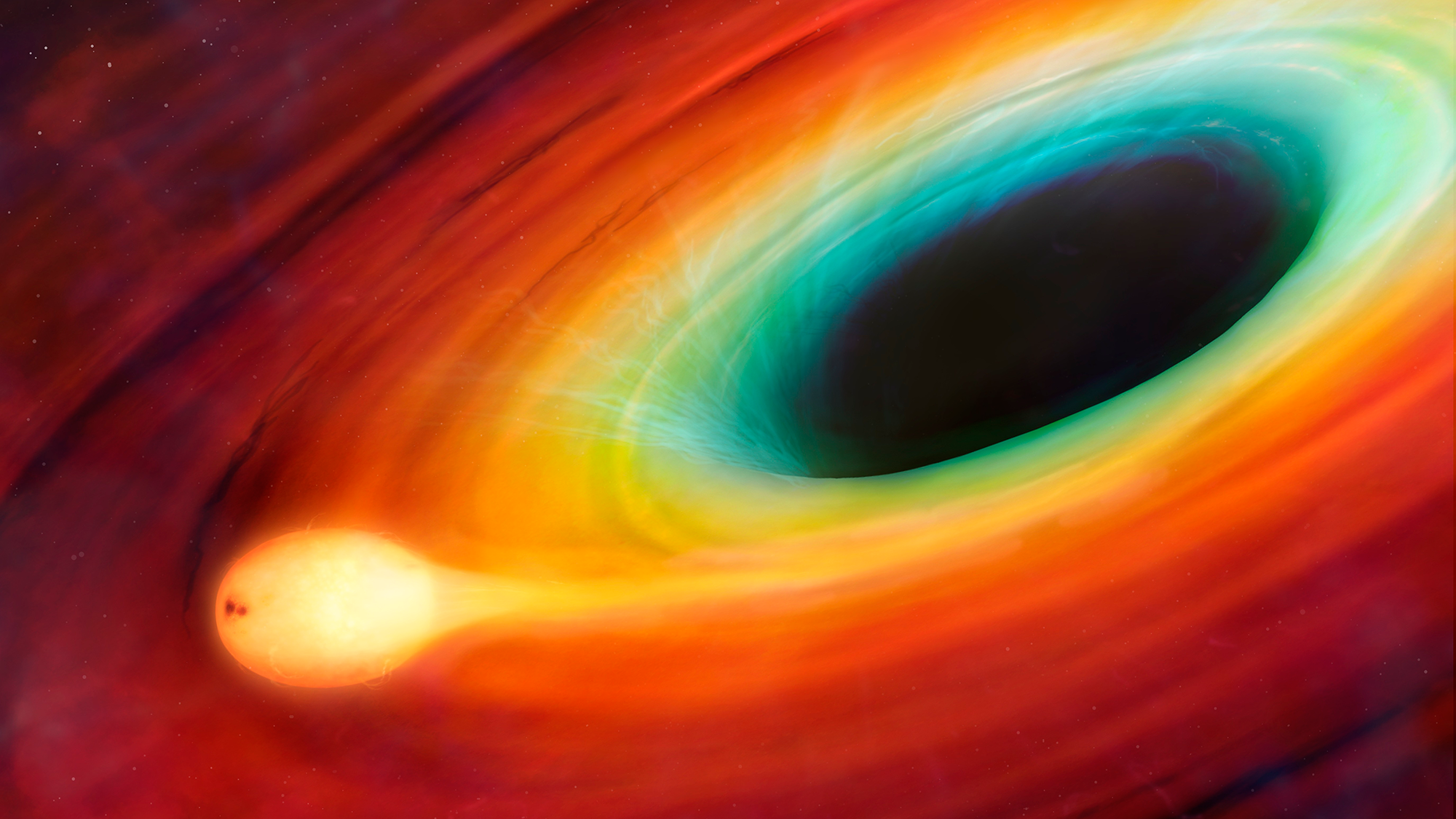
Record-Breaking Star S301 Orbits Sagittarius A* at 8% the Speed of Light
Astronomers have discovered the closest and fastest star ever observed orbiting Sagittarius A* (Sgr A*), the supermassive black hole at the center of the Milky Way. The faint star, known as S301, completes an orbit in just 8.7 years and reaches speeds of approximately 55 million mph (90 million km/h)—about 8% of the speed of light.
S301’s unusually tight orbit could allow researchers to measure the rotation, or spin, of the Milky Way’s central black hole within the next decade. The discovery was reported Aug. 19 in the journal Nature.
Stars act as natural probes of curved spacetime
The center of the Milky Way lies about 27,000 light-years from Earth and provides one of the best natural laboratories for testing physics. Dozens of stars orbit Sagittarius A* in a region where gravity is far stronger than anywhere else scientists can observe in detail.
“Stars orbiting Sgr A* are fascinating because they act as luminous probes of the curved spacetime around the black hole,” researchers said.
From the latest videoLive Science
Until now, the most important star in these studies was S2, a bright star with a 16-year orbit around Sgr A*. Astronomers have tracked S2 through more than two complete orbits since 1992. Its motion has revealed two effects predicted by Einstein’s general theory of relativity: gravitational redshift, in which light loses energy as it escapes the black hole’s gravitational field, and Schwarzschild precession, in which the star’s elliptical orbit slowly rotates.
These effects depend primarily on the black hole’s mass. However, black holes also have another fundamental property: spin. A rotating black hole drags spacetime around with it, an effect known as frame dragging. Because this influence weakens rapidly with distance, measuring Sgr A*’s rotation requires observing a star much closer to the black hole than S2 ever travels.
Measuring black hole spin could also help scientists test theories that extend beyond general relativity. Some alternatives propose the existence of an additional fundamental force linked to attempts to unify gravity with quantum physics.
If S301’s orbit deviates from Einstein’s predictions, it could reveal new physics. So far, observations have found no clear conflict with general relativity, but the discovery of S301 will make these tests significantly more precise.
S301 has the fastest and tightest known orbit
S301 was identified in observations collected with the GRAVITY instrument on the European Southern Observatory’s Very Large Telescope in Chile. The star is so close to Sagittarius A* that its orbit is affected by the black hole’s rotation, making it an ideal target for testing strong-field gravity.
VLT observations show S301 orbiting Sagittarius A*
(Image credit: ESO/GRAVITY collaboration)
S301 first appeared as a faint point of light northwest of the black hole in spring 2023. Researchers then examined archival observations and found the star in data from 2021 and 2017. In total, 19 measurements collected over eight years traced a complete, closed ellipse across the sky.
The star’s orbit is extreme. S301 takes only 8.7 years to circle Sagittarius A*, surpassing the previous record held by a star with a 12-year orbit. Its path is also highly elongated, forming a narrow, needle-like ellipse.
At its closest approach, S301 will pass within approximately 12 astronomical units of Sagittarius A*—12 times the average distance between Earth and the Sun. That is about 10 times closer than S2’s closest approach.
Despite its proximity to the black hole, S301 is not in danger of being destroyed. The star appears to be an ordinary main-sequence star with about 1.5 times the mass of the Sun. Its compact structure should allow it to withstand the black hole’s powerful tidal forces.
However, S301’s extremely elongated orbit may point to a violent past. Researchers suggest that it could once have been part of a binary star system. After the pair passed too close to Sagittarius A*, the black hole may have torn them apart, sending the companion star away from the galaxy as a hypervelocity star.
S301’s orbit already shows strong relativistic effects. Its orbital ellipse rotates by approximately 2 degrees during every revolution, a clear example of Schwarzschild precession. Continued observations could make it possible to measure the spin of Sgr A* within the next 10 years.
How astronomers will measure the black hole’s spin
Detecting S301 was challenging because the star appears roughly 2 billion times fainter than many other stars in the region. It is also located in a crowded field beside much brighter objects.
To isolate the star’s signal, researchers used an advanced image-reconstruction technique and the upgraded GRAVITY+ instrument. The upgrade increases the instrument’s sensitivity by a factor of 10 to 100, allowing astronomers to study fainter stars near the black hole.
There is still an important gap in the observations. The team has measured S301’s motion across the sky, but it has not yet determined whether the star is moving toward or away from Earth. As a result, two possible three-dimensional orbits currently fit the data.
Astronomers plan to resolve this uncertainty by tracking S301 throughout its orbit with GRAVITY and future instruments. They will measure changes in the star’s light as it shifts toward the red or blue ends of the spectrum, revealing whether it is moving away from or toward Earth.
Simulations indicate that roughly 10 years of combined observations could provide enough information to distinguish between a rapidly rotating and a nonrotating black hole. Researchers also estimate that around 100 similar stars may occupy comparable orbits around Sagittarius A*, although most are currently too faint to detect.
Find out how much you know about black holes. Take the black hole quiz!
Source: www.livescience.com