


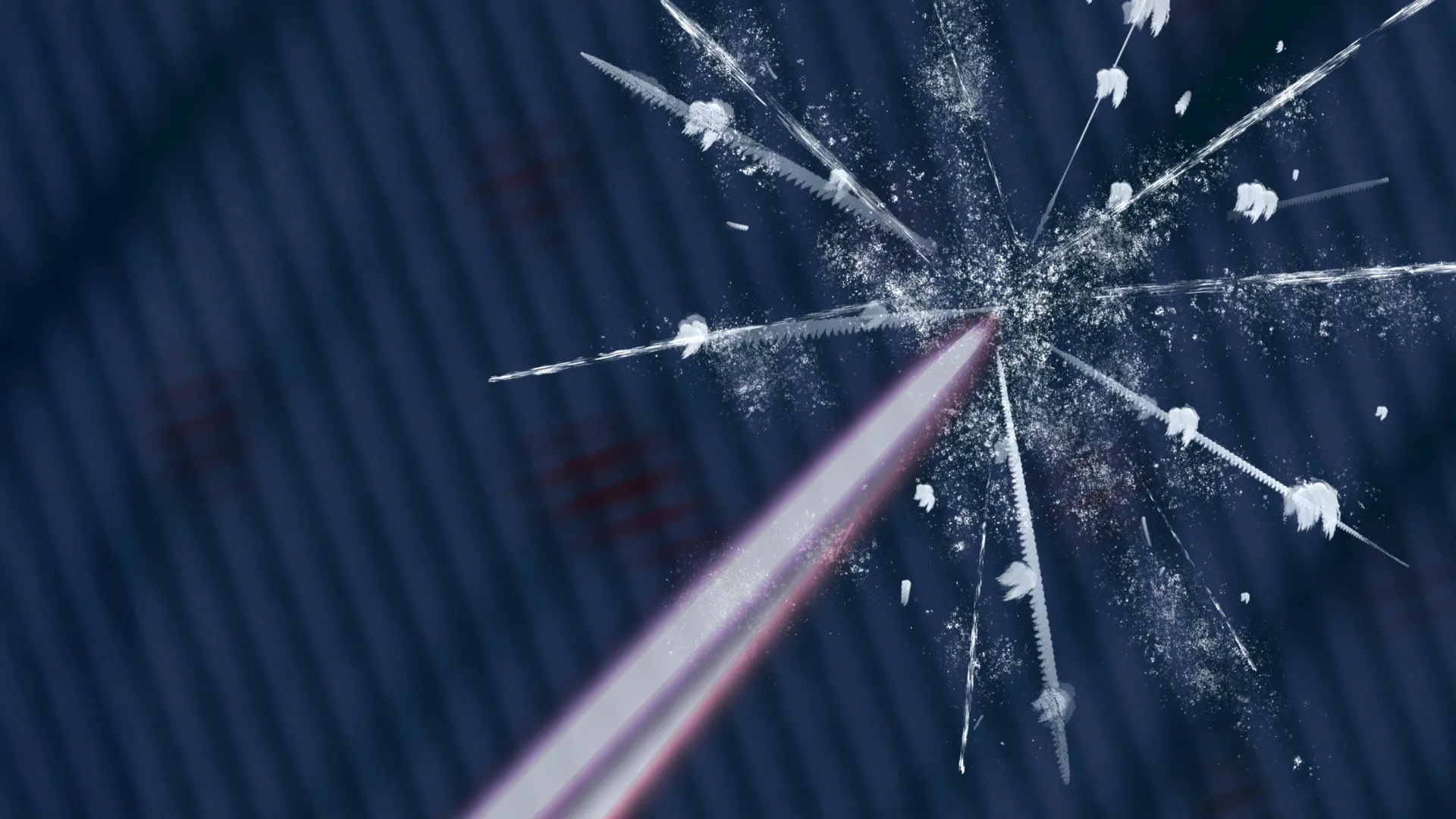
A glass of ice water is a familiar example of two phases of the same substance existing simultaneously: liquid water and solid ice. In quantum materials, however, multiple phases can coexist through far more complex patterns of electronic order.
MIT Physicists Reveal How Multiple Charge Density Waves Form in Quantum Materials
MIT physicists have uncovered new details about how two distinct forms of electronic organization emerge and coexist within a single quantum material. Their findings, published in Nature Physics, could improve scientists’ understanding of superconductivity, magnetism, and other collective electronic phases.
Understanding how these phases develop and interact may eventually help researchers control the electronic properties of advanced materials and design more powerful quantum technologies.
“Many researchers believe that quantum materials with multiple coexisting phases could provide a path beyond traditional silicon-based electronics,” says co-author Alfred Zorn PhD ’20. He conducted the research as a graduate student at MIT and is now an assistant professor at Stanford University. “Our experiments provide a powerful way to study these multiple electronic phases.”
An atomic-scale electronic checkerboard
Researchers led by Nu Gedik, the Donner Professor of Physics at MIT, studied erbium tritelluride, a rare-earth material known for its unusual quantum and electronic properties.
Under normal conditions, electrons are distributed relatively evenly throughout erbium tritelluride. When the material is cooled to a specific temperature, however, the electrons spontaneously organize into repeating wave-like patterns called charge density waves, or CDWs.
As the material is cooled further, a second charge density wave appears perpendicular to the first. Together, these two electronic waves create a pattern resembling a checkerboard at the atomic scale.
Gedik and his colleagues separated the two electronic phases and observed how each one formed. The first charge density wave gradually spread throughout the material, consistent with the conventional model of a continuous electronic phase transition.
The second charge density wave displayed a very different pattern. Instead of emerging smoothly across the material, it first appeared in isolated regions that expanded outward—similar to the way ice crystals form and grow in liquid water.
“Although the mechanisms behind the emergence of this second phase have been debated for many years, our approach provides a powerful new way to uncover the hidden physics of phase transitions in quantum materials,” Gedik says.
Other MIT researchers involved in the study include first author Yifan Su PhD ’24 and former postdoctoral researcher Bai-Qing Lv. Additional contributors include Dongsung Choi SM ’17, PhD ’24, former postdoctoral researchers Doron Azouly and Masataka Mogi, and collaborators from several other institutions.
How charge density waves form
Charge density waves develop when electrons spontaneously arrange themselves into repeating patterns. The peaks of each wave contain a higher concentration of electrons, while the valleys contain fewer. In some materials, this collective electronic order appears only at extremely low temperatures.
Physicists have studied charge density waves for decades. More recently, researchers have identified CDWs in materials that also display complex collective behavior, including magnetism and superconductivity. In a superconductor, electrons move through a material in coordinated pairs without electrical resistance.
“Like superconductivity, charge density waves are collective phenomena in which electrons move together in a specific way,” explains lead author Yifan Su. “CDWs are a simpler form of collective matter than superconductors, making them a useful platform for studying fundamental physics.”
The MIT team wanted to understand what happens when two charge density wave phases exist in the same material. Studying how the two waves emerge, interact, and coexist could offer clues about the more complicated phase transitions associated with superconductivity and other exotic electronic states.
“One of the biggest questions in physics is why some materials support multiple phases while others do not,” Gedik says. “When several phases are present, do they reinforce one another, compete, or coexist independently? This system provides a case study for understanding more complex quantum materials.”
Using ultrafast lasers to disrupt quantum order
Scientists already knew that erbium tritelluride can support two distinct charge density waves. Rare-earth materials such as this one can also be produced as atomically thin sheets, allowing researchers to investigate their quantum-scale electronic properties.
Earlier experiments showed that the first, or dominant, charge density wave appears when erbium tritelluride is cooled to approximately -8 degrees Celsius. This wave travels in one direction through the material.
When the temperature falls to approximately -113 degrees Celsius, a second, subdominant charge density wave appears at a right angle to the first. The combination of the two waves produces a checkerboard-like pattern of coexisting electronic phases.
For the new study, Gedik’s team set out to determine how each charge density wave forms and recovers after being disrupted.
The researchers studied a small, atomically thin sample of erbium tritelluride prepared by collaborators at Stanford University. Gedik’s laboratory cooled the sample to approximately -230 degrees Celsius, a temperature at which both CDW phases could coexist in the checkerboard configuration.
The scientists then disrupted the electronic pattern and monitored how the two charge density waves re-formed. The experiment used two precisely timed laser pulses.
“In this way, you ‘shake’ the system and then ‘listen’ to how it responds,” Gedik explains.
The first laser pulse acted as the disruption, breaking apart the electronic checkerboard. By changing the pulse’s intensity, the researchers controlled how strongly they disturbed the charge density waves.
A second pulse, containing high-energy photons, ejected electrons from the material. The researchers applied this pulse at different time intervals after the first pulse and measured the energy and momentum of the emitted electrons.
These measurements created a sequence of snapshots showing how the electronic phases recovered over time.
“You can see the phases being destroyed, but if you wait long enough, they come back,” Gedik says. “Depending on how you disturb the material, the two phases respond in very different ways.”
Two different mechanisms for rebuilding electronic order
Regardless of how strongly the material was disrupted, the dominant charge density wave gradually returned to a uniform state throughout the sample.
This smooth recovery is characteristic of a textbook second-order phase transition. A similar process occurs when a magnet gradually loses its magnetic order as its temperature rises.
The subdominant charge density wave produced a more unexpected result. Rather than returning uniformly, it first reappeared in scattered pockets. These regions then grew and spread throughout the material, much like ice crystals forming in liquid water.
This behavior is characteristic of a less common first-order phase transition. The observation allowed the researchers to identify the long-debated mechanism responsible for the formation of the subdominant charge density wave.
The discovery could have implications beyond erbium tritelluride. Many quantum materials contain multiple electronic phases, and the interactions between those phases may help explain their unusual properties.
“In more complex systems, including high-temperature superconductors, magnetism, superconductivity, and charge density waves can exist together,” Gedik says. “One theory is that the interactions among these phases produce their exotic properties. The lessons from this study may also apply to more complex materials.”
The research was supported by the EPiQS Initiative, the U.S. Department of Energy, the National Science Foundation, and the Gordon and Betty Moore Foundation.
Source: www.sciencedaily.com