


NASA Tests Solid-State Batteries Built for the Moon’s Extreme Cold
A car battery that struggles on a frigid winter morning is sensitive to extreme cold. On the Moon, however, nighttime temperatures near the south pole can fall to -328°F (-200°C). To support future lunar missions, NASA researchers are developing batteries that can operate safely in these harsh conditions.
Future lunar operations will need batteries that can activate after warming up and power everything from astronauts’ emergency kits to rovers exploring the Moon’s darkest craters—without creating a fire hazard.
NASA’s SPEARS Project Targets Extreme Lunar Conditions
The NASA project, called Solid Power for Extreme Adaptability and Resilience in Space, or SPEARS, could provide an important technology for supporting a sustained human presence on the Moon through the Artemis campaign.
“Batteries have become a critical part of our lives on Earth, powering our laptops, cell phones, power tools, and even cars,” said Donald Dornbusch, SPEARS principal investigator at NASA’s Glenn Research Center in Cleveland. “Batteries will be needed on the Moon as well. These batteries will need to operate reliably and safely in this harsh environment. That’s why we’re working on this technology.”
Why Traditional Lithium-Ion Batteries Struggle on the Moon
Traditional lithium-ion batteries, including those used in cell phones and laptops, rely on liquid electrolytes. At lunar nighttime temperatures, the liquid can freeze and damage the battery. During the lunar day, temperatures can reach 212°F (100°C), causing the battery to stop working until it cools down. Liquid exposed to the vacuum of space can also evaporate.
SPEARS batteries address these challenges by replacing the liquid electrolyte with a solid ceramic- or polymer-based material. Solid electrolytes do not freeze like liquids, allowing the batteries to withstand a wider range of temperatures.
Solid-State Battery Prototype Performs in Extreme Temperatures
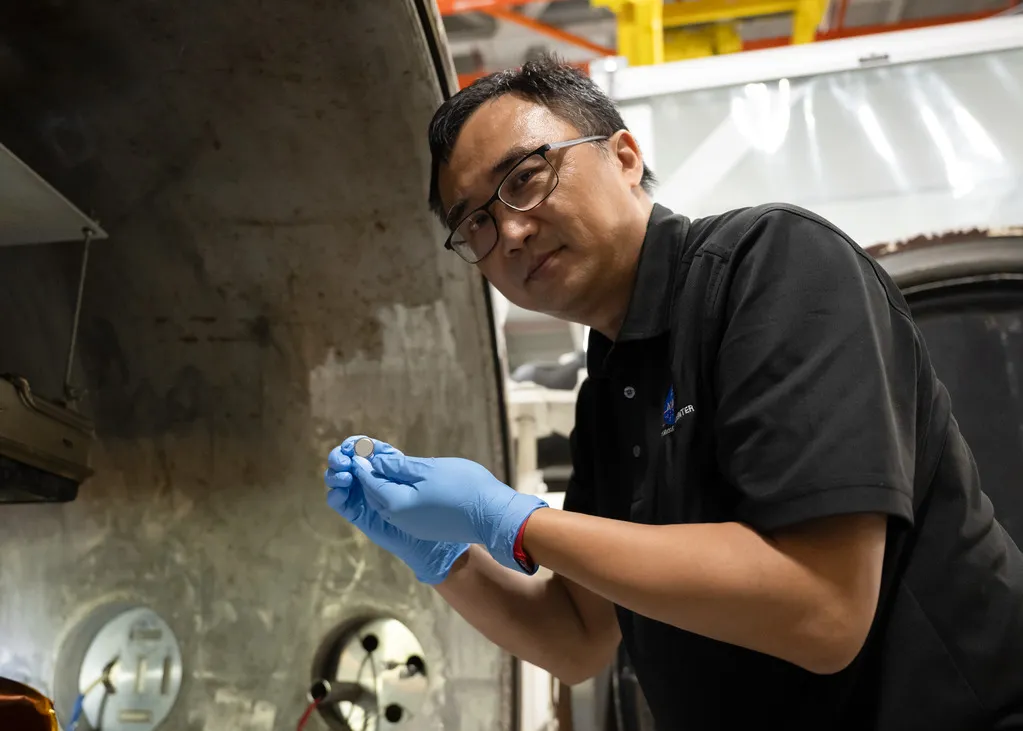
During recent thermal vacuum testing at NASA’s Langley Research Center in Hampton, Virginia, a small SPEARS prototype battery cell performed well at temperatures as high as 176°F (80°C) and as low as -76°F (-60°C). Its performance declined slightly at -112°F (-80°C).
“We have demonstrated for the first time that these cells can operate down to minus 80 degrees Celsius,” said Yi Lin, SPEARS experiment principal investigator at NASA Langley.
Lin said he is confident the team can improve the battery’s performance and potentially expand its operating range in the coming years.
Lunar batteries must also remain reliable through the extreme temperature swings between the lunar day and night. Thermal vacuum testing showed that SPEARS batteries remained undamaged after exposure to temperatures ranging from 212°F (100°C) to -274°F (-170°C).
Yi Lin
SPEARS Testing and Research Leader
How a Small Heater Could Restart a Frozen Battery
Solid-state batteries cannot function at temperatures as low as -274°F (-170°C). However, their solid electrolytes do not freeze like liquid electrolytes, which helps the batteries withstand extremely low temperatures without damage.
A small heater could bring a SPEARS battery back to its operating temperature after exposure to extreme cold. The battery would not need to remain warm continuously; it would only need to be heated when it is ready for use.
This approach could reduce the need for extensive thermal management systems in spacecraft and lunar habitats. Lighter systems could help lower costs and support longer mission durations.
Potential Uses for SPEARS Batteries on the Moon
Potential applications include drills and other tools operating in shadowed lunar craters, emergency power packs for rovers and astronauts, and long-lasting power systems for scientific instruments.
“By using different electrode materials, we can tune the chemical reaction,” Lin said. “Just like the chemistry in earphones is different than the chemistry in a cell phone, and the chemistry in a car is different, all of these chemistries also work with solid electrolytes. Depending on the application, you can tune the energy, you can tune the power, you can tune the durability.”
Could NASA’s Solid-State Battery Technology Help on Earth?
Although SPEARS was designed for space applications, the technology could also be adapted for use on Earth. The project evolved from an earlier battery program focused on aviation applications that Lin and Dornbusch worked on.
“The potential market for solid-state batteries is very broad,” said Ji Hsu, a polymer materials scientist and task leader at NASA Langley. “Cars, cell phones, communications equipment, drones, anything that requires portable power.”
What Happens Next for the SPEARS Project?
The SPEARS project began in 2026 with funding from the Advanced Research and Technology Division within NASA’s Research and Technology Mission Directorate. Its first stage will focus on technology development before the project moves toward commercial cooperation.
NASA’s Ames Research Center in California’s Silicon Valley is developing flight hardware, including test boards and electronics. These systems will help prepare the SPEARS battery for spaceflight and testing in the space environment.
Source: www.nasa.gov