


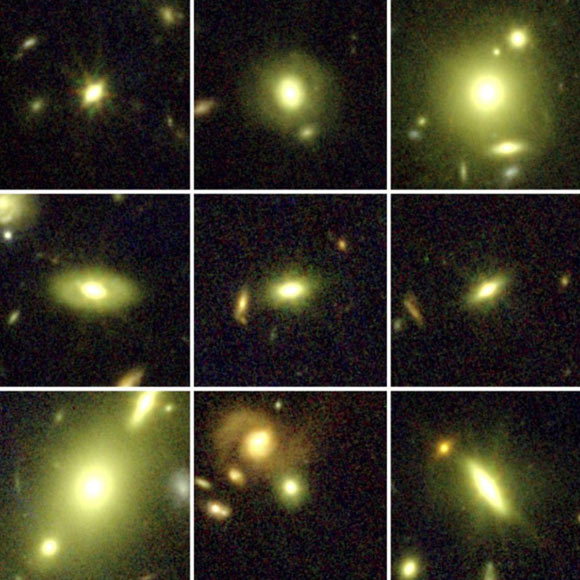
NASA, ESA, and CSA’s James Webb Space Telescope has uncovered a surprisingly large population of faint, low-mass stars in distant galaxies. The discovery suggests that some massive galaxies in the early universe may contain up to four times more stellar mass than previously estimated.
James Webb Space Telescope images of the massive early-universe galaxies studied by Chen and colleagues. Image credit: Chloe Chen.
“These galaxies are different,” said study co-author Dr. Joel Reja, an astronomer at Pennsylvania State University.
“They are difficult to understand because they are much larger and more massive than expected. Their total mass may be three to four times greater than previous estimates suggested.”
For the study, Chloe Chen and her colleagues analyzed detailed spectra from nine massive, mature galaxies that had stopped forming stars billions of years ago, during the early history of the universe.
The researchers found that these galaxies contain far more small, faint, low-mass stars than previously assumed. As a result, the galaxies’ total stellar mass may be three to four times higher than earlier measurements indicated.
The findings challenge the standard assumption that stars form with a similar distribution of masses in all galaxies. They also deepen the mystery of how such massive galaxies assembled so rapidly after the Big Bang.
The discovery could further indicate that the early universe produced more low-mass stars—and potentially more planets—than astronomers previously thought.
“If a galaxy were a city, the brightest stars would be skyscrapers that are easy to see from far away,” said lead author Chloe Chen, a PhD graduate of Leiden University.
“Our model shows that a much larger population of low-mass stars may be hidden among these rare, bright stars, much like houses hidden between skyscrapers.”
“This means the galaxy is substantially more massive than previous estimates suggested.”
“Until recently, these measurements were not possible,” said study co-author Marce Slob, a doctoral candidate at Leiden University.
“We needed a telescope capable of observing extremely distant galaxies, high-quality spectra, and new analytical techniques to detect the subtle signatures of faint, low-mass stars hidden within these cosmic giants.”
According to the research team, the discovery has important implications for understanding galaxy formation and the evolution of the early universe.
“This result demonstrates that much more mass may be hidden in low-mass stars than previously recognized,” said study co-author Professor Mariska Kriek of Leiden Observatory.
“That has consequences for many areas of astronomy. Because many planets orbit low-mass stars, the findings may also suggest that more planets formed in the early universe than previously assumed.”
The findings were published online on August 18, 2026, in the journal Nature Astronomy.
_____
CM Chen et al. Hidden mass of early galaxies revealed by bottom-heavy initial mass function. Nature Astronomy, published online August 18, 2026. doi: 10.1038/s41550-026-02932-4
Source: www.sci.news