


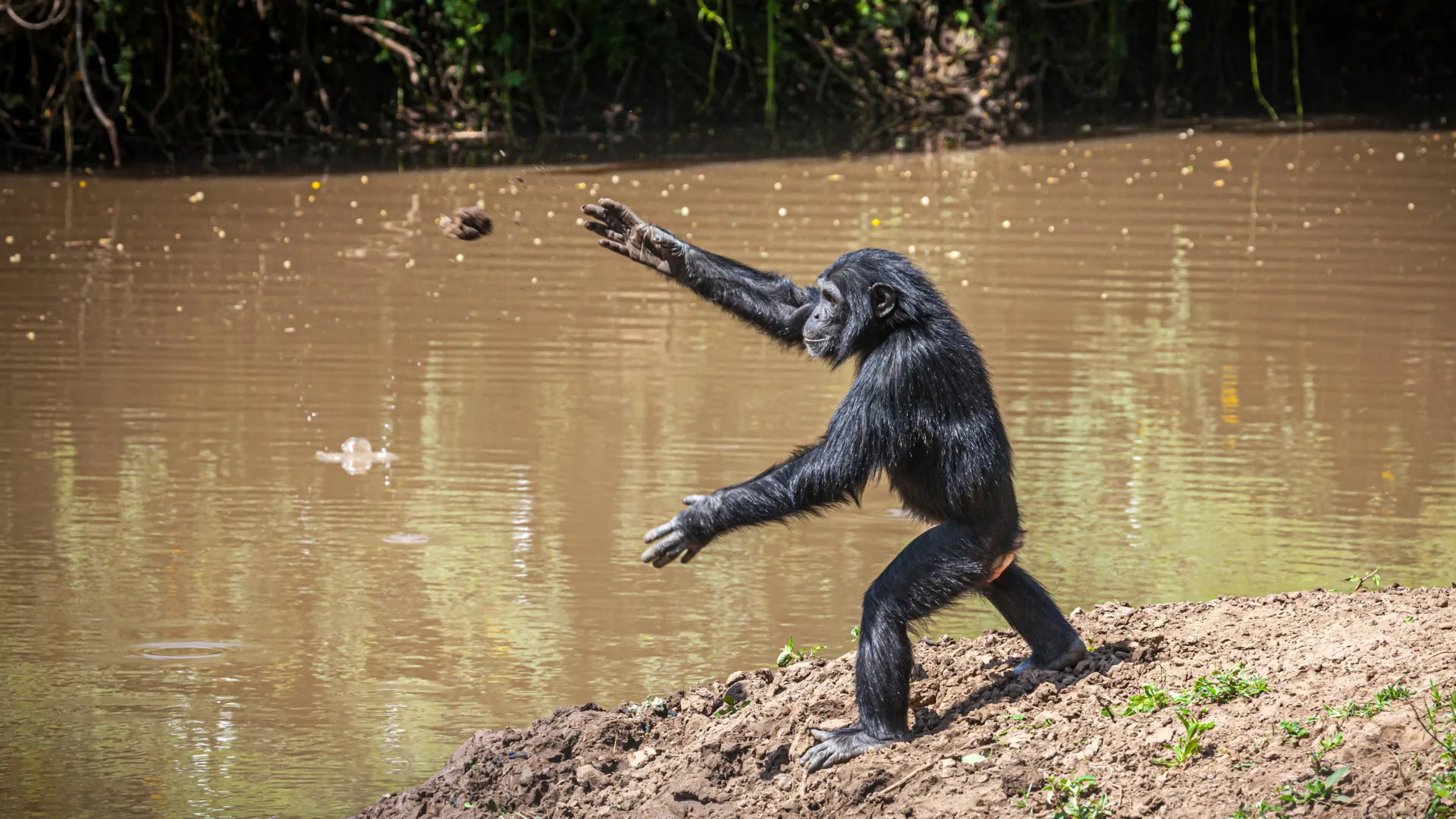
As you walk through the savannah woodlands of Guinea-Bissau’s Boé National Park, you may encounter a tree marked by deep, gnarled scars and surrounded by a growing pile of stones.
The chimpanzees may have already moved on, but the site offers an extraordinary scientific discovery: evidence of a rare behavior known as cumulative stone-throwing. This unusual practice may represent a form of chimpanzee communication, cultural tradition or territorial marking.
Video recordings show wild western chimpanzees—typically adult males—returning to particular trees, throwing stones at their trunks and repeating the behavior over time. Researchers have documented chimpanzees revisiting these trees and repeating the same actions.
[See video link after the end of the article.]
During these displays, chimpanzees often produce a distinctive wheezing sound, which may function as a long-distance communication signal. They may also repeatedly clap their hands or feet against the tree trunk in a behavior known as buttress drumming.
We recently returned from fieldwork in Guinea-Bissau, where we collected data on the social and ecological context of cumulative stone-throwing. Our goal was to better understand what chimpanzees may be communicating when they gather at these distinctive stone-throwing sites.
Because humans share an evolutionary relationship with chimpanzees, studying behaviors such as cumulative stone-throwing may help researchers understand the origins of complex communication and stone-tool use during human evolution.
Cumulative stone-throwing as chimpanzee culture
Pant-hooting, pant-grunting and buttress drumming are all important components of male chimpanzee communication. Cumulative stone-throwing may be an unusual variation of this broader display behavior. Researchers believe it may be a cultural behavior because it has been observed in only a limited number of chimpanzee communities, and because the presence of rocks and suitable trees does not automatically lead to the formation of stone piles.
Previous research suggests that cumulative stone-throwing may be communicative. It could also serve a symbolic purpose, such as marking a location that is important within a chimpanzee’s territory.
However, scientists still do not know exactly what these stone-throwing sites mean to chimpanzees or why individuals return to them. Some primates use stones as tools to crack open nuts, but cumulative stone-throwing is different because it appears to involve stone tools in a social rather than feeding context. So far, the behavior has been documented in only four chimpanzee groups in West Africa.
Preparing for fieldwork in Boé
We traveled to the remote chimpanzee habitat of Guinea-Bissau’s Boé region and based our fieldwork in the small village of Beli. Chimbo, a Dutch nongovernmental organization, maintains a research compound there where visiting researchers and tourists can stay and use solar-powered workspaces.
From Beli, we cycled and hiked approximately 22 kilometers into the savannah woodland. We established a temporary bush camp with field assistants Jay Balde and Val Serra, along with master’s student Taylor Tippett from the Great Ape Behavior Research Institute.
Chimpanzees in Boé are not accustomed to close human contact. When people approach, they usually flee, making direct observation extremely difficult. Instead, we used motion-sensitive camera traps and audio-recording devices to collect behavioral data without disturbing the animals.
At each known stone-throwing site, we installed two video cameras and strategically positioned recording equipment to capture sounds from the surrounding area. These tools allowed us to document chimpanzee visits, vocalizations, drumming and interactions that would have been difficult to observe in person.
Our campsite was located beside the Feffiné River, a large waterway that continues flowing during the dry season. In savannah woodlands, where reliable water sources are limited, rivers are essential to wildlife and local communities. A camera positioned near the riverbank recorded several of our animal neighbors.
Tracking chimpanzee activity
On a typical fieldwork day, I woke at around 6:30 a.m., ate a quick breakfast and traveled to between two and five research sites. At each location, we replaced camera memory cards and batteries, checked that the equipment was functioning properly and collected additional information for later analysis.
We measured the trees used for stone-throwing and created three-dimensional scans of the stones that had been thrown against their trunks. Along the way, we also recorded chimpanzee nests, feeding traces, vocalizations and direct sightings.
The video and audio recordings will help us examine the social characteristics of cumulative stone-throwing. We can investigate the age and sex of the chimpanzee throwing the stones, as well as the presence and responses of nearby spectators. This information may help reveal whether the behavior is intended to attract attention, communicate over distance, mark territory or reinforce social relationships.
Many of the sites first identified by the Pan African Programme and revisited by our team in 2017 were still active during our latest field trip. This suggests that chimpanzees may return to some stone-throwing locations for more than a decade.
The threat of bauxite mining
Many primate species are threatened by human activities. Protecting cultural behaviors and maintaining rich behavioral traditions may help chimpanzees adapt to environmental change and strengthen conservation efforts.
In addition to its potential importance for communication, cumulative stone-throwing represents a form of durable primate material culture. Losing these sites could contribute to the erasure of primate heritage.
Unfortunately, chimpanzee habitat in Guinea-Bissau faces increasing pressure from extractive industries, including industrial mining. During our fieldwork, we encountered a borehole created during bauxite exploration.
Bauxite mining is promoted as a source of economic growth and development in Guinea-Bissau. However, mining can also destroy habitat and pollute soil and water. These impacts can seriously affect chimpanzees, other wildlife and local communities, as has already occurred in neighboring Guinea.
Strong environmental monitoring and effective regulation are essential, particularly in light of the additional challenges created by Guinea-Bissau’s political instability.
By studying and documenting chimpanzee cultural behaviors such as cumulative stone-throwing, we can support chimpanzee conservation, help protect broader biodiversity and preserve valuable examples of primate material culture for future research and education.
Source: www.sciencedaily.com