


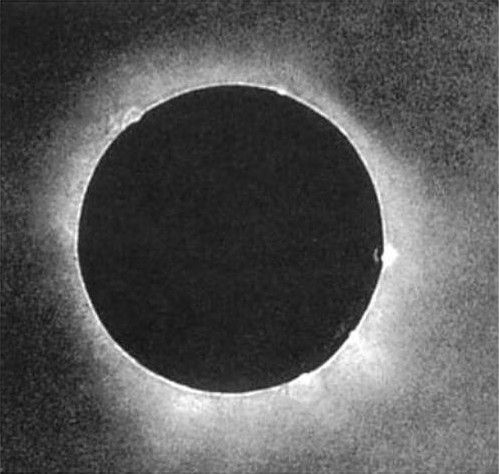
From the first daguerreotype of a total solar eclipse to modern digital astrophotography, eclipse images have transformed solar science, revealed the Sun’s corona and inspired generations to experience the wonder of the solar system.
Johann Julius Friedrich Berkowski / public domain
A total solar eclipse occurs when the Moon passes directly between Earth and the Sun, completely covering the Sun’s visible disk. Along the narrow path of totality, daylight briefly fades and the Sun’s outer atmosphere—the corona—appears around the Moon’s silhouette.
As darkness falls in the middle of the day, animals often behave as though evening has arrived. Crickets begin chirping, bees return to their hives and people gather outdoors to witness one of nature’s most dramatic celestial events.
Samantha Thompson, curator of astronomy at the Smithsonian National Air and Space Museum, saw a total solar eclipse for the first time in 2017 while visiting South Carolina with her family. Both she and her mother cried. “It was the most beautiful thing I’ve ever seen,” Thompson says.
The brief duration of totality makes a total solar eclipse especially compelling. Totality can last from about ten seconds to nearly seven minutes, and a total solar eclipse occurs somewhere on Earth approximately every 18 months, on average. Photographs, however, can preserve those fleeting moments for generations and create a lasting record of astronomical history.
The first successful photograph of a total solar eclipse was made in the 19th century using a daguerreotype by Johann Julius Friedrich Berkowski. The early photographic process produced a unique image on a silver-coated copper plate treated with light-sensitive chemicals. The technique was introduced in the late 1830s by French artist and scientist Louis Jacques Mandé Daguerre.
Working in Königsberg, Prussia—now Kaliningrad, Russia—Berkowski photographed the total solar eclipse of July 28, 1851. Using a refracting telescope with a 2.4-inch aperture, he exposed the daguerreotype plate for 84 seconds as the Moon moved across the Sun.
Relatively little is known about Berkowski. Science historian William B. Ashworth Jr. described him as “almost anonymous,” noting that researchers did not identify his full name until relatively recently. Berkowski’s identity was clarified in a German historical article published in 2013. Even so, his eclipse photograph helped launch a new era of solar observation. As Ashworth wrote, “Solar astronomy will never be the same.”
“Astronomers generally associate the events of July 28, 1851 with the first serious professional solar eclipse expedition,” astronomer and anthropologist Anthony Aveni wrote in his 2017 book, In the Moon’s Shadow: The Science, Magic, and Mystery of Solar Eclipses. Early observers recorded “stunning pink” prominences and produced detailed images of the solar corona, he wrote.
“The eye is an amazing camera because it has a very high dynamic range,” says astronomer Shadia Habbal of the Institute for Astronomy at the University of Hawaiʻi.
More than 175 years after Berkowski’s photograph, imaging technology has advanced dramatically. Yet the fascination with total solar eclipses remains just as strong.
“It’s one of those natural things that people have seen and described throughout history,” says Kelly Korreck, NASA’s solar eclipse program manager. Evidence suggests that people were documenting or interpreting eclipses as early as around 3000 B.C.
/https://tf-cmsv2-smithsonianmag-media.s3.amazonaws.com/filer_public/8f/2f/8f2f7ba3-10d1-45fc-83ef-884d223e6ee2/53641418523_7d43f48fe7_k.jpg)
NASA / Connie Moore
In 1992, researchers discovered a pueblo rock carving in New Mexico that may depict a total solar eclipse observed in 1097. The carving offers possible physical evidence of how long humans have watched, recorded and interpreted eclipses. Other early records of solar eclipses are preserved in historical accounts and manuscripts.
Astrophotography is valuable not only for its beauty but also because it creates a permanent scientific record. “Images can tell stories across generations,” says Kimberly Arcand, a visualization scientist at the Smithsonian Astrophysical Observatory. “We can create moments that last beyond just a very fleeting, tiny, tiny time.” Photographs from the 1851 eclipse continue to help researchers and historians study how people understood the universe.
Overview: Harvard University Astronomy Repository
- The Harvard Plate Stacks contain one of the world’s largest collections of astronomical glass plate photographs.
- Founded in 1886, the collection includes approximately 550,000 glass plate negatives and spectral images of the universe.
For solar scientists, images of total solar eclipses provide important information about the Sun’s outermost atmosphere, the corona. The Sun is so bright that the corona’s delicate structures are normally hidden from view. They can be observed during totality or with a coronagraph, an instrument that blocks most of the Sun’s light.
“Solar eclipses form the backbone of my career at the moment,” says SAO astrophysicist Jenna Samra, who develops instruments for studying the solar corona. “I joined the solar eclipse study in an attempt to take advantage of this natural phenomenon, which provides a great opportunity to study the corona and obtain some of the best data.” Samra recently built her first coronagraph and plans to use a balloon-borne instrument to observe the corona from the stratosphere.
By studying the corona, researchers can learn more about how the Sun produces space weather—the flow of charged particles and magnetic fields that can interact with Earth’s magnetosphere, produce auroras and damage satellites. Observations of the solar atmosphere can also reveal coronal mass ejections, enormous eruptions of plasma from the Sun. Images captured through different wavelength filters can help scientists measure the temperature and speed of material in the corona.
/https://tf-cmsv2-smithsonianmag-media.s3.amazonaws.com/filer_public/53/c9/53c92b49-6a94-4cd2-830c-1e53b00e0b1b/53640675021_14bb4cfd7f_k.jpg)
NASA / Aubrey Gemignani
/https://tf-cmsv2-smithsonianmag-media.s3.amazonaws.com/filer_public/e9/a9/e9a9c640-bca5-460d-b6f4-0927de199508/tse_2024_400mm_md_copy.png)
© 2024 Miroslav Druckmüller, Andreas Möller
Total solar eclipses provide a natural laboratory for studying the corona, but totality is brief and visible only along a limited path on Earth. To extend observation time, scientists have begun creating artificial solar eclipses with spacecraft flying in formation.
Proba-3, a European Space Agency mission, uses two spacecraft flying about 492 feet apart. One satellite blocks the Sun’s light while the other observes the corona. The mission began in December 2024. Scientists say the mission has already produced artificial eclipses lasting as long as approximately five and a half hours, according to Andrei Zhukov, principal investigator of the Proba-3 coronagraph at the Royal Observatory of Belgium.
“It is extremely rare for two total solar eclipses to occur in the same calendar year,” Zhukov says. By contrast, Proba-3 can create dozens of artificial eclipses in a single year.
Even with this technology, Zhukov says natural total solar eclipses remain the best way to observe the corona. “The Moon is far away and a little smaller than what Proba-3 can cover, so the natural stuff is better quality,” he says. “If you were to compare the two images, I would still prefer the total solar eclipse on the ground.”
/https://tf-cmsv2-smithsonianmag-media.s3.amazonaws.com/filer_public/1a/8c/1a8c9b8d-f7f1-448e-8228-41b165a2ef13/53641523513_1db608a13f_k.jpg)
NASA / Keegan Barber
Habbal studies the solar wind and travels around the world to observe and photograph total solar eclipses. Her expeditions require teams to identify suitable locations while navigating weather, challenging terrain, geopolitics and complex logistics. During a 2001 expedition in Zambia, she spotted a hippopotamus near her campsite. In Svalbard, Norway, in 2015, she also had to consider the possibility of encountering a polar bear.
Despite these challenges, eclipse expeditions serve a larger goal: understanding the Sun, the source of Earth’s light and energy. Photography and video provide the most effective ways to document an eclipse. In the past, astronomers relied on daguerreotypes and highly sensitive glass plates that took time to develop. Today, researchers can review and process digital data almost immediately after totality.
“The science is very compelling,” Habbal says, “because each image, each new eclipse gives us new ideas.”
/https://tf-cmsv2-smithsonianmag-media.s3.amazonaws.com/filer_public/fe/96/fe96b3ce-688e-4c05-9624-b04a12572a7f/53641612714_04b45b402e_k.jpg)
NASA / Aubrey Gemignani
The August 12, 2026, total solar eclipse will cross Greenland, Iceland and Spain, among other locations. Habbal plans to observe it from Spain. The following year, another total solar eclipse will pass through parts of the world on August 2, 2027. That eclipse is expected to feature the longest totality of the century, lasting nearly six minutes, according to Korreck.
After years of traveling to observe eclipses and meeting people from different cultures, Habbal says the human experience is as meaningful as the scientific work. “You’re exposed to the common human anatomy,” she says. “We may look and speak differently, but at the end of the day we are all human beings, and that becomes very evident when you go to different countries.”
Thompson reflects on how important it must have been for ancient civilizations to share knowledge about the Sun and explain why, during an eclipse, “suddenly the Sun disappears. The thing you rely on the most is gone.”
Solar eclipses have often inspired fear as well as awe. The word eclipse comes from the Greek ékleipsis, meaning “abandonment” or “failure”—a sense that something has gone wrong. As Aveni explains, even people who understand the science can find the sudden disappearance of daylight unsettling.
Greater understanding can help ease that fear, and photography plays an important role in sharing what scientists learn. “I think the tradition of telling stories about what we learn continues in photography,” Thompson says.
Arcand notes that few people outside astronomy have the opportunity to observe a total solar eclipse through advanced telescopes and scientific equipment. By sharing research images, scientists can communicate complex ideas, spark curiosity and allow people around the world to participate in discovery.
“The scientific lifespan of an astronomical image is much longer than the technology used to create it,” Arcand says. The 1851 daguerreotype is “a perfect example of that,” she adds.
Source: www.smithsonianmag.com