


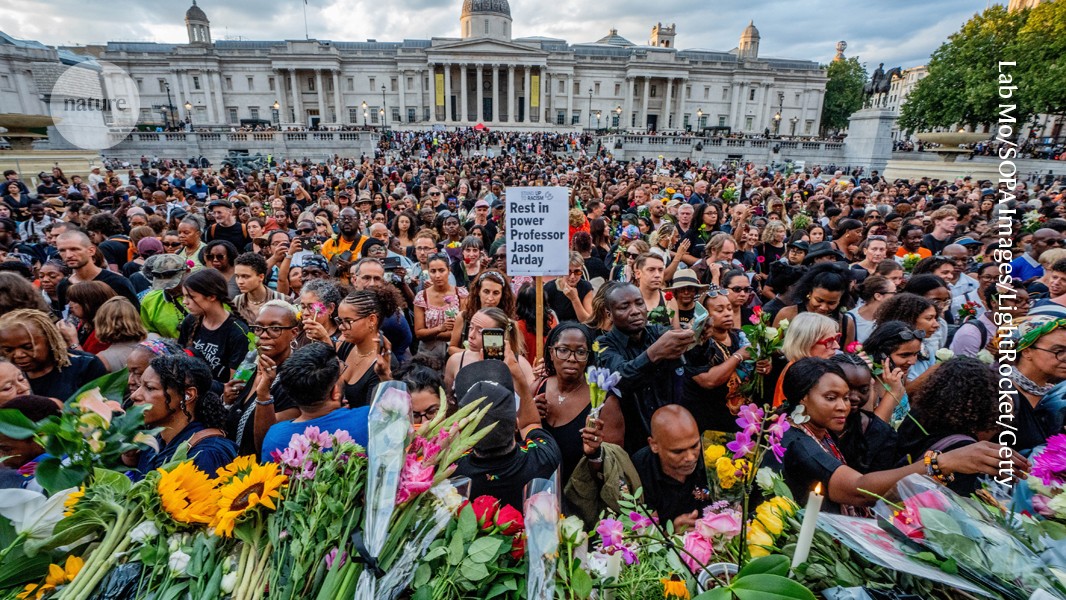
On August 17, people gathered in London’s Trafalgar Square to remember sociologist Jason Arday.
Credit: Lab Mo/SOPA Images/LightRocket/Getty
“The years since my appointment have also been marked by relentless public scrutiny and personal attacks. Criticism is an inevitable part of academic life, but what I experienced goes far beyond academic disagreement.”

Racism: Overcoming science’s harmful legacy
These were the words of Jason Arday in his
resignation statement.
Arday was appointed Professor of Sociology of Education at the University of Cambridge on August 5, amid allegations of research misconduct. In his statement, he said he had “reached the limits of what a human being could reasonably be expected to endure.”
Nine days later, Arday died following intense media coverage of his professional and personal life. His death was a profound tragedy for his family, friends, students and colleagues, as well as a serious loss for the research community. The death of a Black autistic scholar who influenced a generation has raised difficult questions about media scrutiny, racism in academia, allegations of plagiarism and the University of Cambridge’s response to the controversy. These issues concern not only universities and research institutions, but also the wider higher-education and media sectors.
Two critical questions about the Jason Arday case
This editorial examines two issues in a complex and evolving situation. The first is how universities should conduct research-misconduct investigations under intense media pressure. Such investigations should follow a transparent process while protecting confidentiality for everyone involved, including whistleblowers whose testimony may be central to the outcome. These procedures exist to ensure fairness and reduce the risk of harm. The question is whether those safeguards were followed in this case.
The second issue is how journalists should report allegations of research misconduct fairly, accurately and without causing unnecessary harm.
Arday’s death is particularly distressing for Black academics and other groups that remain underrepresented in research. Many members of these communities already report feeling vulnerable and unsupported. Systemic racism continues to affect academia, making the sector an unwelcoming environment for many people who have entered it despite significant barriers. These obstacles must not be allowed to persist. The intensity of the attention directed at Arday has also left many academics wondering whether they could face similar treatment. For some, the question is simple: “Will I be next?”
Science must overcome its racist legacy: Nature’s guest editors speak
When the University of Cambridge appointed Arday in February 2023, it issued a statement describing him as the youngest Black professor in the university’s history. The appointment quickly became an international media event.
In his memoir, Great Expectations and Disappointments, Arday wrote: “I’ve been thrust into the public eye in a way that no one could really prepare for or predict, and to be honest, it’s something I’m still getting used to.” After arriving at Cambridge, he also began reporting incidents of racism and hate speech directed at him.
Last year, allegations emerged that Arday’s doctoral dissertation on peer mentoring among student teachers, along with some of his published research, contained instances of plagiarism. Liverpool John Moores University, which awarded his doctorate, investigated the claims and concluded that the doctorate remained valid. Nevertheless, criticism and scrutiny continued both within and beyond academia, including attention directed at Arday’s personal life.
In April, Arday was invited to deliver the keynote address at the British Sociological Society’s annual general meeting, held during its 75th-anniversary year. In a speech titled “Wanted Dead or Alive: The Playbook,” he described how some researchers scrutinize the publication records of Black scholars for possible miscitations and similarities to existing work. He said such claims are often published online and amplified through traditional and social media, placing pressure on universities to respond.
Relentless media coverage and racism in academia
Matt Walsh, head of journalism at Cardiff University, conducted an initial analysis of British media coverage of Arday between July 25 and August 20, the period when renewed plagiarism allegations began to receive attention. He reviewed 242 substantive articles published in the print editions of British national newspapers and found strong evidence of racial framing.
“Race-related framing is present across the sample, with some articles explicitly criticizing Cambridge University for appointing Arday because of the color of his skin,” Walsh wrote. His findings are explained in an article published by The Conversation.
On July 31, Simon Baron-Cohen, a developmental psychologist and autism researcher at the University of Cambridge who worked with Arday, expressed concern on the social-media platform X about the possible impact of the coverage. He highlighted more than a decade of research indicating that one in four autistic people have planned or attempted suicide (RL Moseley et al., eClinicalMedicine 93, 103793; 2026) and urged the media to stop what he described as the “relentless bullying of vulnerable autistic men.”

Ending racism is the key to better science: A message from the Nature guest editors
Estimates of the extent of plagiarism in academia vary. Even the lower estimates, however, indicate that the number of cases is substantial. Nature has noted that few other cases have attracted the same level of attention and public scrutiny as the allegations involving Arday. This raises an important question: why was this case singled out when many plagiarism allegations remain unreported?
The Editors’ Code of Practice issued by the Independent Press Standards Organisation, which represents many of Britain’s largest news organizations, states that journalists “must not engage in intimidation, harassment or persistent pursuit.” It also says journalists should stop questioning or following individuals when asked to do so.
In a statement, IPSO said it was reviewing “a large number of complaints and concerns regarding recent coverage of Dr Arday.” The organization said it would take appropriate action under its Editors’ Code if it identified any breaches.
Why does confidentiality matter in academic investigations?
Media organizations are not the only institutions whose actions require scrutiny. The University of Cambridge must also explain the decisions it made, particularly its decision to announce an investigation while the controversy was receiving intense public attention. In its August 5 announcement, the university said it would investigate the matter. Arday resigned on the same day.
Under the code of practice issued by Acas, the UK’s independent workplace-relations body, employees facing an investigation are generally entitled to confidentiality. An investigation is not itself a disciplinary process; it is a fact-finding exercise to determine whether there is a case to answer.
Cambridge’s decision to announce an investigation amid a media frenzy appeared to undermine that confidentiality and risked creating the impression that Arday had done something wrong before the process was complete.
People under investigation should be able to review the allegations and evidence against them and respond with their own evidence. They should also be allowed to attend and receive representation at formal meetings. Where an individual has a registered disability, the organization conducting the investigation must take that into account.
The university said on August 5 that it had opened an investigation after receiving new information. It did not explain whether that information had been shared with Arday or whether he had been given an opportunity to respond. Cambridge should account for its decisions and identify the lessons that can be learned. Why did the university believe it was necessary to announce the investigation publicly? Did that decision reduce the likelihood of Arday receiving a fair hearing?
We have previously argued for the creation of an independent body capable of holding academic institutions accountable (Nature 648, 7; 2025). The case for revisiting that proposal is now more urgent. Establishing such a body would take time, but a public inquiry, as many have called for, could provide an appropriate route to answers in this case.
“The relentless accusations, speculation and public commentary have taken a heavy toll on me and those I love,” Arday wrote in his resignation letter. He continued: “For the sake of my own well-being, my family, and those who have supported me through this difficult time, I have concluded that the only way to close this chapter is to withdraw.” He also promised to return “stronger, wiser and with the same determination that has always defined my journey.”
Arday did not return. His death requires both the media and academia to reflect on their responsibilities. Universities, research institutions and news organizations must communicate information fairly and accurately while taking steps to avoid preventable harm. The tragedy of Jason Arday should prompt meaningful changes in how research misconduct, race, disability and public accountability are handled.
Source: www.nature.com