


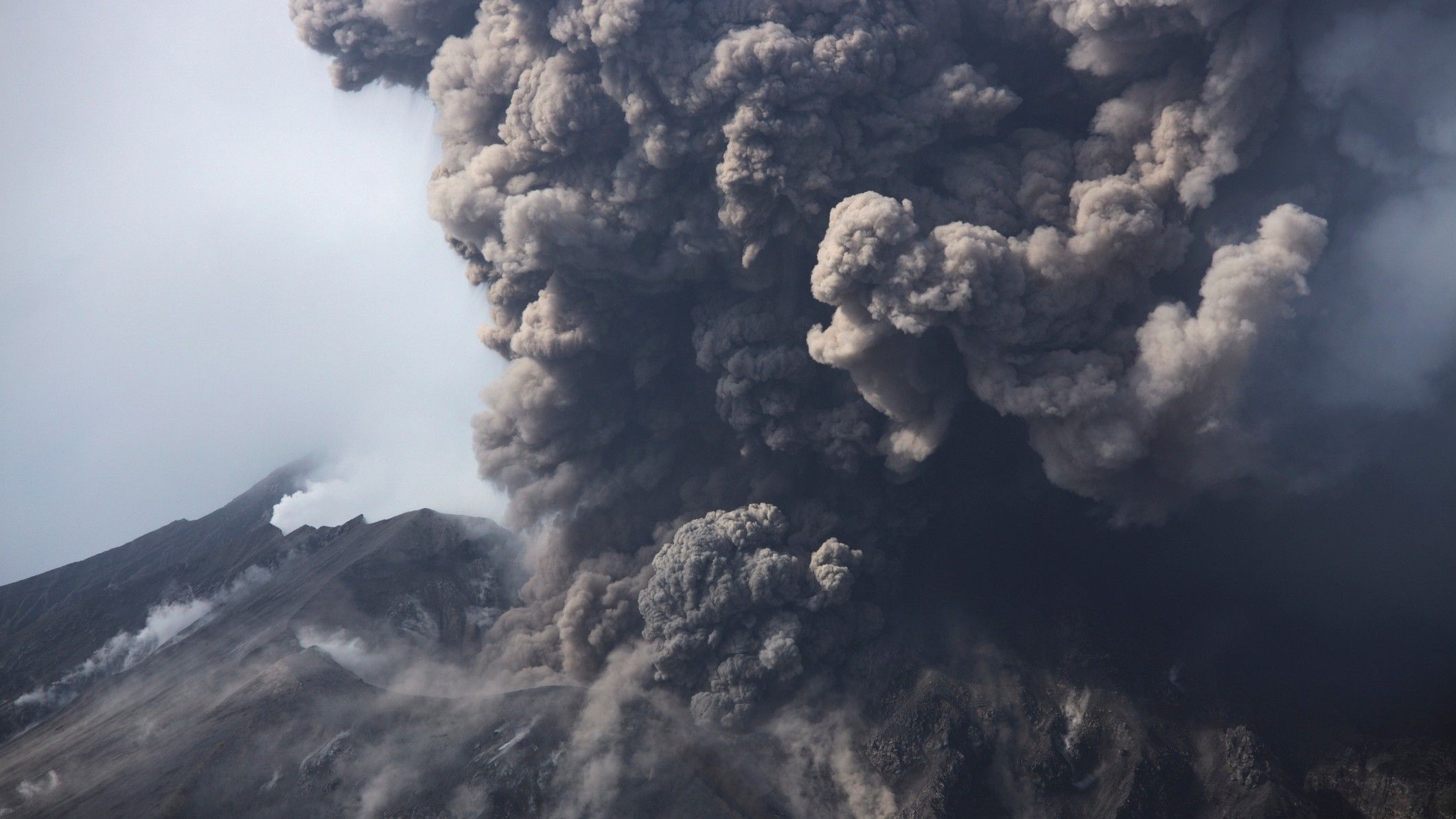
Scientists have reconstructed the enormous size and explosive history of an ancient volcano buried beneath eastern England. The heavily eroded volcanic system stretches beneath parts of Norfolk and Lincolnshire and was active approximately 454 million years ago, during the Ordovician Period.
Although evidence points to at least one exceptionally powerful eruption, researchers caution that calling the structure a supervolcano may be misleading because the term has no precise scientific definition.
“It must have been a very large eruption, but the sediments are so poorly preserved that calculating the eruption’s exact volume would be extremely difficult,” said Michael Poland, a research geophysicist at the Cascade Volcano Observatory and scientist-in-charge at the Yellowstone Volcano Observatory. Poland, who was not involved in the discovery, told Live Science that this uncertainty is one reason he dislikes the term “supervolcano.”
from the latest videoslive science
In a study published April 29 in the Bulletin of the Geological Society of America, researchers analyzed zircon crystals collected decades ago from boreholes in Norfolk and Lincolnshire, roughly 40 miles (65 kilometers) apart.
Zircon crystals are smaller than the diameter of a human hair. They form in molten magma beneath volcanoes and contain uranium that gradually decays into lead at a predictable rate. By measuring these isotopes, scientists can determine when the crystals—and the volcanic rocks containing them—formed.
The zircon crystals from eastern England matched crystals found in the Kinnecar tephra, a widespread layer of volcanic ash preserved across Scandinavia and the Baltic Sea region. The match suggests that ash from volcanoes in what is now England traveled across the ancient Tornquist Sea during the Ordovician Period, which lasted from about 488.3 million to 443.7 million years ago.
The Kinnecar tephra is visible beside railway tracks north of Oslo, Norway. The dipping layers of the Late Ordovician Arnestad Formation contain a thin band of gray-green volcanic ash.
(Image credit: © Tim Pharaoh)
Geologists already knew that the Kinnecar tephra formed during a major volcanic eruption. The new analysis provides important evidence of how far the ash traveled, offering clues about the eruption’s immense scale.
Such an eruption could have generated enormous pyroclastic flows—fast-moving avalanches of hot gas, ash and volcanic rock—that raced down the volcano’s slopes. Peter Rowley, a volcanologist and senior lecturer at the University of Bristol who was not involved in the study, said the eruption may have been comparable in style to the Oranui eruption at Taupo in New Zealand more than 26,000 years ago.
Get the world’s most fascinating discoveries delivered straight to your inbox.
While the ancient eruption would have been extraordinarily powerful, experts emphasize that the word “supervolcano” is vague. Scientists generally classify eruptions by the volume of material they release rather than by labeling the volcano itself.
“Supervolcano is not a term volcanologists use very often,” researchers explained. A more precise description may be an ultraplinian eruption, one of the most explosive types of volcanic eruption.
Ultraplinian eruptions can eject more than 240 cubic miles (1,000 cubic kilometers) of volcanic material. Although the exact size of the eastern England eruption remains uncertain, researchers say it may have lasted for days or weeks and produced an ash column more than 25 miles (40 kilometers) high—high enough to reach the stratosphere.
Many geologists avoid the term “supervolcano” because it does not clearly describe the size or behavior of an eruption. Instead, they focus on measurable evidence, including the volume and distribution of ash and other volcanic deposits.
Stephen Self, a physical volcanologist at the University of California, Berkeley, said “supervolcano” has become a popular buzzword. What scientists are actually identifying, he explained, are the deposits left behind by a massive eruption—not a perfectly preserved volcano.
Very little of the material ejected by the ancient English volcano remains exposed. Most of the volcanic debris has been eroded away or buried beneath younger rocks. Because the geological record is incomplete, determining the original eruption volume is particularly difficult for volcanoes hundreds of millions of years old.

One of the borehole sample locations studied at North Creek in Norfolk.
(Image credit: © Tim Pharaoh)
The ancient volcanic ash has also deteriorated over time, further limiting what researchers can learn about the original eruption, Poland said.
The study also identified evidence of an earlier eruption from the same volcanic system, dated to approximately 453.7 million years ago. No visible volcano remains at the surface today. The boreholes lie beneath some of the flattest parts of England, where layers of volcanic rock are concealed underground, according to lead author Tim Pharaoh of the British Geological Survey. The organization described the findings in a statement.
The discovery is consistent with evidence of widespread volcanic activity across Britain about 450 million years ago. The ancient volcanic region also included areas that are now Eryri National Park in Wales and the Lake District in northwest England.
Rather than picturing a complete volcano preserved underground, researchers say it is more accurate to imagine layers of eruption deposits and rocks that formed inside magma chambers beneath the original volcanic structure. Tectonic forces later deformed and altered these rocks, making detailed geological analysis essential for reconstructing the volcano’s ancient history.
Pharoah, T. C., Rushton, J., Condon, D., Chenery, S., Horstwood, M., Sahy, D., Thomas, C., Hamilton, E., Going, C. J., Busby, J., Haslam, R., and Torsvik, T. H. (2026). The Wash Igneous Complex of eastern England: A candidate for the Avalonian origin of the Baltoscandian Sandvian Tephra and its implications for the closure of the Tornquist Sea. Bulletin of the Geological Society of America.
Source: www.livescience.com