


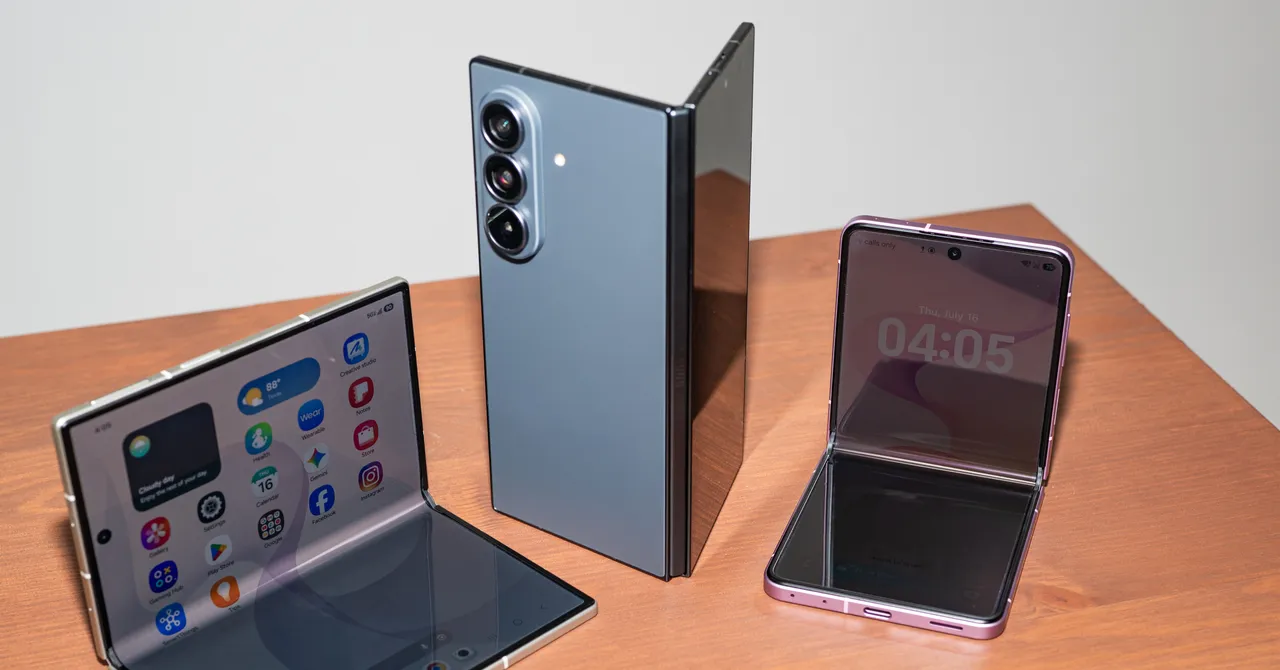
the night before Samsung said it is not threatened by Apple’s long-awaited foldable iPhone. Instead, the company that helped pioneer foldable smartphones says new competition is “absolutely welcome” for the growing foldable phone market.
The comments came from Moon Hee-chul, head of Samsung’s advanced machinery R&D group, during a virtual Zoom interview with WIRED alongside Seung-gi Choi, head of Samsung’s smartphone R&D group. Before discussing Apple’s entry into the market, the executives explained how Samsung reduced the weight of its latest Galaxy Z Fold8 by 75 grams compared with the company’s first foldable smartphone.
Weight remains one of the biggest factors in the success of foldable phones. A device that is too thick or heavy can be uncomfortable to carry and less convenient to use. Over the past two years, foldable smartphones from Honor, Google, and Samsung have become noticeably thinner and lighter. That trend may have contributed to a 30 percent worldwide increase in preorders for Samsung’s newest foldable compared with last year’s model. Nearly half of those orders were for the Galaxy Z Fold8, whose smaller passport-style design is easier to hold.
“I’m very proud to see other brands enter the market and recognize the value we pioneered in this new category of foldable smartphones,” Moon said through an interpreter.
When asked what advice he would give Apple ahead of its foldable iPhone launch, Moon emphasized the importance of weight. “The key to delivering the best customer value in this market is all about the weight of the device,” he said. “That’s not easy.” Apple’s foldable iPhone, which may be called the iPhone Ultra, is rumored to weigh between 230 and 241 grams. That would make it heavier than Samsung’s latest foldable and close to the 233-gram iPhone 17 Pro Max.
Photo: Julian Cioccatu
Samsung has made significant progress in reducing the weight of its flagship foldable. The Galaxy Z Fold8 weighs 201 grams, making it lighter than the single-screen Galaxy S26 Ultra at 214 grams. Samsung credits the Fold8’s smaller passport-style design and a detailed review of its internal components for the reduction. According to YouGov survey data from 2024, a bulky design was the main concern among people who were not interested in buying a foldable phone.
Samsung says its engineers analyzed every component in the Galaxy Z Fold8 and Fold8 Ultra, including circuit boards, antennas, adhesives, tapes, and fasteners. The review covered approximately 270 primary components and more than 180 auxiliary parts.
The company looked for opportunities to reduce weight throughout the device. Engineers redesigned the printed circuit board by removing unnecessary circuitry and improving the component layout, helping reduce the internal space required. Samsung also eliminated 15 auxiliary parts and machined the internal display support plate to approximately 0.2 millimeters thick. To preserve the durability of the thinner display, the company developed a “Flex Titanium” screen layer. The titanium-alloy film is about one-third the width of a human hair and is designed to help the display remain flat and resist creasing after years of folding.
Source: www.wired.com