


Astronomers have combined 2,884 Type Ia supernovae to create one of the most comprehensive records of cosmic expansion ever assembled. When combined with cosmic microwave background measurements and galaxy-mapping data, the findings provide new evidence that dark energy may change over time—challenging the standard cosmological constant model.
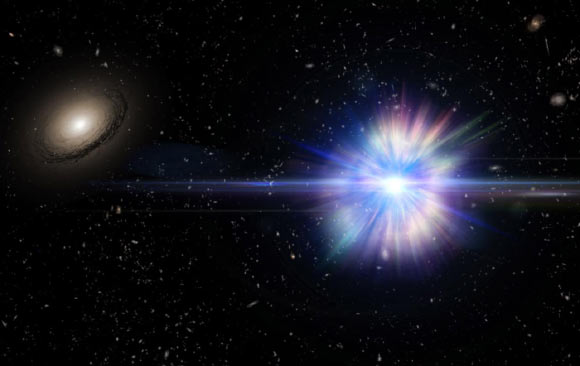
Artist’s concept of a Type Ia supernova exploding in intergalactic space between galaxies within a galaxy cluster. Image credit: Alex Parker / NASA / SDSS.
“Our project establishes a new global benchmark in supernova cosmology and provides the clearest picture yet of how the universe has expanded over time,” said Ryan Camilleri, a Ph.D. candidate at the University of Queensland.
“We have reconstructed 30 years of astronomical observations within a single, coherent framework.”
The research team combined the supernova data with other major cosmological measurements, including the afterglow of the Big Bang—the cosmic microwave background—and maps showing how galaxies are distributed throughout the universe.
The standard model of cosmology assumes that dark energy, the mysterious force driving the accelerated expansion of the universe, remains constant. However, the new analysis provides additional evidence that dark energy could evolve over time.
The new dataset combines historical Type Ia supernova observations with data from the Dark Energy Survey (DES), published in 2024.
To create a consistent catalog, Camilleri and his colleagues also reanalyzed earlier observations using the latest understanding of how supernovae behave.
“Over the years, we have learned more about the properties of supernovae, allowing us to revisit older data and analyze it with improved methods,” Camilleri said.
The researchers combined observations from multiple telescopes with different capabilities while accounting for factors that can influence supernova light, including cosmic dust and the mass of the galaxies hosting the explosions.
The analysis also considers gravitational lensing, a phenomenon in which the gravity of massive objects bends and magnifies light as it travels from a distant supernova to Earth.
Professor Tamara Davis of the University of Queensland said the dataset represents an important step toward understanding the nature of dark energy.
“The 2024 Dark Energy Survey supernova results showed a departure from the standard cosmological model, although in a slightly different direction. The findings suggested that dark energy could vary over time,” Davis said.
Independent observations from the Dark Energy Spectroscopic Instrument (DESI) have also provided hints of evolving dark energy. By studying ancient sound waves preserved in the distribution of matter across the universe, DESI researchers have identified possible signs that dark energy is not static.
“With two independent measurements pointing toward possible time variation in dark energy, the standard model—which treats dark energy as constant—is facing increasing scrutiny,” Davis said.
Understanding whether dark energy changes over time could have major implications for cosmology and fundamental physics. The answer may also provide clues about how gravity, described by general relativity, can ultimately be reconciled with quantum physics.
“Both theories have been extraordinarily successful in their respective domains. Finding a way to bring them together would represent a major advance in theoretical physics,” Davis added.
_____
J. Lee et al. 2026. Supernova mergers: Measurement of host galaxy masses of Type Ia supernovae and implications for cosmology. arXiv: 2609.05321
Ryan Camilleri et al. 2026. Supernova Unite: Combination of Pantheon+ and DES-SN5YR. arXiv: 2609.05053
Source: www.sci.news