


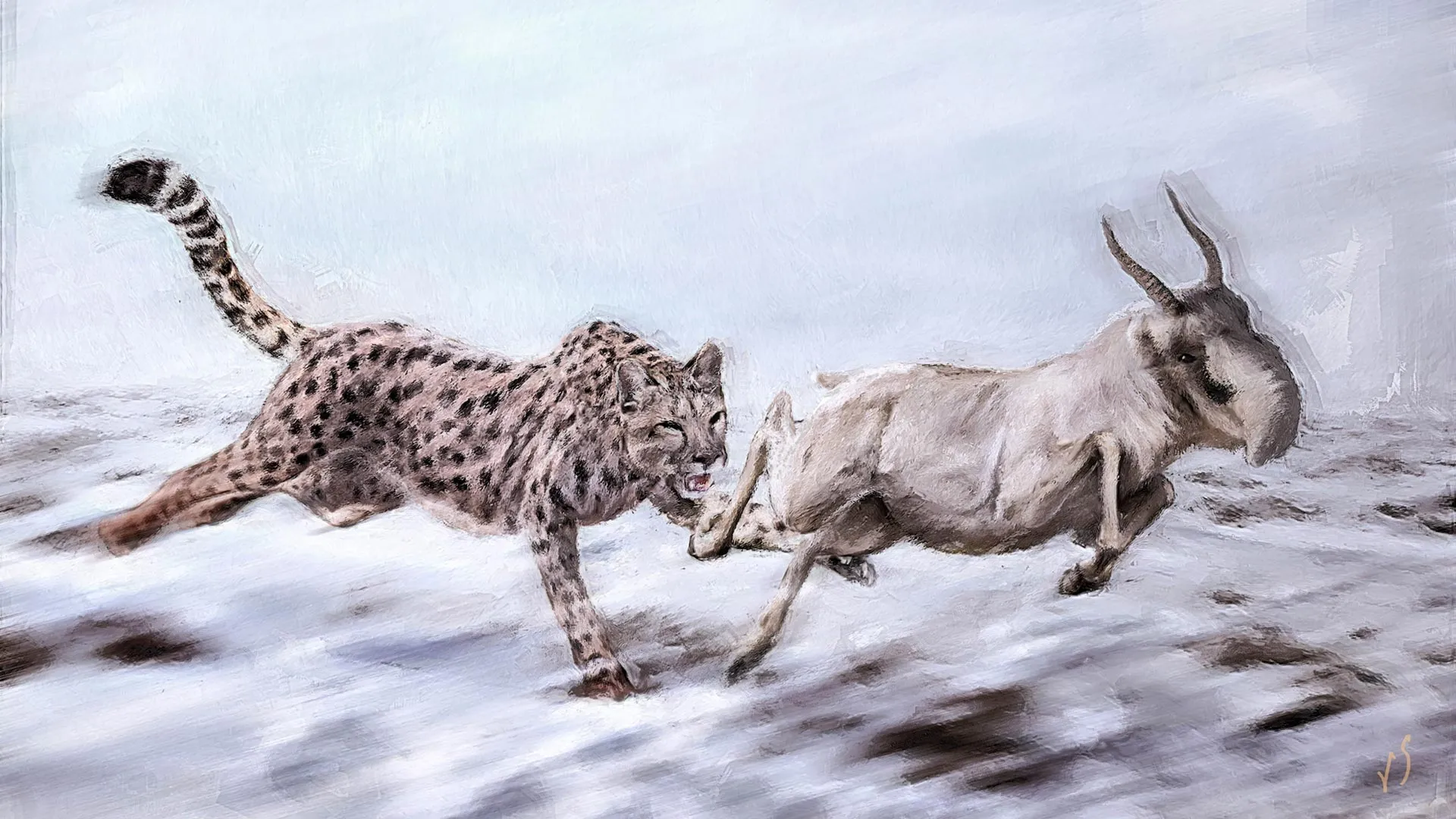
A new study led by scientists at the University of California, Santa Cruz, is reshaping what researchers know about Mirasinonychus tormani, an extinct North American predator commonly known as the American cheetah. Evidence from its nuclear paleogenome and stable isotope analysis indicates that this animal was not actually a cheetah. Instead, it was a highly adaptable relative of the mountain lion. Its far-northern populations may have relied heavily on fish to survive in the Arctic environment.
The findings were published on September 4 in Current Biology and extend the species’ known range by approximately 20 degrees of latitude farther north than previously recognized. In regions such as Wyoming and Florida, M. tormani lived in temperate grasslands as a common predator. In the Arctic Yukon, however, these cats occupied a very different ecological niche as tertiary consumers and may have specialized in eating anadromous fish, including salmon.
Adult Mirasinonychus tormani likely weighed approximately 150 pounds, stood about 3 feet tall, and measured nearly 8 feet from head to tail. Its slender body and elongated front legs may have helped it move efficiently across the open landscapes of Pleistocene North America. Although its proportions resembled those of modern cheetahs, growing evidence suggests that this feline was a more versatile hunter. It may have pursued prey on land while also using its powerful forelimbs to grab and restrain animals.
“These cats were incredibly flexible, much like modern mountain lions,” said Dr. Molly Cassatt-Johnston, a candidate in the Paleogenomics Laboratory at the University of California, Santa Cruz, and the study’s lead author. “We found loss-of-function mutations in genes that regulate circadian rhythms, suggesting that northern populations may have adapted to the extreme seasonal changes in daylight experienced during Arctic summers and winters.”
Rethinking America’s “Cheetah”
For decades, M. tormani played an important role in theories about Ice Age ecology in North America. Scientists often identified this predator as a possible explanation for the pronghorn’s unusual speed.
Under the “ghosts of past predators” hypothesis, pronghorns evolved exceptional speed because they once faced fast-running predators similar to cheetahs. According to this theory, their speed was an evolutionary defense against high-speed hunters that later disappeared.
New genomic evidence challenges that interpretation. Researchers confirmed that M. tormani was a sister species to modern pumas and diverged from their evolutionary lineage approximately 2.6 million years ago. Its narrow, “cheetah-like” body therefore appears to be an example of evolutionary convergence. This occurs when unrelated species independently develop similar physical traits in response to comparable environmental pressures.
Genetic Clues to Arctic Survival
To understand how this species survived in such varied habitats, researchers sequenced high-coverage genomes from fossils dating between 23,000 and 31,000 years ago. The genetic data revealed traits that may have helped northern populations withstand the harsh conditions of the late Pleistocene.
The Yukon fossils examined in the study were recovered from the Tr’ondëk Hwëch’in Traditional Territory and the Vuntut Gwitchin Traditional Territory, recognizing the deep cultural connections and stewardship of these lands.
Genetic analysis also revealed unusual sensory characteristics. M. tormani and all feline species sampled in the study lacked a functional gene involved in producing receptors responsible for detecting sour tastes. Although cats are already known to lack the ability to taste sweetness, this is the first documented example of a feline species losing a gene associated with sour taste perception. This sensory change may have been linked to a highly specialized diet.
“This carnivorous species ranged from the Arctic to approximately 48 degrees north latitude,” said co-author Matthew Wooler, a professor in the Department of Fisheries and Marine Sciences at the University of Alaska Fairbanks. “The populations appear to have been highly specialized at both ends of their range while consuming two very different types of food.”
Low Genetic Diversity Before Extinction
The study also offers new clues about why M. tormani eventually disappeared near the end of the Pleistocene. Researchers found low genetic diversity in populations from both Wyoming and the Yukon.
Unlike modern mountain lions, however, these populations showed no evidence of severe inbreeding or sudden population bottlenecks. Instead, the genetic record indicates a gradual decline from the early Pleistocene through the late Pleistocene. This long-term reduction may help explain why fossils of the species are relatively rare and why the cats may have been increasingly vulnerable to extinction.
Beth Shapiro, a professor of ecology and evolutionary biology at the University of California, Santa Cruz, co-director of the Paleogenomics Institute, and senior author of the study, said that low genetic diversity alone does not necessarily cause extinction. “Mirasinonychus persisted for a very long time without the signs of inbreeding typically expected before a population collapse,” she explained. “The decline was gradual rather than abrupt, which may be why the species was unable to adapt to a changing climate.”
The discovery also highlights the risks of identifying extinct animals primarily by their physical appearance. Researchers say the popular name “American cheetah” is misleading in two important ways: It implies a close evolutionary relationship with true cheetahs and suggests that the species had a similarly specialized hunting strategy. Neither interpretation is supported by the new evidence.
The research was conducted through a collaboration involving scientists from the University of Alaska Fairbanks, the Yukon Paleontology Program, and Des Moines University.
Source: www.sciencedaily.com