


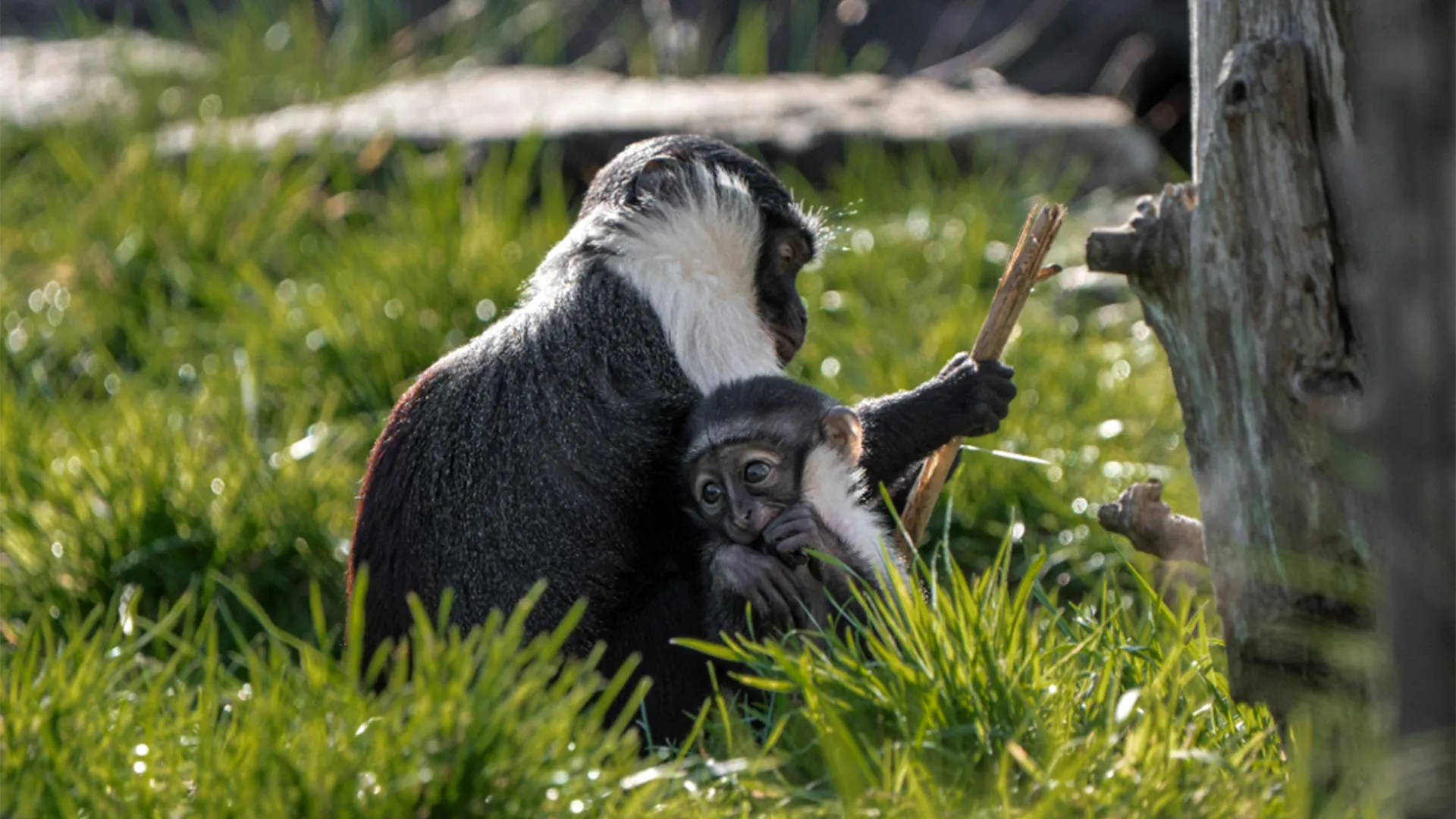
An endangered Roloway monkey at Chester Zoo has given birth just months after pioneering surgery saved her leg from amputation.
Masaya, a 15-year-old Roloway monkey, underwent a complex operation after developing a golf-ball-sized mass on her foot. Zoo veterinarians worked alongside surgeons from the University of Liverpool Small Animal Teaching Hospital to remove the growth while preserving as much of her paw as possible.
The veterinary team could not find any previous record of the same procedure being performed on a Roloway monkey. The operation was successful, allowing Masaya to keep all but one of her toes and retain normal use of her leg.
Months later, Masaya gave birth to a daughter named Lagertha. Primate experts at Chester Zoo say the newborn is already displaying traits similar to her mother.
Life-saving surgery saved Masaya’s leg
Rachel Barrow, a veterinarian and lecturer at the University of Liverpool, assisted with Masaya’s CT scan and subsequent surgery.
She said: “This was the last chance to save Masaya’s leg before it was amputated. Working with primates is very different from caring for my usual patients, who are generally cats and dogs, and it was a real privilege to treat such an unusual animal. It is wonderful to see the surgery has been successful. Masaya is comfortable, active and using her limbs well.”
The successful operation became even more significant after Masaya gave birth. Her ability to walk and use her legs normally is essential for carrying and caring for her offspring.
Zoe Edwards, a primate keeper at Chester Zoo, said: “Masaya is a very experienced mother and is doing an excellent job raising her young. Lagertha is only a few weeks old and very small, but she has already shown an interest in the Roloway monkey habitat and in the keepers.”
“The fact that Masaya’s leg has healed so well is a huge relief. If she had needed an amputation, we would have faced serious questions about whether she could carry her offspring or continue her normal behaviour.”
Birth highlights the importance of endangered species conservation
Lagertha is Masaya’s third daughter, making her birth especially important for the future of the endangered Roloway monkey.
Edwards added: “Chester Zoo is one of only two places in the UK where Roloway monkeys can be seen. Masaya is incredibly important not only to her family but to the species as a whole, as there are only a small number of breeding females in European zoos.”
According to the International Union for Conservation of Nature (IUCN), fewer than 2,000 Roloway monkeys remain in the wild. The species is found in parts of Ghana and Ivory Coast, where it faces threats from habitat destruction and poaching.
Because Roloway monkeys are so rare, the health and reproductive success of individual animals such as Masaya can have wider conservation significance. She is part of the European Endangered Species Programme, a coordinated breeding initiative designed to help prevent endangered species from becoming extinct.
Masaya’s ongoing foot problems
Masaya’s foot problems began before her surgery and had troubled her repeatedly since she arrived at Chester Zoo in 2023.
Veterinarians carried out X-rays, ultrasounds and biopsies, but identifying the underlying cause remained difficult. They eventually suspected that Masaya had a persistent abscess, possibly caused by an old thorn injury.
By 2025, the swelling had become significantly worse. Zoo staff decided that Masaya needed further diagnostic imaging and transported her to Liverpool for a CT scan.
Charlotte Bentley, a veterinarian at the zoo’s animal health centre, said: “It’s not every day that you take a monkey to veterinary school. We had to bring everything Masaya needed, from anaesthesia equipment and medication to blankets.”
“After the scan, we decided that surgery was the best option. She was an absolute trooper throughout, and I’m really glad we were able to help her.”
Masaya has since made a strong recovery, while her newborn daughter is also developing well.
Lagertha, whose name was inspired by a Viking queen, can now be seen alongside Masaya and four other Roloway monkeys at Chester Zoo.
Source: www.sciencedaily.com