


As Cities Grow, Rural Areas Are Being Hollowed Out
Urbanization is usually measured by what cities build. It should also be measured by what rural areas lose. By 2050, 67% of the world’s population is predicted to live in urban areas.1 But this trend is not driven only by migration into cities.
Rural areas left behind by migrants are being steadily dismantled. Up to 400 million hectares of land have been abandoned worldwide since the 1950s,2 while as much as half of the world’s rangelands—large areas used for livestock grazing—are thought to be degraded.3
At the same time, growing urban demand for food, water and biomass is intensifying the extraction of resources beyond city boundaries. The effects are already visible in the hollowing out of Europe’s interior, the disappearance of cities in East Asia and the expansion of informal settlements in Latin America.
How do we reconcile buildings and cities with our lives?
These examples reveal a common policy oversight: the tendency to treat urban greening and nature-based solutions as environmental panaceas. Cities depend on their hinterlands for food, water and carbon sequestration. Creating green space within cities does not prevent rural working environments from losing their ability to support human custodians, fertile topsoil and essential ecosystem services.
Addressing this crisis requires urban and rural areas to be managed as a single system. An effective approach would combine geospatial monitoring, landscape engineering and watershed planning to improve ecological productivity and livelihoods in the countryside.
How urban growth creates a one-way flow of resources
Rural decline is driven by three interconnected flows: demographic, land and ecological.
Demographic flows begin when working-age people move to cities in search of higher-paying jobs and a more affluent lifestyle. As fewer workers remain in rural areas, infrastructure and services decline. Many remaining families are then forced to migrate, weakening the local tax base and eroding community memory.
Land flows refer to changes in land use driven by urban demand. Ecosystem flows describe the movement of water, biomass and ecosystem services from rural regions to cities.
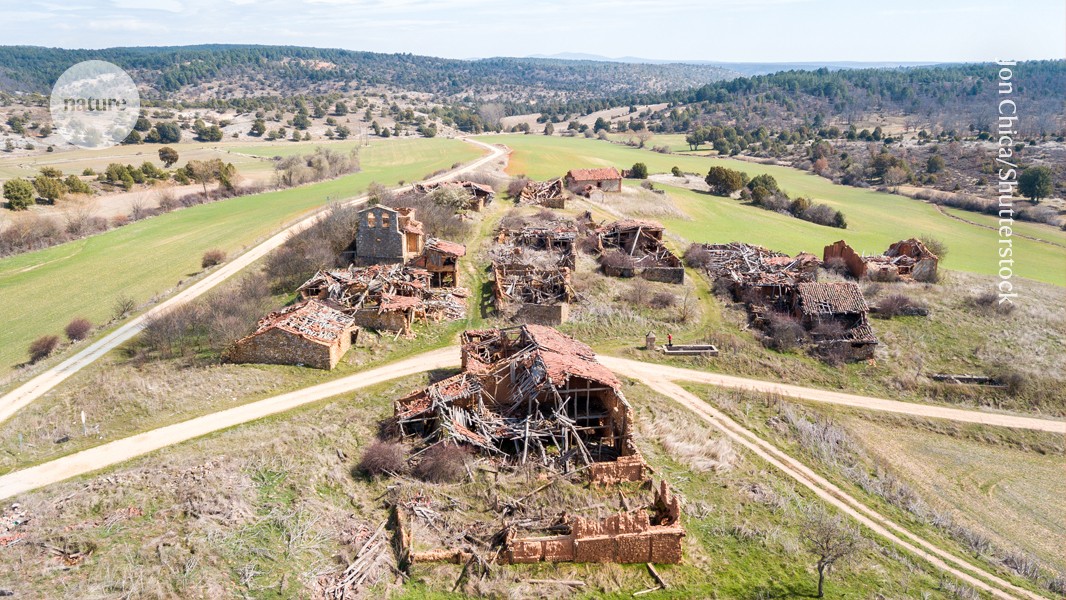
Thousands of small towns and villages around the world are experiencing severe population decline, as shown in the accompanying analysis of growing cities and disappearing countryside. In Spain, approximately 4,000 of the country’s roughly 8,000 municipalities have fewer than 13 inhabitants per square kilometre.4 The Iberian Highlands in central and eastern Spain have approximately two inhabitants per square kilometre (see go.nature.com/4agrer).

Source: Top: go.nature.com/4cevar; bottom: Analysis by Y. Liu et al.
Japan faces a similar demographic challenge. A 2024 report classifies 744 of the country’s 1,729 municipalities as being at risk of severe population decline.5 The classification is based on a decrease of at least 50% in the number of women aged 20–39 between 2020 and 2050.
Minamimaki Village in Gunma Prefecture illustrates this pattern. The prefecture’s population decreased by 73% between 1980 and 2020 (see go.nature.com/4y5lpnc). By 2024, approximately two-thirds of the remaining population will be over 65 years old.
Long-term migration from rural to urban areas has also reshaped Brazil’s settlement patterns. In 2022, 16.4 million people lived in informal favelas and other urban communities, representing 8.1% of the national population.6 In neighbouring Colombia, research shows that poverty and insecurity are associated with an increased risk of rural population decline.7
Can China’s Great Wall shape efforts to stop the world’s deserts?
A large city does more than accommodate people. It draws on land, water and biomass far beyond its administrative boundaries, creating a one-way transfer of resources from the countryside to urban centres.8
For example, the metropolitan area of Beijing receives nearly 80% of its water through a transfer system from the Danjiangkou Reservoir, more than 1,000 kilometres away. Peri-urban landscapes are often treated as disposable hinterlands, with fragile ecosystems converted to crop production. From 2000 to 2018, almost 90% of global deforestation was linked to agricultural expansion.9
This disconnect between where resources are produced and where they are consumed creates what can be called a “rural decline syndrome”: the collapse of demographic, economic and environmental capital across rural societies.
Why conventional policy interventions fail
Traditional initiatives, including green roofs, are inadequate because they address individual symptoms rather than the interconnected drivers of rural decline. Urban greening strategies can also contribute to gentrification, as wealthier residents move into greener neighbourhoods and widen socioeconomic and health disparities.10
Green cities: a necessity or a luxury?
Government subsidies to local areas often provide only temporary relief. The European Union’s Common Agricultural Policy has a budget of around €55 billion a year, yet its support remains highly concentrated. Between 2014 and 2020, 20% of beneficiaries received 80% of direct payments.11
Targeted infrastructure investments are also inadequate when they are deployed in administrative silos. In Japan, increased funding for local roads and broadband access has not stopped demographic collapse in local governments. Without integrating infrastructure with local land management and ecosystem restoration, these networks may simply accelerate the extraction of local assets and their movement to metropolitan centres.
How landscape engineering can help restore rural resilience
We propose a framework for understanding human flows, land and ecosystem services that combines earth system science, geospatial modelling and landscape engineering. We call it Geo-STEP: Geographic Science–Technology–Engineering–Practice.
Geo-STEP includes three main components:
- Biophysical assessment of the area.
- Landscape-wide planning to manage land, water, carbon and jobs.
- Scientific monitoring and engineering interventions designed to improve ecological productivity and human livelihoods.
The gully land-consolidation project around Yan’an city on China’s Loess Plateau illustrates these principles. Begun in 2011, the programme aims to restore more than 2,600 square kilometres of dry, eroded agricultural land by consolidating more than 2,000 canyons and introducing regional land and resource-management plans.12

Danjiangkou Reservoir supplies water to Beijing and other northern regions of China.Credit: Silkwayrain/Getty
The Loess Plateau’s slopes are made of wind-blown silt that is highly susceptible to erosion by rainwater. Storm runoff widened the canyons and carried fertile topsoil and other sediment downstream. To address the problem, workers excavated soil from hillsides and compacted it inside the canyons. They planted trees on cleared slopes, built drainage canals and dams to control water flows, and developed watershed plans for the wider region.
Scientists used satellite remote sensing, soil surveys and hydrological models to inform the engineering designs. They also tracked results through field stations. Flattening the canyons increased the storage of organic carbon in the soil through upslope sediment deposition and the accumulation of material from plants and their roots.
The new farmland is intended to support local agricultural production, strengthen food security and secure rural livelihoods. Stabilized slopes, drainage structures and dams also help reduce runoff and sediment transport into downstream waterways.
An adaptive approach for rural and urban regions
This integrated methodology can be adapted to different contexts using different technologies, funding mechanisms and forms of community participation.
In the highlands of East Africa, for example, watershed-management programmes could expand traditional hill terraces. Community-based land-governance systems, combined with satellite hydrological tracking, could help protect upstream water sources and prevent the accumulation of sediment downstream.
As cities continue to grow, sustainable urbanization will depend on more than greening streets and buildings. It will require policies that recognize the rural landscapes supplying urban food, water, biomass and ecosystem services—and that invest in the people and environments sustaining them.
Source: www.nature.com