


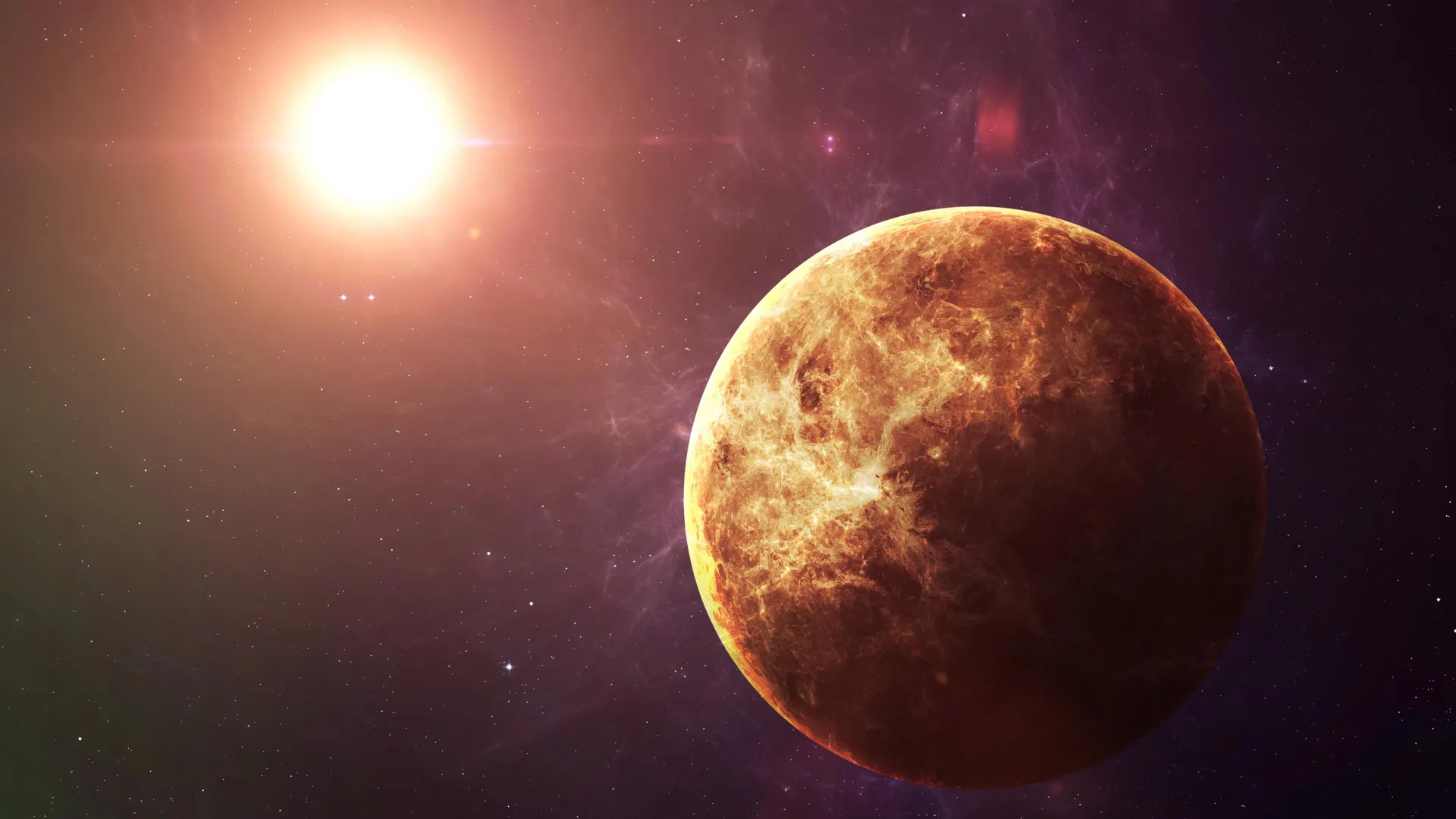
Why Venus Has No Moon: Study Suggests It May Have Spiraled Into the Planet
Scientists have long wondered why Venus does not have a moon, even though its size, mass and overall structure are similar to Earth’s. A new study from the University of California, Riverside, suggests a surprising possibility: Venus may once have had a moon, but the satellite could have gradually spiraled inward and collided with the planet.
Previous theories have generally focused on two possibilities. Venus may once have had a moon that was later destroyed in a massive collision, or the planet may never have experienced the type of impact needed to create a moon.
New research published in The Astrophysical Journal offers another explanation. Venus may not have needed a dramatic external event to lose a moon. Its own gravity and extremely slow rotation could have caused the satellite to move inward until it collided with the planet.
“My research shows that Venus didn’t need a catastrophe to get to what we can see today,” said UCR astrophysicist and lead author Stephen Kane. “It turns out that the planet’s own gravity and natural rotation rate combined to cause the moon to collapse on top of it.”
Why is Earth’s moon moving away from Earth?
Scientists know that Earth’s moon is gradually moving away from our planet because the Apollo 11 mission left a mirror on the lunar surface. Researchers can use the mirror to measure the distance between Earth and the Moon with great precision.
“We know that the moon is slowly moving away from Earth at a rate of about 4 centimeters per year,” Kane said.
The Moon’s movement is closely related to Earth’s relatively fast rotation. Earth rotates once every 24 hours, and some of the energy associated with that rotation is transferred to the Moon, gradually pushing it outward over time.
Venus behaves very differently. One rotation of Venus takes approximately 243 Earth days. Because the planet rotates so slowly, a moon orbiting Venus would not necessarily move outward like Earth’s Moon. Instead, the combination of Venus’s gravity and slow rotation could cause the satellite to gradually spiral inward and eventually collide with the planet.
How scientists simulated a moon colliding with Venus
To investigate this possibility, Kane developed a computer model that simulates how planets and moons interact through gravity.
He first tested the model using the Earth-Moon system, reproducing its known evolution to ensure that the simulation behaved realistically.
Kane then applied the model to Venus. He varied the planet’s rotation speed and tested hypothetical satellites with masses ranging from half to 10 times the mass of Earth’s Moon.
In most of the simulations, the results were surprisingly consistent: the moon eventually collided with Venus. Larger satellites met the same fate even earlier.
“I was shocked when I made this discovery,” Kane said. “I knew the wide range of scenarios I was considering would lead to different outcomes, but everything went in pretty much the same direction.”
The simulation does not prove that Venus actually had a moon. Kane considers it a possibility, but it remains unclear whether a Venusian moon ever formed.
The study does suggest that if Venus once had one or more moons, they may not have lasted forever.
Could evidence of an ancient Venusian moon be hidden inside the planet?
Venus has undergone major geological changes, making direct evidence of an ancient moon impact difficult to find.
About 80% of Venus’s surface appears to be relatively young, which scientists interpret as evidence of a major resurfacing event roughly a billion years ago. That event may have erased much of the planet’s older geological record.
Clues could instead be hidden deep inside Venus.
Scientists believe Earth’s Moon formed after a massive impact early in Earth’s history. Seismic research has identified an unusual structure deep below Earth’s surface that may contain debris related to an ancient collision.
Comparative measurements of Venus may one day reveal whether the planet absorbed one of its own moons.
How a moon collision could have changed Venus
A collision between Venus and a moon could provide clues about another major question: whether Venus was once capable of supporting life.
If a moon collided with Venus, it would have delivered a huge amount of energy and angular momentum to the planet. That impact may have influenced Venus’s rotation, geology and climate.
If Venus once had an ocean or another environment more favorable to life, the moon’s impact could have significantly altered the planet’s subsequent evolution.
This possibility is particularly interesting because Venus is the closest planet to Earth and may once have been much more similar to Earth than the extremely hot world observed today.
What Venus can teach us about Earth-like exoplanets
The findings could also have implications far beyond our solar system.
When scientists search for habitable planets around other stars, they often focus on worlds similar to Earth. Whether these planets have moons is one factor researchers consider when studying their long-term environments.
Earth’s Moon causes tides, may have contributed to the continuation of geological activity and has played an important role in Earth’s evolution. However, scientists still do not know whether a large moon is necessary for life to develop or survive.
“My sense is that there are benefits to having the moon, but it’s not necessary for habitation,” Kane said. “The moon has clearly changed the way Earth has evolved over time, but we don’t fully understand how important its role is.”
Kane’s findings suggest that the formation of a moon may be only part of the story. A planet must also be able to sustain it.
If a planet rotates too slowly, its moon could spiral inward and eventually collide with the surface, dramatically changing the planet’s history.
“When people think about twin Earths around other stars, one of the questions they have is, ‘Does it have a moon?’” Kane said. “My research points to a disturbing scenario for many of those cases: If these planets don’t rotate fast enough, the moons will collide with the surface, which will change the course of their history.”
Source: www.sciencedaily.com