


Astronomers Discover the Youngest Exoplanet Ever Seen—A “Baby” World Less Than 1 Million Years Old
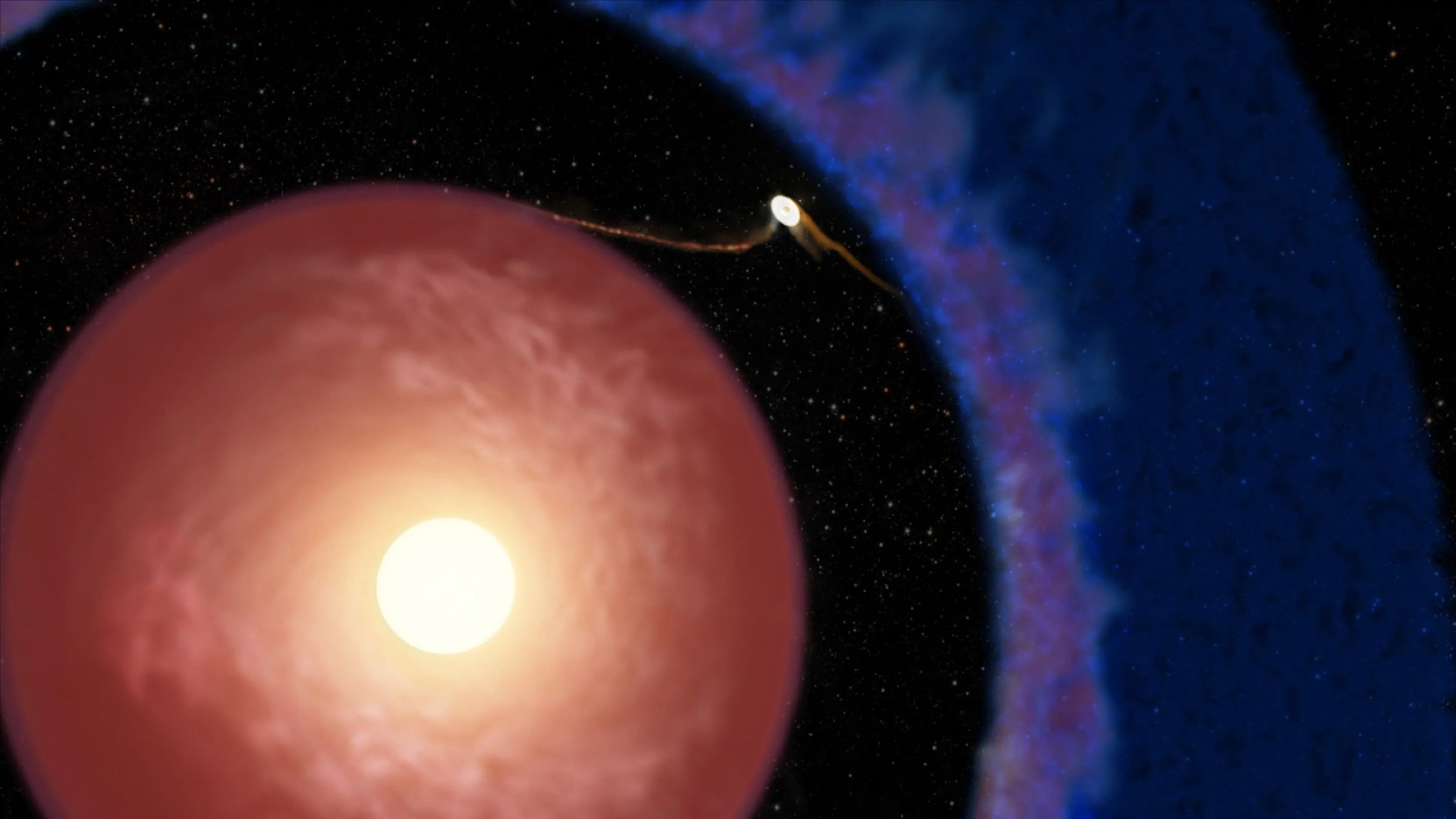
Astronomers have directly imaged a “baby” exoplanet emerging from the cosmic cocoon surrounding a nearby young star. Less than 1 million years old, Elias 2-24 b is the youngest alien planet ever identified and could offer scientists an unprecedented look at how planets—including Earth—form.
Elias 2-24 b orbits a newly formed star about 450 light-years from Earth. The giant exoplanet has between two and four times the mass of Jupiter and orbits nearly twice as far from its star as Neptune does from the sun.
How astronomers found the newborn planet
Astronomers first noticed signs of Elias 2-24 b in 2017, when they observed a small gap in the star’s protoplanetary disk—the swirling ring of gas, dust and debris left over from star formation.
Such gaps can form when material in the disk gathers together under gravity to create a planet. However, the suspected planet was too difficult to see directly at the time.
In a new study published September 16 in The Astrophysical Journal Letters, researchers combined observations from three powerful observatories: the W. M. Keck Observatory in Hawaii, the Atacama Large Millimeter/submillimeter Array in Chile and the European Southern Observatory’s Very Large Telescope, also in Chile.
The combined observations allowed the team to directly image Elias 2-24 b and confirm that it is a planet. The data also helped researchers estimate its age: probably less than 1 million years.
“What makes Elias 2-24 b so remarkable is its age,” Andrea Bernardi, the study’s lead author and a Ph.D. student at the Institute of Astrophysics of the University of Diego Portales in Chile, said in a statement. “This is the youngest planet ever detected and is still actively accreting material from its surroundings, allowing us to observe a stage of planet formation that is rarely seen directly.”
Image credit: Bernardi et al. 2026
A planet still growing
Elias 2-24 b is about 5,000 times younger than Earth. Compared with the oldest known exoplanet, PSR B1620-26 b, also known as Methuselah, the newly discovered world is only about 0.008% as old. Methuselah formed roughly 1.1 billion years after the Big Bang.
On a human timescale, Elias 2-24 b would be comparable to a baby only a few days old.
The exoplanet is also still actively accreting material from its surroundings. In other words, it is continuing to grow by drawing gas and dust from the protoplanetary disk around its star.
That makes Elias 2-24 b an especially valuable target for astronomers. Most known exoplanets are much older, meaning scientists generally observe them long after the planet-forming process has ended.
The youngest exoplanet ever detected
Elias 2-24 b is not the first “baby” exoplanet discovered, but it is at least twice as young as any previously known planet.
Before this discovery, some of the youngest known planets included worlds orbiting stars that were approximately 5 million years old. In 2024, astronomers discovered TIDYE-1b, which is thought to be about 3 million years old. In 2025, researchers reported that AB Auriga b could be as young as 2 million years old.

Image credit: NASA/JPL-Caltech/R. Hurt (IPAC)
“Our planet formation models were already struggling to explain the previous record holder for the youngest known planet,” Lucas Cieza, an astronomer at the Institute of Astrophysics who led the 2017 study that first identified the gap around Elias 2-24, said in a NASA statement.
“Elias 2-24 b shows that even our best planet formation models are still missing some important processes,” Cieza added.
Why young planets are difficult to find
More than 6,000 exoplanets have been discovered, but most were found using the transit method. This technique detects the small dip in a star’s brightness that occurs when a planet passes between its star and Earth.
That method is difficult to use when a planet is still embedded in a protoplanetary disk. The disk can permanently dim the star’s light, making it harder to identify the temporary brightness change caused by a planetary transit.

Image credit: NASA/SDO/AIA
Young planets can be easier to locate when a protoplanetary disk is oriented face-on toward Earth. From that angle, astronomers can more clearly see gaps in the disk that may have been carved by forming planets.
Even then, the bright light from the young star can overwhelm the faint light reflected or emitted by the planet. As a result, only a small number of these planetary infants have been observed directly.
More newborn planets could be discovered
This situation could change as new space telescopes improve astronomers’ ability to study young stars and their surroundings.
NASA’s Nancy Grace Roman Space Telescope is expected to use advanced instruments, including a coronagraph that blocks light from distant stars, to investigate their environments. Experts predict that Roman could lead to the discovery of up to 100,000 new exoplanets during its mission.
Better observations could reduce the current bias toward detecting older planets and reveal many more worlds during the earliest stages of formation.
“This is just the beginning of a new era of discovery,” Cieza said. “Roman takes planetary exploration to the next level.”
Study: Bernardi, A., Zurlo, A., Cieza, L. A., Ruane, G., Christiaens, V., Dasgupta, A., Guidi, G., Mawet, D., Mesa, D., Pérez, S. and Williams, J. P. (2026). “Search for embedded protoplanets using Keck/NIRC2 vortex coronagraphs: Confirmation of accretionary planets in narrow gaps in the Elias 2-24 disk.” The Astrophysical Journal Letters, 1009(1), L3.
Source: www.livescience.com