


AI’s Math Breakthroughs Spark a Fierce Debate Among Mathematicians
At the Heidelberg Laureate Forum, leading mathematicians debated whether AI will accelerate human discovery—or change the profession beyond recognition.
HEIDELBERG, Germany — Mathematics is often viewed as the slowest, most systematic and most abstract of the sciences. Its advances are typically incremental and highly specialized, meaning they rarely attract mainstream attention.
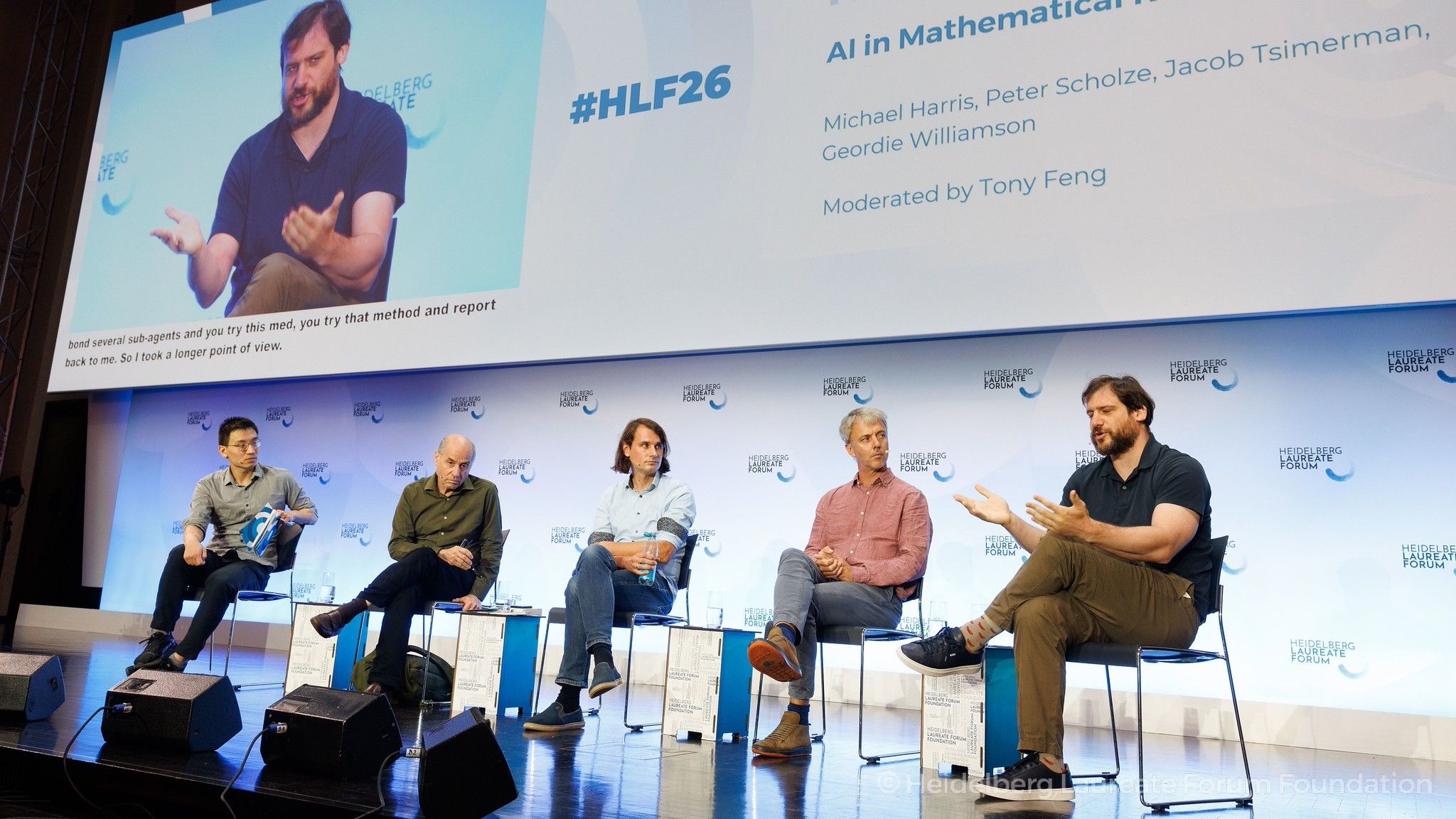
That changed on September 15, when a panel of leading mathematicians took the stage at the Heidelberg Laureate Forum, a conference that connects young researchers with award-winning mathematicians and computer scientists.
The discussion focused on the rapid rise of artificial intelligence and its growing role in mathematical research. Recent AI developments have placed new pressure on a field built around human insight, painstaking proof and long-term expertise.
AI is beginning to tackle major mathematical problems
Over the past year, AI systems have contributed to solutions for dozens of mathematical problems. One example involves a problem posed by prolific Hungarian mathematician Paul Erdős. The work reportedly produced publishable, doctoral-level research and was officially verified with two pieces of evidence.
AI has also been credited with making progress on 10 other long-standing unsolved problems.
On September 8, OpenAI announced that it had deployed 10,000 AI agents to work on mathematical problems. The announcement focused on the Navier–Stokes existence and smoothness problem, one of the seven Millennium Prize Problems established by the Clay Mathematics Institute in 2000.
Only the Poincaré conjecture has been resolved to the institute’s satisfaction. A correct solution to any of the remaining problems carries a $1 million prize.
Researchers raise concerns over the use of their work
Mathematicians Tristan Buckmaster and Levent Alpöge had reportedly worked on the Navier–Stokes problem for about a year and claimed that OpenAI had learned about their work. They also claimed that OpenAI representatives threatened them against publishing it.
The controversy was addressed at the Heidelberg forum by Michael Harris, a professor of mathematics at Columbia University. Harris had written about the OpenAI Navier–Stokes announcement in the Silicon Reckoner newsletter, focusing on what he viewed as a dispute over how OpenAI used Buckmaster and Alpöge’s research.
“There are no legal impediments to the kind of plunder that we have seen in particular over the last month, just as there were no legal impediments to the violent acquisition of territory by suzerain powers in the 19th century,” Harris said.
Harris described major technology companies developing AI as “gangs” and called for a regulatory framework to protect mathematicians from similar behavior. He also argued that people who act destructively toward the mathematical community should not be considered members in good standing.
AI researchers say the breakthrough could mark a turning point
Other panelists shared Harris’s concerns while emphasizing the scale of AI’s mathematical capabilities. Geordie Williamson, a mathematics professor at the University of Sydney and a 2026 Fields Medal medalist, was among those discussing the issue.
Jacob Tsimerman, who joined OpenAI in July as an AI safety researcher, highlighted the significance of the company’s in-house AI model. He said the importance of AI solving a Millennium Prize Problem could be overshadowed by the broader question of what the technology is capable of doing.
“I think the top line is getting buried a little bit,” Tsimerman said. “AI has solved the Millennium Prize problem, but I don’t think it was effective enough to at least inform people of the functions that AI should have.”
Tsimerman is also focused on AI safety through the Mathematical AI Safety Research Institute, an independent nonprofit organization he founded. He believes OpenAI’s Navier–Stokes announcement could represent a turning point in how mathematics is conducted—and who gets to conduct it.
“If humanity values doing mathematical research at the frontier level, developing expertise and progressing slowly, I think we’re nearing the end of that,” he said at a separate press conference at the forum.
Why some mathematicians remain skeptical
Peter Scholze, co-director of Germany’s Max Planck Institute for Mathematics and a 2018 Fields Medal medalist, took a more skeptical view of the OpenAI announcement. He dismissed it as “some kind of PR.”
Scholze argued that the purpose of the Millennium Prize Problems is not simply to solve individual questions. Their deeper value, he said, lies in generating new perspectives on a broad range of related unsolved problems and building human understanding.
That kind of understanding may be difficult to achieve through long, machine-generated proofs. Scholze acknowledged that he had never created a large-scale language model and proudly showed the audience his “dumb phone,” but he said AI may primarily accelerate mathematical progress—a benefit he considers limited when researchers already struggle to understand all the progress being made.
What happens to human mathematics?
Several initiatives are now attempting to preserve the human foundations of mathematics, including Proofs and Prompts, Mathematical Discourse and the Human Mathematics Association.
These efforts aim to keep mathematics a stronghold of human culture and understanding. However, the panelists agreed that the speed of AI development makes the field’s future difficult to predict.
“Honestly, every time someone talks about what’s going to happen 10 years from now, or even five years from now, it seems like an immeasurably far away,” Tsimerman said. “The world in two years will be incredibly different than it is now.”
Source: www.livescience.com