


US Sanctions Prompt Chinese Companies to Rely More on Science, Study Finds
Chinese companies have increased their reliance on scientific publications after the United States restricted access to sensitive information.
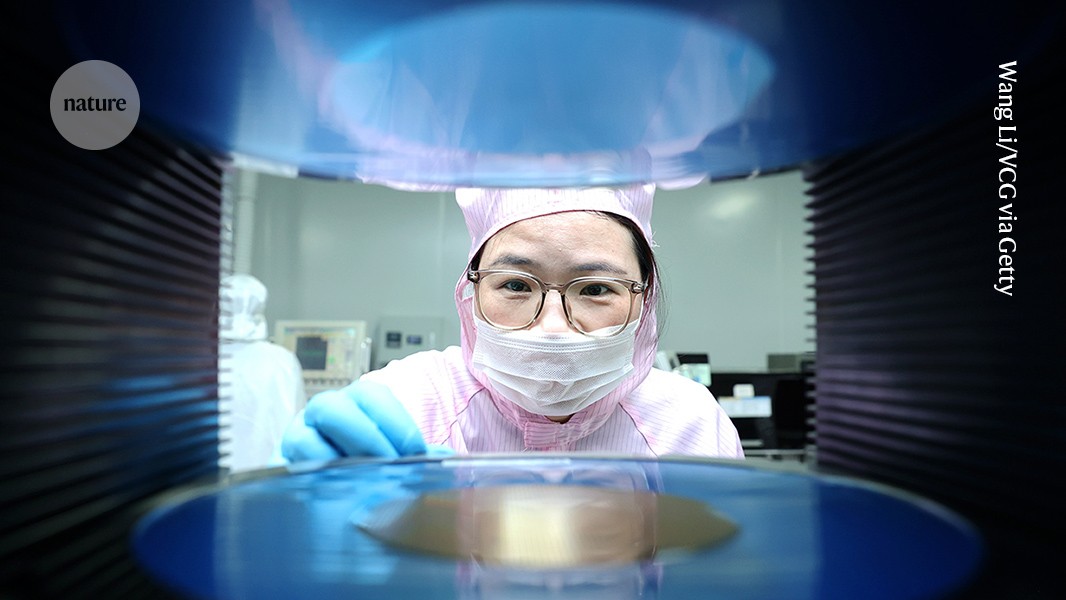
Credit: Wang Li/VCG via Getty
Chinese companies with limited access to certain US technologies increased their use of scientific publications to support innovation, according to an analysis of patents and research papers.1
The study examined how Chinese companies responded after the US government placed them on its Entity List. Companies on the list can be restricted from licensing certain materials or participating in joint research and development projects. The US government says the list is intended to protect national security. Major Chinese companies began appearing on it in 2018, amid strained relations between China and the United States.
After being added to the Entity List, Chinese companies produced more patents citing scientific publications and published more scientific papers than similar companies that were not subject to the same restrictions.
Gong Cao, an innovation policy researcher at the University of Nottingham in Ningbo, China, said the findings revealed an “unintended consequence” of US export controls.
“Whether you support technology management or not, it’s important to recognize that it can come at a cost,” said Dinsha Mistry, a political economist at Stanford University in California.
Although Chinese companies increased their involvement in science after the regulations were introduced, the researchers cautioned that the companies’ inclusion on the Entity List might not have caused the change. Other factors could also have contributed, said Kenneth Huang, a researcher in innovation and technology management at the National University of Singapore.
How sanctions affected Chinese innovation
Previous studies have examined the impact of US sanctions on Chinese innovation. Mistry said the latest analysis used some of the strongest data and most rigorous methods for this type of research.
To assess the impact of US sanctions, the researchers used data covering 2010 to 2022 from several sources. These included China’s patent and trademark office, the China National Intellectual Property Administration (CNIPA), the Web of Science article-indexing platform and the China Stock Market and Accounting Research Database.
The research team first identified long-term trends in Chinese science and technology. Regardless of sanctions, Chinese companies became increasingly engaged with the scientific community during the study period.
For example, the number of patents granted by CNIPA that cited at least one scientific paper increased more than 18-fold, from 5,225 in 2010 to 94,441 in 2022. The number of patents granted to Chinese companies by the US Patent and Trademark Office rose more than 13-fold, from 452 to 6,071. American inventors and companies nevertheless remained the world leaders in using scientific knowledge in patents.
The researchers then compared Chinese companies placed on the US Entity List between 2010 and 2022 with similar Chinese companies outside the list. To make the comparison more robust, they matched companies with similar characteristics, including industry, ownership and location.
Entity-listed companies produced more research
The analysis found that Chinese companies subject to sanctions produced 72.3% more patents citing at least one scientific publication than companies not subject to similar sanctions.
Sanctioned companies also published 33.3% more papers indexed by China’s National Knowledge Infrastructure, the country’s largest academic-paper database. The increase in publications indexed by Web of Science was more than 85.2%.
Mistry said the number of patents citing Chinese companies’ publications and the number of papers they produce could continue to increase with or without sanctions, partly because China invested heavily in science and technology during the study period.
“The authors convincingly show that Chinese companies targeted by US sanctions pursued more intensive approaches to science and technology than they would have otherwise,” Mistry said. “These Chinese companies appear to double down on innovation when faced with sanctions.”
Source: www.nature.com