


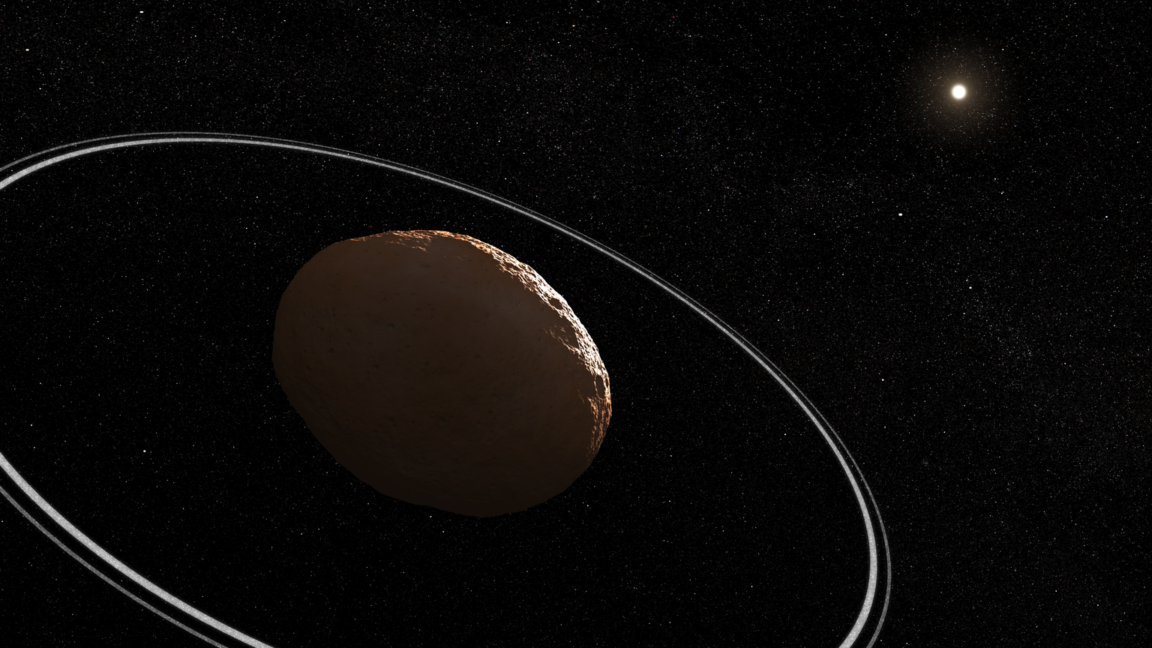
Chariklo’s Mysterious Rings May Be Fed by an Undetected “Ghost Moon”
Scientists are still trying to determine where the extra material in Chariklo’s outer ring came from. “We don’t know where the extra material came from, but we have several hypotheses,” Santos-Sanz said.
An unseen shepherd moon could stabilize Chariklo’s outer ring
One likely explanation is a small shepherd satellite sharing the orbit of Chariklo’s outer ring. Such an object could help explain the ring’s stability and sharply defined edges. It could also release debris that replenishes the ring, known as C1R.
“This satellite, if it exists, has not yet been detected,” Santos-Sanz said.
JWST data hint at different ring compositions
Computer models based on observations from the James Webb Space Telescope also offer clues about what Chariklo’s two rings are made of. However, Santos-Sanz emphasized that this part of the research remains incomplete.
“Our feeling after using this model is that the inner ring should be made up of larger particles than the outer ring. We think the outer ring is dustier,” he said. “But this is a work in progress. Well, we can’t say with certainty that this is dusty and this is not.”
Another occultation could reveal whether the rings are changing
The researchers say the best way to test these possibilities is to observe another Chariklo occultation, this time in visible light. Comparing observations at different wavelengths could help scientists distinguish genuine changes in the rings from effects caused by the observing wavelength.
“We are looking for new occultations,” Santos-Sanz said.
Understanding how rings around small celestial bodies evolve over time is important because Chariklo is not the only object known to have them. Other bodies in the same broad category include Chiron, the dwarf planet Haumea, and the trans-Neptunian object Quaoar.
Small-body rings may change like planetary rings
Rings around giant planets are already known to change over months and years. Saturn’s D ring has shrunk considerably, while Neptune’s Adams arc has been repositioned. The latest findings suggest that rings around smaller celestial bodies may also evolve.
“I think this study is only part of the puzzle,” Santos-Sanz said. “However, it could provide important clues for broader studies of the rings around small bodies and giant planets.”
Santos-Sanz’s research is published in Science Advances.
Source: arstechnica.com