


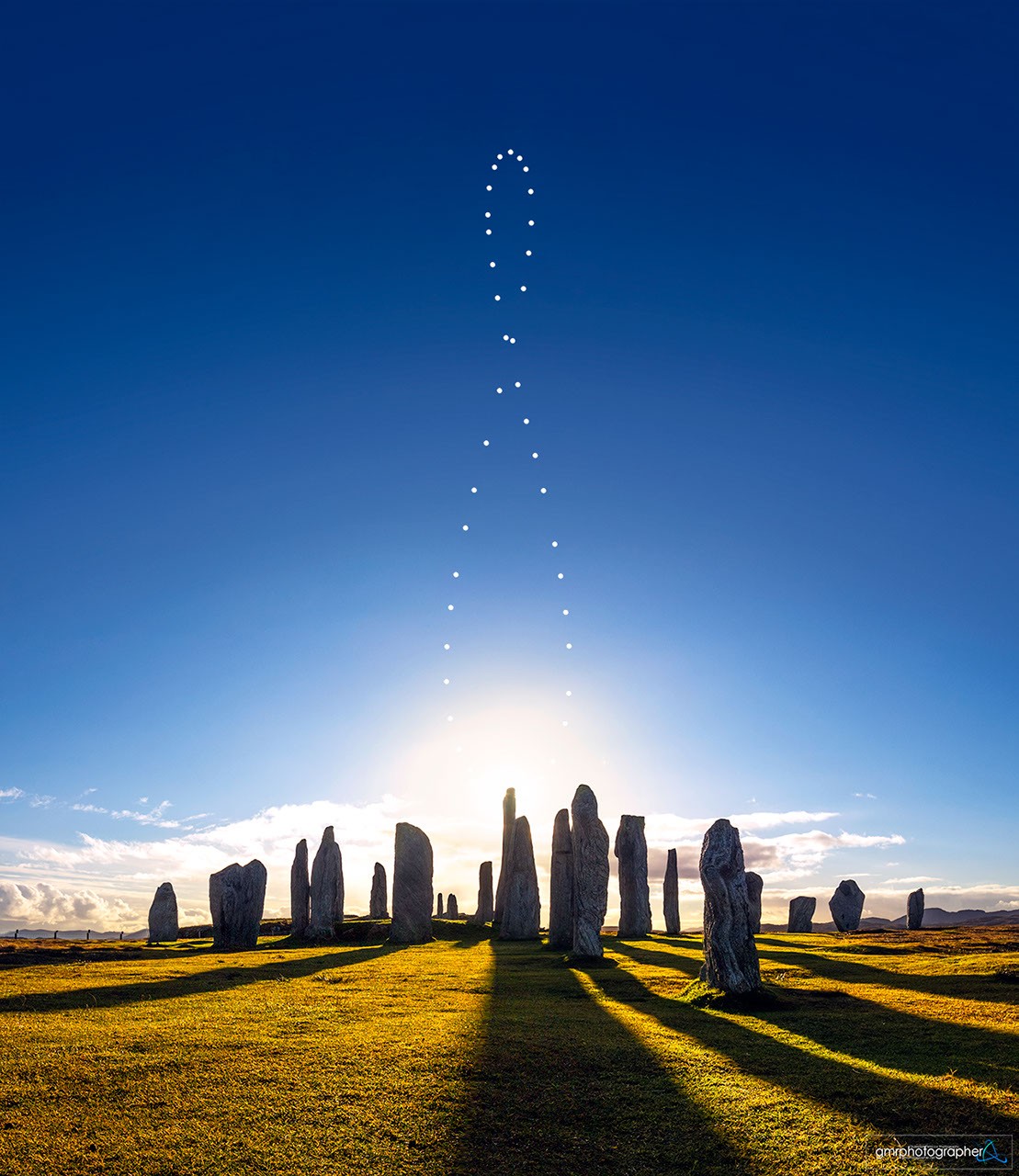
What Is an Analemma? A Figure-Eight Sun Path Over Callanish, Scotland
Explanation: If you go outside at the same time every day and photograph the Sun, its position will gradually shift throughout the year. A composite image made from photographs taken from the same location at the same time over the course of a year is called an analemma.
This featured solar analemma is composed of images taken around noon every few days near the village of Callanish in the Outer Hebrides, Scotland, in the United Kingdom.
The Callanish Stones and the Sun’s Figure-Eight Path
In the foreground are the Callanish Stones, a stone circle built around 2700 B.C. during the Bronze Age. It remains unknown whether the location of the Callanish Stones had astronomical significance, although their alignment continues to inspire questions about how ancient people observed the sky. You can also explore this video of the stones.
The distinctive figure-eight shape of an analemma is caused by the tilt of Earth’s axis and the elliptical shape of Earth’s orbit around the Sun.
Why the Sun Moves Along the Analemma
At the summer solstice, the Sun appears at the top of the analemma, while at the winter solstice it appears near the bottom. This featured image was taken near the December solstice, so the Sun is visible near the lower part of the figure eight.
Around the vernal equinox, the Sun appears near the midpoint of the analemma. During the equinox, or “equal night,” day and night are approximately equal in length around the globe. Many cultures celebrate the seasonal change marked by the vernal equinox.
NASA’s main Astronomy Picture of the Day site is moving:
Visit apod.nasa.gov for updates, or go to On the Move for more information.
Tomorrow’s photo: Open Space
Source: science.nasa.gov