


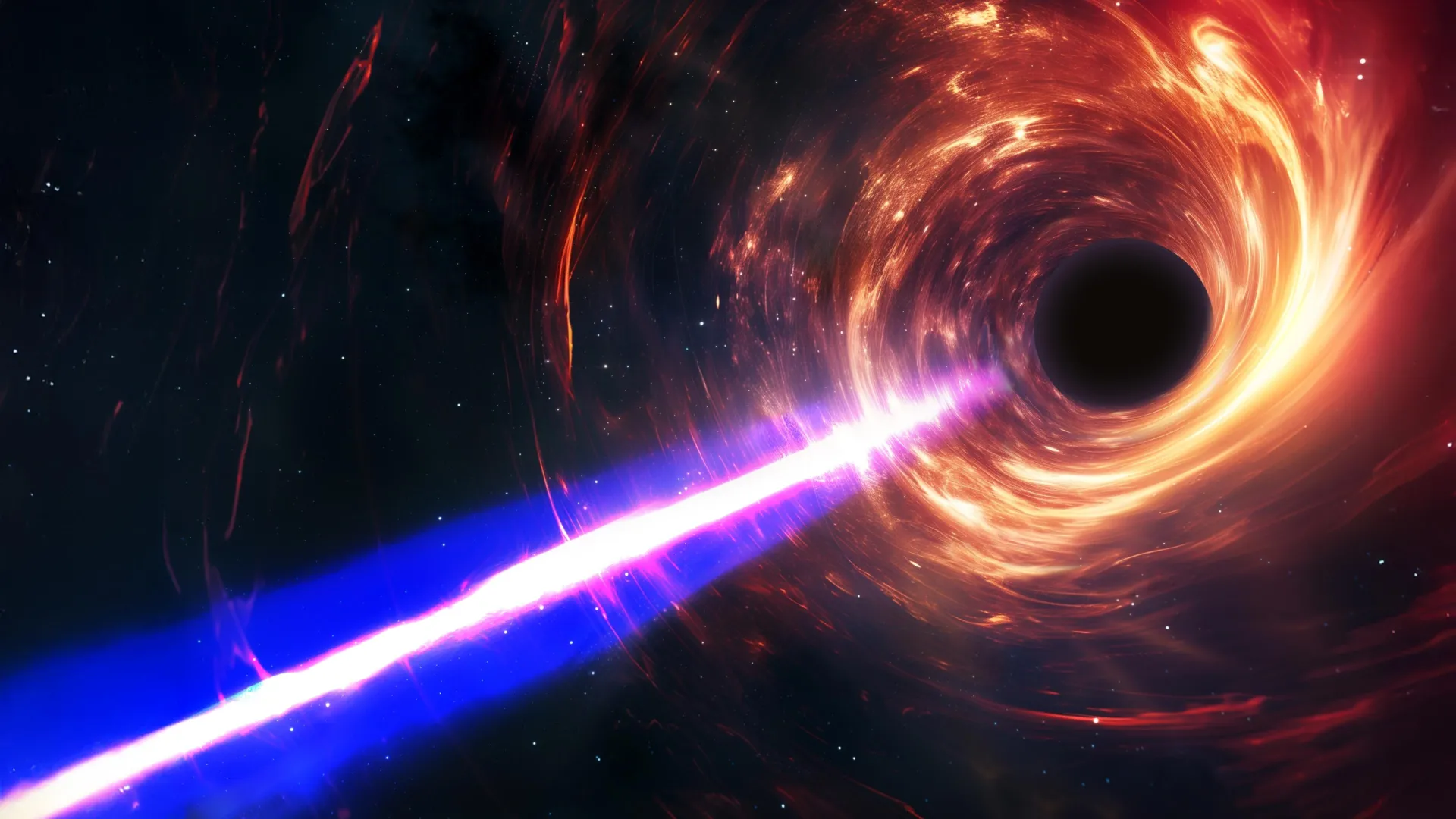
Black Holes May Follow a Universal Law for Powerful Jet Formation
An international team of astronomers co-led by researchers from the Institute for Advanced Study (IAS) has identified what appears to be a universal law governing one of black holes’ most dramatic behaviors: the production of powerful jets.
The researchers found that black holes of vastly different sizes can launch jets at the same critical stage of their feeding cycle. This includes stellar-mass black holes, which are about 10 times the mass of the Sun, and supermassive black holes, which can be millions of times more massive.
The research was conducted by Andrew Mummery, Martin A. and Helen Chorjian (2025–30) from the School of Natural Sciences at the Institute for Advanced Study, and Adele Goodwin, a Forest Research Foundation Fellow at the International Radio Astronomy Research Center at Curtin University in Western Australia.
Watch a Black Hole Tear Apart a Star
Published in Nature Astronomy under the title “Universal critical accretion rate for black hole jet formation,” the study brings together years of observations across multiple wavelengths. The researchers combined data from telescopes in the United States, Australia, India, South Africa, and space-based observatories.
The team focused on tidal disruption events. These occur when a star passes close enough to a supermassive black hole to be torn apart by its intense gravity. Such events give astronomers a rare opportunity to observe how black holes respond after suddenly receiving large amounts of stellar material.
“We really wanted to solve this huge puzzle,” Mummery said. “Why do some supermassive black holes fire off a radio jet right after shattering a star, while others sit there like they’re completely dormant and suddenly fire their jets months or years later?”
Black holes are often compared with cosmic vacuum cleaners, but their feeding behavior is far more chaotic. “When a black hole tears apart a star, it doesn’t swallow everything cleanly,” Goodwin said.
Some of the star’s material falls toward the black hole, while much of it can be violently ejected into space through powerful outflows. These giant cosmic “burps” can transport matter across vast distances and may significantly influence the evolution of the galaxies that contain them.
How Tidal Disruption Events Help Astronomers Study Black Holes
Astronomers have long suspected that black holes obey the same fundamental laws of physics, even though their masses vary dramatically. Confirming this idea has been difficult because changes around supermassive black holes can typically unfold over thousands or millions of years.
Tidal disruption events offer a way around this challenge. After a star is destroyed, the resulting feeding process around a supermassive black hole can evolve over just a few years. This allows scientists to study processes that would otherwise be difficult to observe in real time.
The key insight behind the new research emerged unexpectedly. While talking in a bar during an astrophysics conference in Madrid, Mummery and Goodwin realized that the same laws known to govern jet production in smaller black holes might also apply to supermassive black holes.
Two Stages of Black Hole Jet Formation
To test the idea, the researchers investigated 20 tidal disruption events using optical, ultraviolet, X-ray, and radio observations.
They narrowed the sample to 10 high-quality events for which they could reliably determine both the black hole’s feeding rate and the timing of its radio outflow.
The analysis revealed two distinct periods when a jet could form.
The first occurs early, while the black hole is consuming matter at an extremely high rate. The second occurs much later, hundreds to thousands of days after the star was initially torn apart.
During this later stage, the black hole’s supply rate falls to about 2% of the Eddington limit. At the Eddington limit, the outward pressure of radiation balances the inward pull of gravity.
The 2% threshold is especially significant because it is already known to trigger jet formation in much smaller black holes within galaxies. Finding the same threshold in supermassive black holes suggests that this aspect of black hole physics operates in essentially the same way across an enormous range of masses.
Predicting When Black Holes Will Launch Jets
The discovery could also help astronomers plan future observations.
If researchers can predict when black holes are likely to produce delayed jets, they can schedule telescope time more efficiently and improve the chances of capturing these short-lived events as they occur.
This could help scientists make better use of highly requested telescopes and reduce observations conducted when little activity is expected.
The ability to predict these eruptions could be particularly valuable for future major observatories, including the Square Kilometre Array radio telescope project, which is expected to begin collecting scientific data in 2028.
“We hope that our research will pave the way to even deeper discoveries about our universe,” Mummery said.
Source: www.sciencedaily.com