


Perseverance Finds Three Episodes of Water Alteration in Mars’ Jezero Crater
Data from NASA’s Perseverance rover show that the geologically puzzling Margin Unit in Jezero Crater experienced at least three distinct episodes of water-related alteration. The findings increase the unit’s importance as a target in the search for signs of ancient life on Mars.
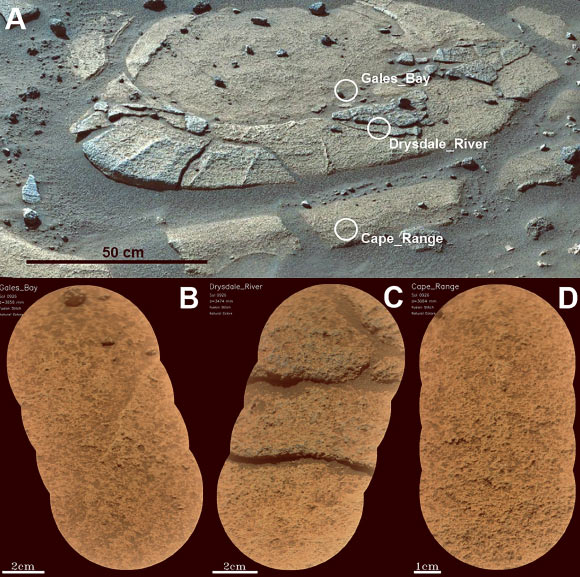
Concentric features on the eastern margin of the Margin Unit in Jezero Crater, Mars. Image credit: Bedford et al., doi: 10.1038/s43247-026-03997-9.
NASA’s Perseverance rover landed in Jezero Crater in February 2021 to investigate its geological record and search for evidence of ancient life.
Jezero Crater is approximately 45 km (28 mi) in diameter. It lies on the northwestern side of the 1,200-km (746-mi) Isidis impact basin, northeast of the Syrtis Major volcanic province and near the region known as Nili Fossae.
The Margin Unit preserves a complex history of water on Mars
In a new study, Purdue University planetary scientist Candice Bedford and colleagues examined the Margin Unit, a band of olivine- and carbonate-rich rocks that follows the inner rim of a crater near the shoreline of an ancient lake.
Using chemical and imaging data collected by Perseverance’s SuperCam instrument from more than 185 rock targets, the researchers determined that the Margin Unit began as an igneous rock rich in crystalline olivine. The rock likely formed through the slow cooling of magma deep within a magmatic body.
“Igneous rocks are excellent record-keepers, especially because the mineral crystals within them preserve details about the precise moment of their formation,” the researchers said.
“In this case, they preserved an incredibly complex record of water activity on early Mars.”
Beneath what scientists believe was once the second terrace level of ancient Lake Jezero, the team identified evidence of three separate fluid-alteration events.
Three stages of fluid alteration
- Carbonate formation: Carbon dioxide-rich fluids moved through cracks in the rock and formed carbonate-rich deposits. Erosion of those deposits later produced the unit’s distinctive ridges.
- Silica precipitation: Exposure to lake water and chemical changes in groundwater remobilized some of the carbonate and caused silica to precipitate in the rock’s pore spaces.
- Hydrothermal activity: Hydrothermal fluids moved through young fractures and deposited veins rich in fluorite and calcium sulfate minerals, a feature more commonly associated with hydrothermal systems on Earth.
The researchers also found evidence that some parts of the Margin Unit were physically reworked by lakeshore activity or debris flows.
“Before we arrived at the Margin Unit, the main hypothesis, derived from in-orbit observations, was that the carbonates seen from orbit were formed through interaction with the lakes present in Jezero Crater,” Dr. Bedford said.
“But now we know that this site was a kind of crossroads for the water system.”
“The discovery of the Margin Unit is important because Jezero Crater lies within one of the highest carbonate exposures on Mars, so what we learn here has implications far beyond this crater.”
“Some of the rocks in the Margin Unit also contain silica,” added Eleni Lavanis, a planetary scientist at the University of Hawaii at Manoa.
“Converting olivine to carbonate can leave behind silica, which is often found in rocks below the waterline.”
A promising target in the search for ancient life
The results suggest that the Margin Unit was altered by a combination of groundwater circulation and possible long-term direct interaction with the Jezero paleolake.
Because the rocks record exposure to different groundwaters, lake water and hydrothermal fluids, they may preserve a detailed record of the environmental conditions that existed on early Mars.
“The Margin Unit recorded a complex water history caused by multiple alteration events due to exposure to different groundwaters and lakes, cementing the samples collected by the Margin Unit and Perseverance as prime targets of astrobiological interest,” the researchers concluded.
Their paper appears in the journal Communications Earth & Environment.
_____
C. C. Bedford et al. 2026. Lake- and groundwater-related alteration of an olivine-rich margin unit in Jezero Crater, Mars. Communications Earth & Environment 7, 728; doi: 10.1038/s43247-026-03997-9.
Source: www.sci.news