


Early Solar System Was Selective From the Beginning, Study Finds
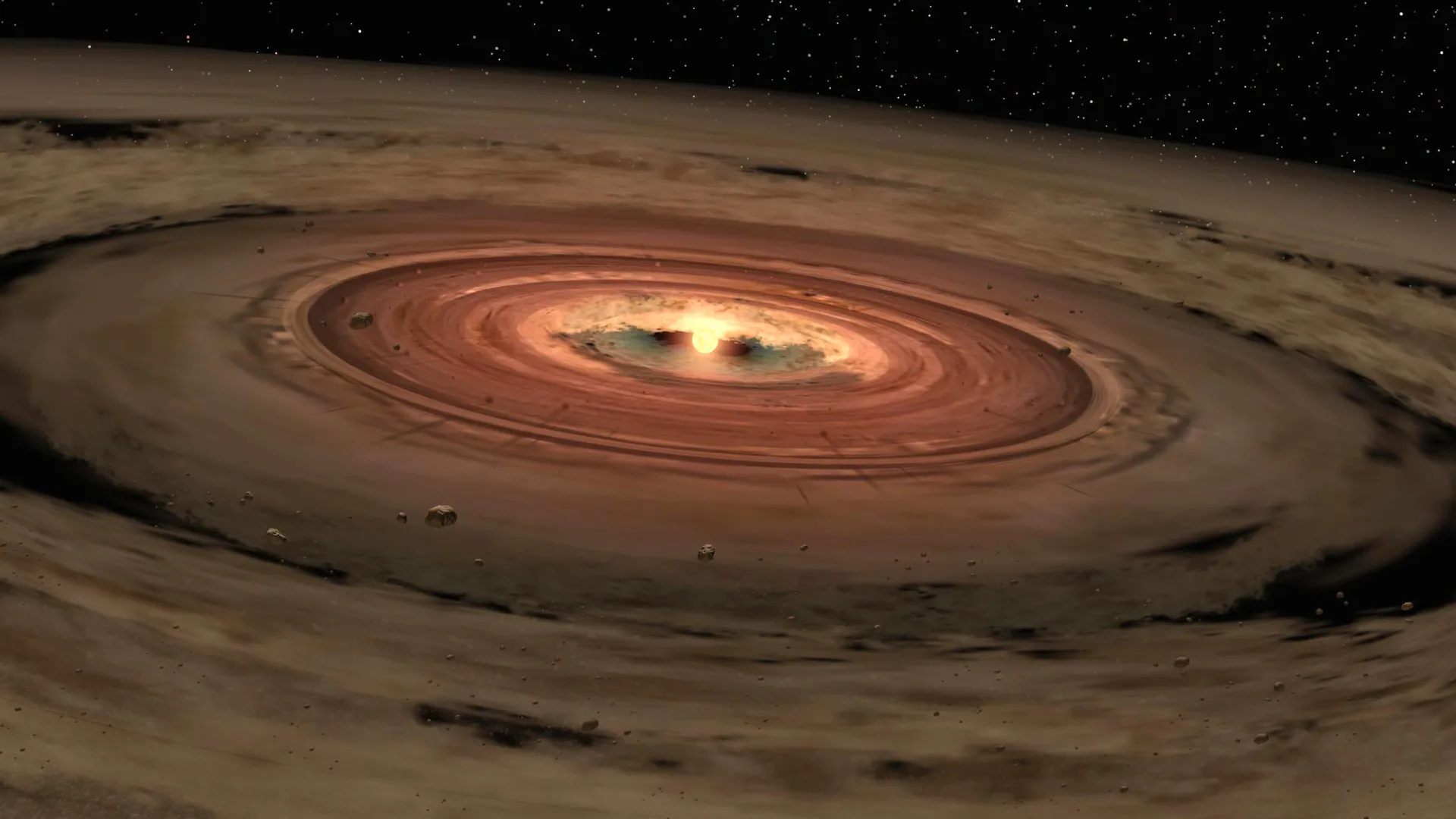
The early stages of planet formation may have been far more selective than scientists once realized. As the young solar system began assembling solid bodies—including planets, moons, and protoplanets—two major types of material were available: chondrules and matrix.
Chondrules are millimeter-sized pieces of rock formed at high temperatures. Matrix is cold, fine-grained dust rich in water ice and organic matter. A new study led by Yale University provides the first geochemical evidence that chondrules were preferentially incorporated into solid bodies during the solar system’s first million years.
The findings, published September 18 in Nature Astronomy, show that this selection process began much earlier than previously documented. Until now, scientists had identified similar sorting only in objects that formed between 2 million and 4 million years after the solar system began.
The Young Solar System Favored Chondrules
“Our study shows that this assembly process was strikingly selective from the beginning,” said Damanveer Grewal, assistant professor of Earth and Planetary Sciences in Yale’s School of Humanities and Sciences and lead author of the study. “The oldest objects in the outer solar system are composed of 83% to 92% chondrules, with very little of the icy, volatile-rich dust that dominates later-forming objects.”
Chondrules are small spheres of rock found inside chondrites, some of the most primitive meteorites preserved in geological collections. These structures provide scientists with a direct physical connection to the solar system’s earliest stages.
“When you pick them up, you know they started as part of a process that started billions of years ago,” Grewal said. “That’s a difficult timescale to wrap your head around.”
Scientists have long known that carbonaceous chondrites—primitive stony meteorites containing organic compounds and water in silicate minerals—display age-related patterns in the outer solar system. Older examples generally contain a higher proportion of chondrules and less matrix, while younger examples contain more cold, volatile materials.
This pattern suggests that the regions where the first solid bodies, known as planetesimals, formed were already favoring thermally formed chondrules while excluding much of the icy dust.
How Scientists Investigated the Solar System’s First Million Years
Determining what happened during the solar system’s first million years has been difficult because no preserved undifferentiated objects from that era remain. As a result, scientists previously had no direct way to determine the original balance of chondrules and matrix in these early bodies.
Grewal and his colleagues addressed this problem by examining chemical clues preserved in iron meteorites from the outer solar system.
The parent bodies represented by these meteorites contained enough radioactive aluminum-26 to eventually melt completely. That melting erased physical structures that could have revealed the bodies’ original composition.
However, the chemical reactions that occurred during melting preserved valuable information. The researchers identified two independent chemical tracers associated with the matrix:
- The high concentration of sulfur in the matrix.
- The oxidation state of iron, which can indicate how much water ice and oxidized dust was incorporated into the original body.
Iron Meteorites Reveal Early Chondrule Abundance
Using these two tracers, the team reconstructed the composition of the ancient parent body. They calculated that matrix accounted for only 8% to 17% of the original material—a smaller proportion than has been measured in known chondrites.
In other words, the remaining material was overwhelmingly composed of chondrules.
“Both tracers independently tell the same story; these early planetesimals had a significantly poorer matrix,” Grewal said. “That convergence is what makes the results robust.”
The discovery may also help explain a mystery in the meteorite record. Very old chondrules appear to have been abundant in the early solar system, yet they are surprisingly rare today.
According to Grewal, many of these ancient chondrules were likely embedded in the first generation of planetesimals. Those bodies later melted, destroying the physical evidence and making the oldest chondrules much harder to identify in surviving meteorites.
What the Finding Reveals About Planet Formation
The results indicate that the separation and selection of planetary materials began almost simultaneously with the formation of the first solids. Instead of containing an even mixture of chondrules and icy dust, some of the young solar system’s earliest planetesimals strongly favored chondrules.
“These ubiquitous tiny beads of rock are the fundamental building blocks from which the planet itself will eventually be assembled,” Grewal said. “And now we know that they were already classified and incorporated into first-generation solids from the beginning.”
Co-authors of the study are Zhongtian Zhang of Princeton University and Joanna Drążkowska of the Max Planck Institute for Solar System Research in Germany.
Yale University provided funding for the study.
Source: www.sciencedaily.com