


Family photo of SpaceX’s Raptor engine.
Credit: SpaceX
SpaceX’s Starship Faces Raptor 3 Engine Problems as Next Tests Approach
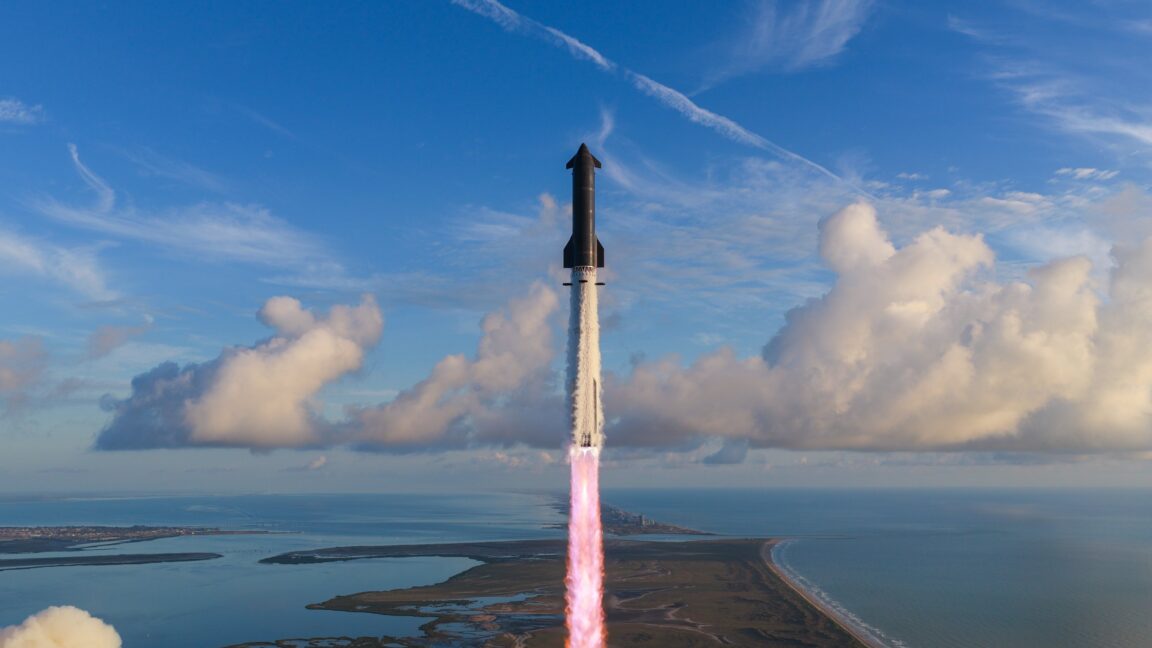
SpaceX has encountered engine problems on all three Starship flights that used the company’s Raptor 3 engine. Despite the failures, the issues are not expected to prevent the next Starship launch as the company continues developing its massive reusable rocket.
Raptor engine failures affected recent Starship flights
During the flight in May, one Raptor engine shut down midway through the Super Heavy booster’s flight. A few minutes later, another engine on Starship’s upper stage also failed.
The next flight, scheduled for July, was canceled at the last minute after multiple Raptor engines failed to ignite on the launch pad. SpaceX replaced two engines and successfully launched the spacecraft one week later.
Elon Musk says Raptor 3 is difficult to manufacture
SpaceX founder and CEO Elon Musk addressed the engine’s development on social media:
“Deleting parts seems easy in theory, but figuring out how to do it in practice is actually very difficult and requires a lot of iteration.”
Musk also wrote that the inside of the Raptor 3 engine “has a very complex shape that can only be manufactured using highly modified 3D metal printing.”
FAA says Monday’s Starship flight stayed within authorized activities
Although Raptor 3 is still in development, the propulsion problems have not stopped SpaceX from advancing Starship. The engine issues seen during Monday’s flight are unlikely to delay the next launch.
The Federal Aviation Administration also cleared SpaceX to proceed with Monday’s flight and will not require the company to conduct a formal accident investigation.
“All flight events for both the Starship vehicle and the Super Heavy Booster occurred within the scope of planned FAA-authorized activities,” an FAA spokesperson told Ars.
SpaceX’s next Starship goals
One of SpaceX’s likely near-term goals is to attempt to return Starship to Starbase and catch it with the launch site’s giant mechanical arm. SpaceX engineers have already demonstrated a similar catch with the Super Heavy booster.
Returning Starship to its launch site would require the vehicle to reenter over land. That would require additional safety screening to ensure that its approach to Starbase does not pose undue risks to populated areas.
Ultimately, SpaceX wants both Super Heavy and Starship to land routinely so the vehicles can be fully and rapidly reused.
Other near-term Starship objectives include longer orbital flights and the vehicle’s first demonstration of in-orbit refueling. That capability is a prerequisite for future missions that would land astronauts on the Moon under NASA’s Artemis program.
Starship could launch more Starlink satellites
In the meantime, Starship is expected to launch more Starlink satellites. Commercial and government demand for Starlink services, along with SpaceX’s long-term plans for an orbital data center, will keep the rocket busy as engineers bring its more advanced capabilities online.
Source: arstechnica.com