


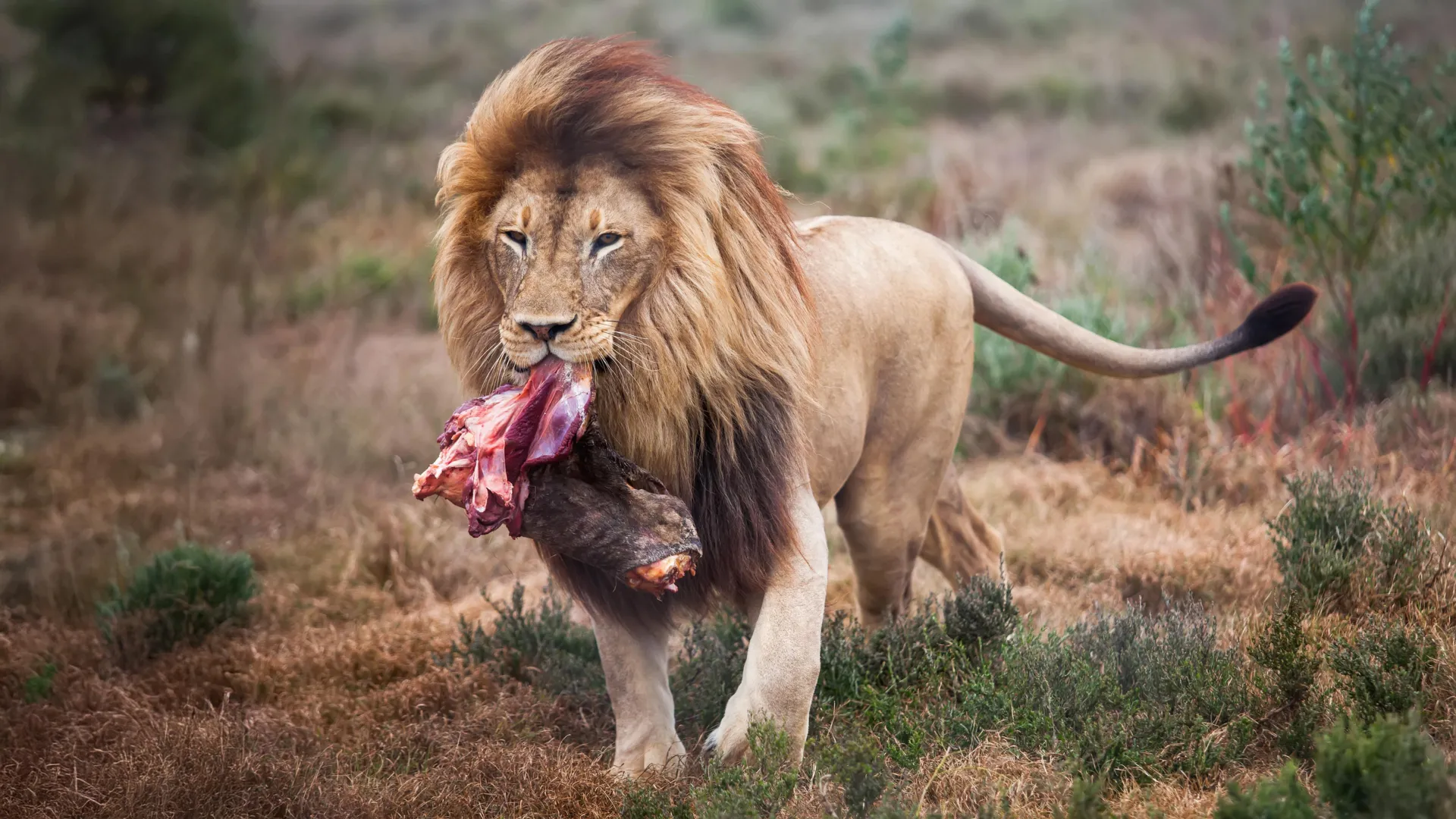
Whole-Carcass Feeding Helps Zoo Lions Behave More Like Wild Lions, Study Finds
A new Australian study suggests that lions in zoos may display more natural behavior when they are fed whole animal carcasses as part of a feast-and-fasting schedule.
Published in Applied Animal Behaviour Science, the research was conducted by the University of Adelaide and South Australia’s Monarto Safari Park. Scientists studied three adult African male lions after animal care staff added a whole carcass to an existing feeding routine built around feeding and fasting periods.
Continuous video monitoring over three months showed that the lions spent much longer eating when provided with carcasses, rested for longer afterward, and became progressively more active as the fasting period continued. Together, these patterns more closely resembled the natural feeding cycles of wild lions.
Lead author Lesia Hrihorenko, from the University of Adelaide’s School of Animal Veterinary Medicine, said the study provides new insight into how feeding practices shape the behavior of carnivores living under human care.
“Lions in the wild do not eat at the same time every day. They naturally experience periods of feeding and fasting depending on their hunting success,” Hrihorenko said.
“We wanted to understand how African lions in human care would respond if their feeding habits more closely resembled natural patterns.”
Researchers tracked lions around the clock
The research team, which included visiting Belgian master’s student Florence Dumoulin from the University of Liège, observed the three adult male lions at Monarto Safari Park before and after whole carcasses were introduced into their feeding routine.
During the experimental phase, each feeding event involved a carcass weighing approximately 200 kilograms. The food was left for up to three days, after which the lions entered a period of rest and digestion.
Researchers used eight infrared cameras to continuously record the animals. This produced a detailed 24-hour dataset of African lions in human care under a carcass-feeding regime.
Compared with normal meals, the lions spent almost three times as long eating carcasses. They also fed more frequently and for longer periods as they tore, pulled, manipulated and consumed the carcasses.
These activities gave the animals more opportunities to display feeding behaviors that are part of life in the wild.
Feast-and-fast cycles mirrored wild lion behavior
After finishing their meals, the lions spent considerable time lying down and resting. As the fasting period progressed, their movements gradually increased again.
This repeated pattern of intense feeding, extended rest and rising activity closely matched the feast-and-fast rhythms recorded in wild lion populations.
“Providing the whole carcass changes much more than the nutritional content of the diet,” Hrihorenko said.
“This gives lions the opportunity to engage in behaviors such as tearing, pulling and manipulating food over long periods of time, which are important components of their natural feeding ecology.”
Lion pacing appeared linked to routine rather than hunger
The researchers also tracked pacing, a repetitive behavior in carnivores that is often associated with anticipation.
Although pacing increased slightly during the study period, it did not consistently rise as the lions spent more time without food. Instead, the largest increases occurred around predictable events, including the arrival of keepers and the times when the animals moved between habitat areas.
This pattern suggests that pacing may be more strongly connected to familiar routines and dietary expectations than to hunger itself.
The researchers also found no increase in aggression or disruption to social stability during whole-carcass feeding events.
Long-term monitoring may improve zoo animal welfare research
Co-author Associate Professor Alexandra Whittaker said the findings demonstrate why animal behavior should be monitored over time when evaluating zoo management practices.
“A lot of zoo research focuses solely on what happens immediately after feeding,” Whittaker said.
“Our results show that feeding schedules can influence behavior over subsequent days, making it important to examine behavioral patterns across feeding cycles rather than single feeding events.”
The researchers say future studies could combine behavioral monitoring with physiological measurements to provide a more complete picture of how different feeding strategies affect the welfare and well-being of lions in human care.
Source: www.sciencedaily.com