


Space-Based Solar Power Could Beam Clean Energy to Earth—but Is It Finally Feasible?
Giant solar satellites, wireless power beams and a new space race are reviving a decades-old idea. Here’s why space-based solar power could transform energy—and why engineers still face enormous technical, financial and environmental challenges.
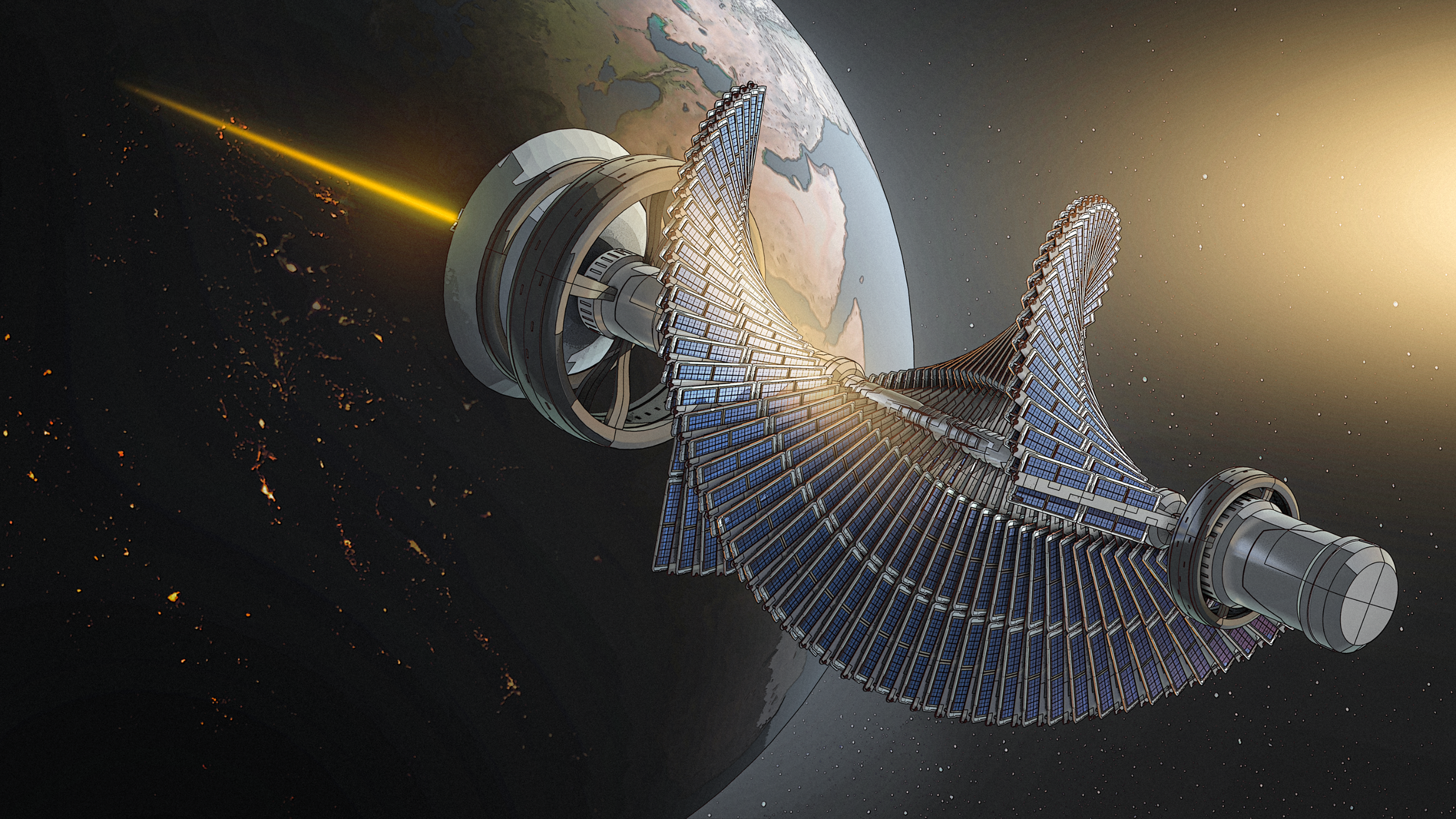
Imagine looking up at the night sky in 2050 and seeing the first constellations appear in perfect rows. The amber lights would not be stars, but vast satellite clusters harvesting sunlight before beaming energy back to Earth.
That vision may sound like science fiction because it began as one. Known as space-based solar power (SBSP), the concept featured prominently in the techno-utopian ideas of 20th-century writers and futurists. For decades, however, critics dismissed it as a pie-in-the-sky proposal.
Now, a new space race is prompting governments and private companies in China, the United States, the United Kingdom and Japan to reassess whether space solar power can work. Projects under development include China’s ZhuRi (“Chase the Sun”) program, Japan’s OHISAMA project, the U.K.’s Space Solar and power-beaming experiments led by Caltech and the Air Force Research Laboratory in the U.S. Several are targeting test launches within the next five years.
Supporters say SBSP could meet Earth’s energy needs many times over while causing relatively little environmental harm. Critics counter that the technology would be extraordinarily expensive, relies on untested assumptions and may be too complicated to deploy during the urgent transition to clean energy.
The basic challenges are formidable: launching enormous solar-panel-covered satellites, assembling them in orbit, keeping their panels pointed toward the sun, converting sunlight into a usable energy beam and transmitting that energy safely to receivers on Earth.
Yet researchers continue to return to the idea because the most important step—generating energy—is already being handled by the sun. Every second, our star fuses hydrogen atoms and releases energy equivalent to approximately nine trillion atomic bombs.
“We’re not a competitor to fusion. We are fusion,” Peter Garretson, the U.S. Air Force’s former chief of future technology and an SBSP expert, told Live Science.
From science fiction to a NASA proposal
The earliest ideas resembling space-based solar power can be traced to Russian rocket scientist and astronautics pioneer Konstantin Tsiolkovsky. In 1923, he suggested deploying mirrors in space that could concentrate sunlight toward Earth with enough intensity to boil 10 cups of coffee.
Tsiolkovsky’s proposal soon entered science fiction. In Olaf Stapledon’s 1937 novel Star Maker, an advanced alien civilization uses a “gauze of light traps” to focus escaping solar energy for intelligent use. The concept later became associated with theoretical physicist Freeman Dyson’s idea of a Dyson sphere.
Isaac Asimov offered one of the clearest early fictional depictions of SBSP in his 1941 short story “Reason.” In the story, robots work aboard a space station that collects sunlight and sends it to Earth as microwaves. Asimov focused less on the station’s engineering than on the robots’ religious worship of the vessel.
The transformation from fiction to an engineering proposal began in 1968. Aerospace engineer Peter Glaser, a consultant and project manager for the Apollo 11 mission’s distance-measuring laser reflectors, designed a “solar power satellite” with three central components: a solar-energy collector, a converter and a transmitter.
Glaser proposed placing a disk of photovoltaic panels approximately 22,400 miles (36,000 kilometers) above Earth in geostationary orbit. The satellite would receive near-constant sunlight, convert the energy into microwaves and beam it through the atmosphere to receiving antennas on the ground. Those antennas would then convert the microwaves into electricity for the grid.
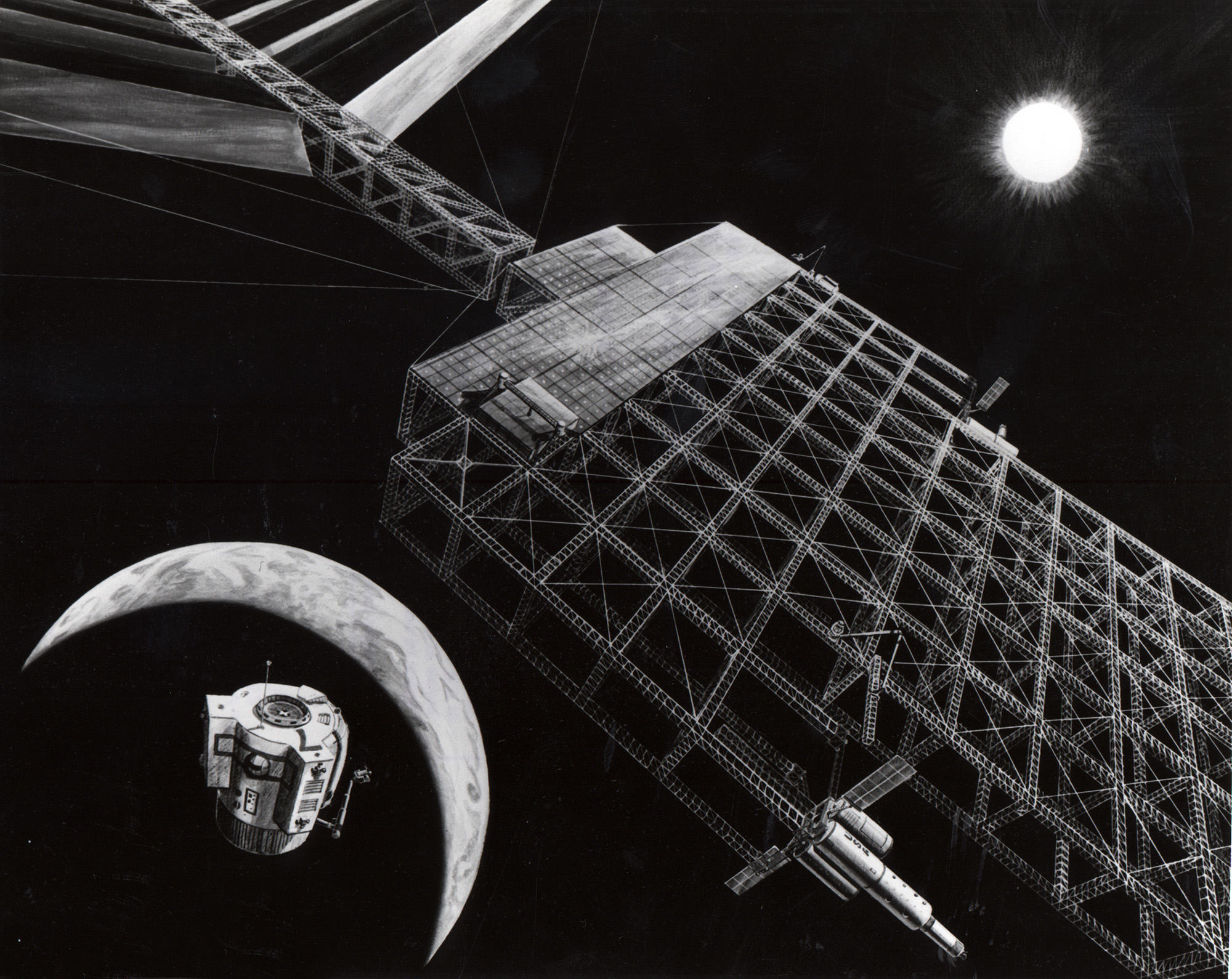
NASA awarded Glaser a contract to study the concept. Energy crises, including the 1973 oil crisis and the 1979 Three Mile Island nuclear accident, added momentum to the proposal.
But the design quickly ran into technical and financial roadblocks. Its sheer size was the most serious obstacle. A 1981 U.S. Department of Energy study estimated that a “meaningful” contribution of 300 gigawatts—enough to power hundreds of millions of homes—would require 60 satellites. Each satellite would span approximately 21 square miles (55 square kilometers) and weigh 50,000 tons (45,000 metric tons).
The plan was deemed unaffordable.
Later assessments suggested that advances in solar cells and other technologies could make SBSP more realistic. A 1997 report by NASA physicist John Mankins pointed to several improvements, but skepticism remained.
A 2015 report from the Strategic Studies Institute of the U.S. Army War College concluded that SBSP systems were technically feasible but found “no compelling evidence” that they would be economically competitive with terrestrial power systems. The report noted that advocates often described the technology as being only 10 years away.
Why space-based solar power is being reconsidered
A great deal can change in a decade, including the cost of launching rockets into orbit.
Since the 2015 assessment, SpaceX’s reusable Falcon 9 rocket has reduced launch costs to approximately 30 times less than those of NASA’s Space Shuttle, according to a cited financial analysis. Satellites have also become cheaper as manufacturers adopt mass production and improve clean-room facilities. SpaceX’s larger Starship rocket could further reduce costs by carrying more than five times the payload of a Falcon 9.
“What you have is a cadre of people in the space community that have grown up before Starlink and SpaceX,” Garretson said. “They literally could not believe that, as your launch rate goes up and you amortize your costs, [the launch cost] approaches the cost of fuel.”
Lower launch costs have encouraged new studies. A 2021 assessment commissioned by the U.K. government estimated that a 2-gigawatt, mile-wide space-based solar power array would cost 17.3 billion British pounds, or approximately $23.4 billion, and generate electricity at 50 British pounds, or $68, per megawatt-hour over its century-long lifetime.
The assessment described the output as comparable to that of a large power station in the U.K. It estimated that the initial costs could be 39% to 49% lower than those of biomass, nuclear power or the most efficient gas energy sources. However, SBSP remained 14% to 52% more expensive than terrestrial wind and solar power.
One potential advantage is flexibility. Energy beamed from space could theoretically reach remote locations that lack suitable land for large renewable-energy installations.
Based on the findings, the U.K. government awarded 4.3 million British pounds, or approximately $5.8 million, in seed funding in 2023 to companies and universities working to advance SBSP.
How the CASSIOPeiA solar satellite would work
The U.K. assessment selected CASSIOPeiA as its reference design. Developed by U.K. company Space Solar, the concept is intended to solve one of the biggest problems facing solar satellites: keeping the panels aligned with the sun to maximize energy collection.
Other designs, including China’s Multi-Rotary Joint Solar Power Satellite and John Mankins’ SPS-ALPHA, would rotate solar panels or use mirrors to redirect sunlight. CASSIOPeiA instead resembles a gigantic DNA strand. Its shape, combined with a sun-synchronous orbit and a slow spin, is intended to allow the satellite to receive and transmit solar energy without heavy, failure-prone moving parts.
Space Solar says a single CASSIOPeiA satellite would be approximately 1 mile (1.6 kilometers) in diameter and could beam as much as 2 gigawatts of continuous power to a fixed point on Earth—enough to supply a city of about 2 million people.
The company also argues that a solar station in orbit could operate more efficiently than solar panels on the ground because sunlight reaching the satellite would not be scattered or weakened by Earth’s atmosphere.
“You use a lot less materials compared with terrestrial solar, and you utilize them more,” Sam Adlen, Space Solar’s co-founder and co-CEO, told Live Science. “So it’s 100% utilized in space rather than 10% if you’re on the ground—and you’ve got 13 times more instant energy, so you’re getting much more out of the materials.”
Beaming electricity from orbit to Earth
The next major challenge is transmitting gigawatts of energy across tens of miles of atmosphere, including through potential cloud cover.
Proposed power-beaming systems generally fall into two categories: lasers and microwaves.
Lasers could transmit energy precisely—but struggle with clouds
California-based startup Aetherflux is developing an infrared laser system designed to transmit power from satellites in low Earth orbit. Its demonstration satellite is intended to test the technology at approximately 1 kilowatt, enough to supply the basic electrical needs of a household.
Lasers and other optical beams can travel long distances with high precision. However, infrared and near-infrared beams can be scattered by water droplets in the atmosphere, making power transmission difficult or impossible on cloudy days.
Efficiency problems also become more serious at gigawatt power levels. Although laser power beaming may be useful for certain applications, these limitations make it less practical for utility-scale energy transmission.
Microwaves can handle clouds but require enormous receivers
Microwaves can operate at frequencies capable of carrying much higher power and generally experience less atmospheric attenuation. That is why Space Solar, Japan’s OHISAMA project and China’s ZhuRi program plan to use microwave-beaming systems.
Microwaves have longer wavelengths than lasers, however, so their beams spread more widely over long distances. Even transmitters hundreds of meters wide could require receiving antennas covering dozens of square miles on Earth.
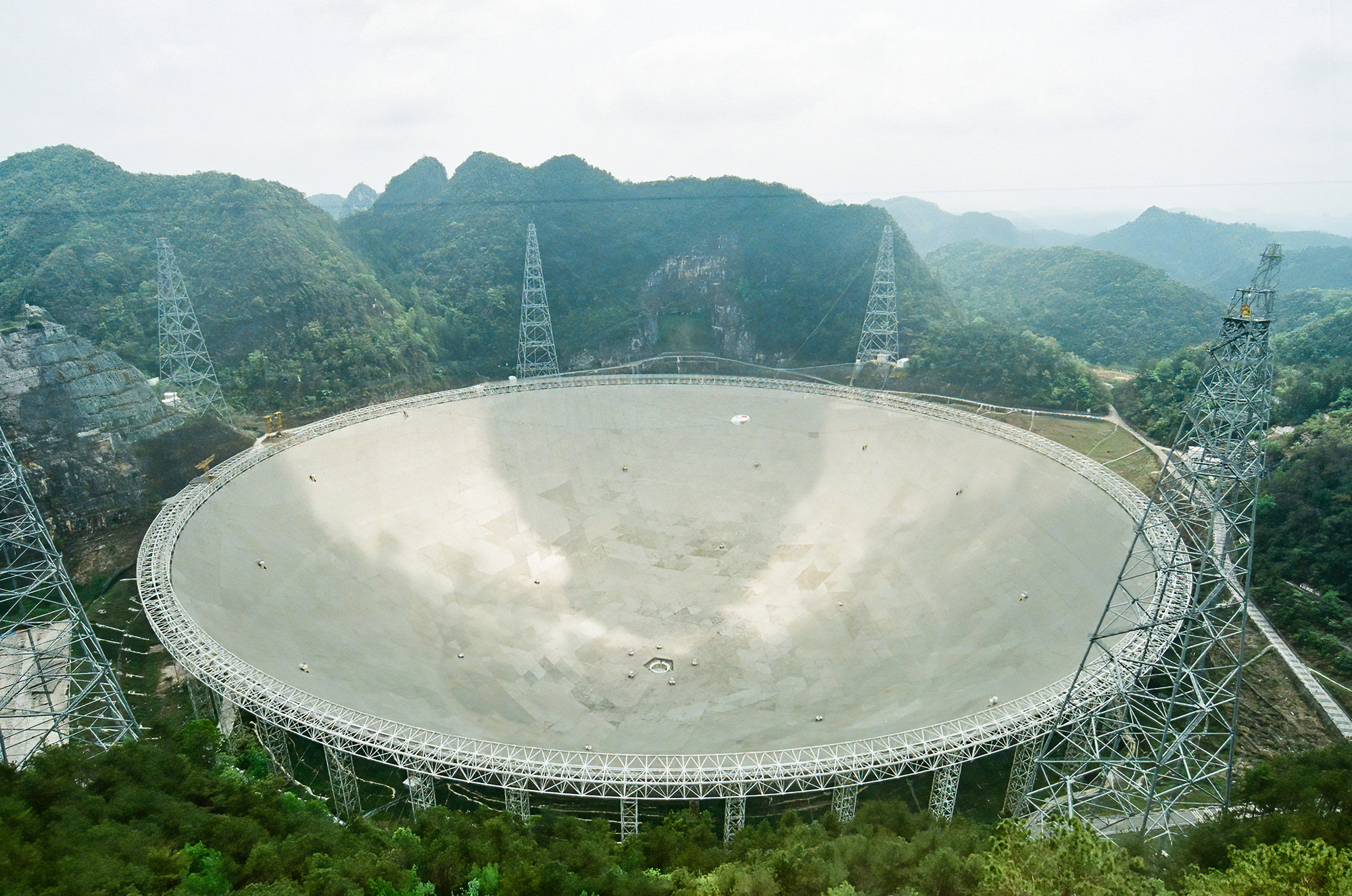
These limitations mean that gigawatt-scale power beaming is still many years away, according to Remo Proietti Zaccaria, head of the DELTA Lab at the Italian Institute of Technology.
Greater transmission efficiency would also create safety concerns. Even battery-powered laser pointers can blind or burn, so laser-based SBSP systems would need safeguards capable of shutting down the beam if an aircraft or another object crossed between the transmitter and receiver.
Power-beaming systems could also have military applications. A laser or microwave beam may not be powerful enough to destroy an object or boil an egg, but it could potentially disrupt communications and disable electronics.
“If you throw even that amount of intensity of power to our antennas, you’re going to freeze the electronics; that’s for sure,” Proietti Zaccaria said. “It’s not necessary to destroy them. As long as you freeze the electronics, you’ve done the job.”
Space mirrors could extend daylight
The difficulties of transmitting electricity have encouraged some engineers to consider simpler concepts. One proposal would use mirrors in orbit to reflect sunlight toward Earth after sunset.
A single space-based reflector could extend the daylight reaching solar panels by approximately 20 minutes. Multiple reflectors could potentially extend that period to as much as two hours, depending on their arrangement and altitude.
“The sunlight that you deliver, if it all turns into electricity, could power thousands of homes,” Onur Celik, a space-technology researcher at the University of Glasgow, told Live Science.
Is space-based solar power cheaper than Earth-based solar?
The central question is whether SBSP can produce electricity more cheaply and efficiently than renewable-energy systems on Earth.
The median cost estimated by the U.K. government was 50 British pounds per megawatt-hour, or approximately $68. That figure is broadly comparable with offshore wind and terrestrial solar power.
NASA’s 2024 cost report was far less optimistic. Depending on the satellite design, NASA estimated that SBSP could produce electricity at between $610 and $1,590 per megawatt-hour. NASA concluded that the U.K. government’s lower estimate would be achievable only after substantial future reductions in launch and manufacturing costs.
Independent studies have reached widely different conclusions. One assessment suggested that SBSP could reduce Europe’s need for land-based renewable energy by up to 80%. Another estimated that space-based systems could cost 12 to 80 times more than terrestrial alternatives.
A study published in Acta Astronautica estimated that SBSP could contribute between 3% and 31% of global electricity demand, depending on limitations such as the number of satellites that could safely occupy an orbit, the size of receiving antennas and where the energy could be delivered.
“For the numbers we found, I don’t believe that this technology could actually be employed to generate energy for Earth,” Proietti Zaccaria, a co-author of the study, said. He suggested that SBSP might become more attractive if humanity eventually used all available land for solar panels, but that terrestrial solar is currently far cheaper and easier to install.
He sees potential uses for SBSP in future missions to the moon or Mars, where delivering energy from Earth would be difficult.
Orbital construction and environmental concerns
Building space-based solar power systems would require transporting raw materials into orbit and assembling massive structures in space. That could make constructing the International Space Station—the most complex structure ever built in orbit—seem relatively simple.
Operators would also need to maintain the arrays and prevent them from colliding with other satellites in increasingly crowded orbits.
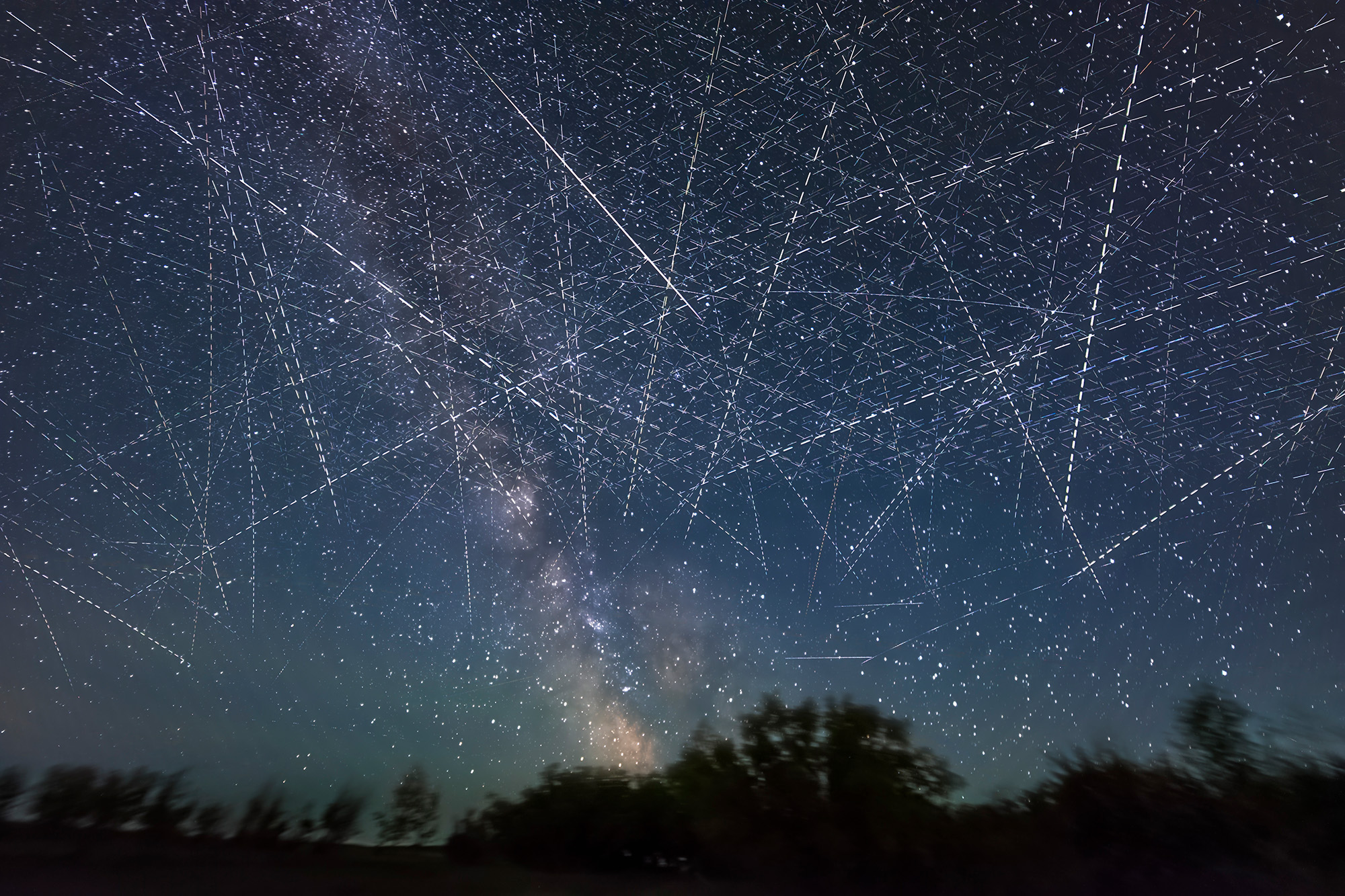
Large-scale SBSP would also have environmental costs that remain uncertain. Modern rockets use methane, a potent greenhouse gas, and release much of it into Earth’s upper atmosphere, where its effects can be especially significant.
“Clearly, there is a question there on how launching 100,000 of these superheavy vehicles into the atmosphere will actually impact the atmosphere itself, as opposed to the benefit that we get in the next 20 years or so from having solar power from space,” Matteo Ceriotti, a senior lecturer in space systems engineering at the University of Glasgow, told Live Science.
Because the technology has never been deployed at this scale, Ceriotti said the most likely path forward is for smaller companies to conduct proof-of-concept tests and gradually refine the systems.
“Obviously, it’s not something that we have ever done,” he said. “So clearly, we need to start somewhere, and we need to start small.”
Could space solar power become a reality?
Supporters of SBSP point to technologies such as personal computers and reusable rockets that were once considered impossibly expensive or unrealistic but later became widely available.
Companies including Space Solar, Reflect Orbital, Aetherflux and Virtus Solis are pursuing demonstration missions over the next several years. If those missions succeed, they could show whether power collection, wireless transmission, satellite assembly and orbital maintenance can work beyond small-scale experiments.
“The private sector is good at this, because it has to be,” said Sanjay Vijendran, an SBSP consultant who led the European Space Agency’s now-shuttered SOLARIS project. “It can break the problem down to quite a small level and start to do things with today’s technology and today’s way of doing things, and start to show that this can be valuable.”
For now, space-based solar power remains caught between promise and practicality. The sun provides more than enough energy, and lower launch costs are making ambitious satellite designs more plausible. But the economics, environmental impact, orbital construction challenges, power-beaming technology and safety risks have yet to be resolved.
The next few demonstration missions may determine whether SBSP remains a futuristic concept—or becomes a new way to generate electricity on Earth.
Topics
Source: www.livescience.com