


‘Blackzilla’ Crayfish Discovery Reveals Possible Size Limit for North American Crayfish
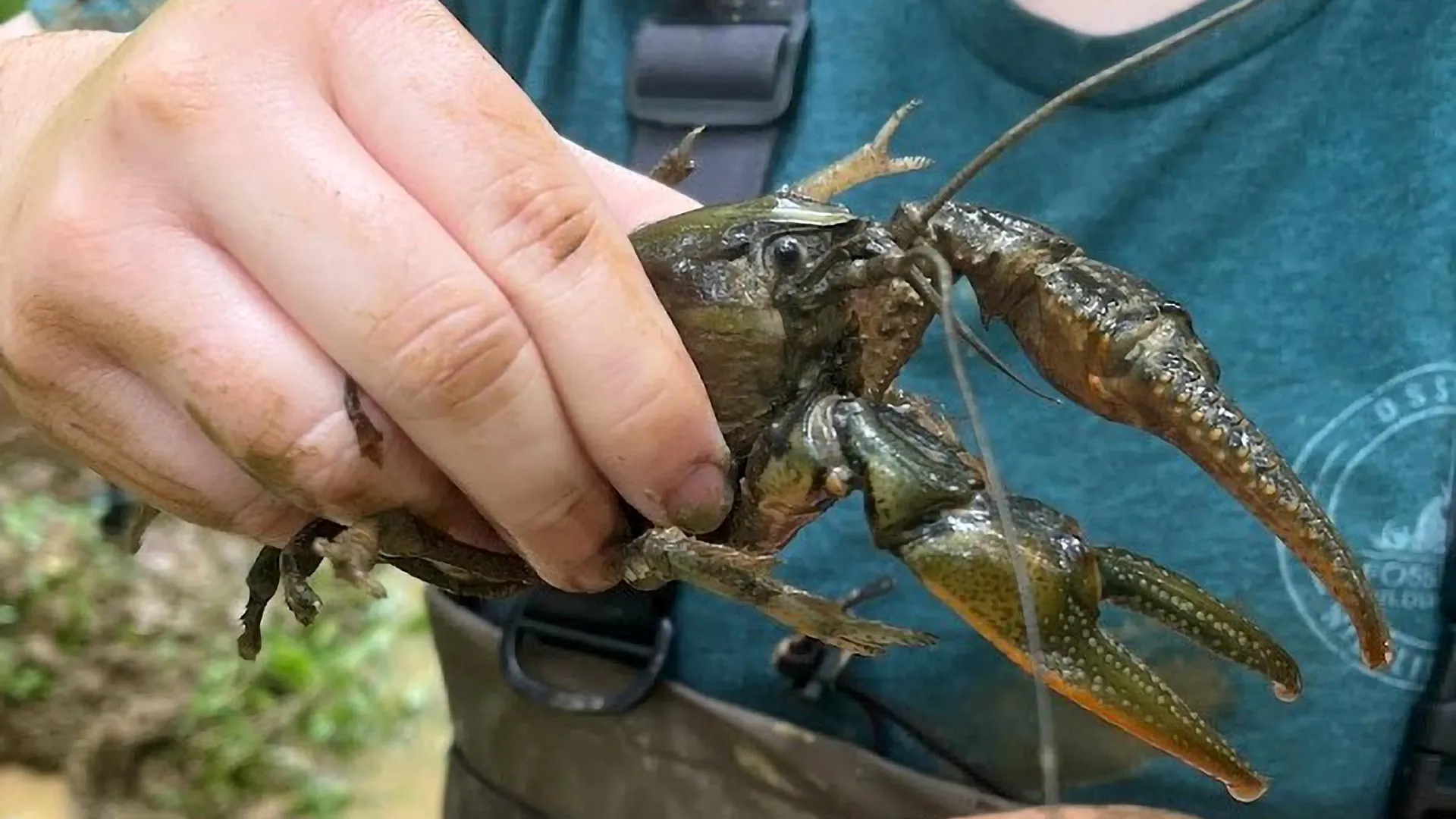
A giant crayfish nicknamed “Blackzilla” has helped scientists uncover a possible biological limit on how large North American crayfish can grow.
The discovery began when Caitlin Bloomer pulled a giant black-headed crayfish from the mud during a biological survey in Kentucky. “Black crawfish” is the creature’s common name, and Bloomer initially believed she had caught the largest crayfish ever recorded.
When she brought the specimen back to campus and showed it to her colleagues, however, one biologist quickly challenged that assumption.
“I thought, ‘There’s no question that I caught the biggest crawfish anyone has ever seen!’ I took it back to campus and showed it to my colleagues, and of course I bragged that I had caught the biggest crawfish ever,” said Bloomer, an assistant professor in the Department of Natural Resources and Environmental Sciences at the University of Illinois Urbana-Champaign.
“But like any biologist or sports fisher, he took one look and said, ‘Holy cow, I caught something bigger.’”
A nationwide search for North America’s largest crayfish
What started as friendly competition soon became a nationwide search for record-size crayfish. Bloomer contacted biologists and museum curators across the United States and asked them to examine their collections for unusually large specimens.
The researchers measured preserved crayfish with calipers, instruments designed to measure objects with high precision. Their search identified 20 exceptionally large individuals representing 18 different species. The findings were published in the scientific journal Ecology.
Although Bloomer’s original “Crawzilla” did not claim the top spot, it still ranked among the largest confirmed crayfish specimens in the study.
“My work wasn’t the biggest, but it was in the top 20, so I’m very proud of it,” Bloomer said. “And I was also the only burrowing crayfish on the list, so I win.”
Scientists identify the largest known North American crayfish
The largest specimen was a Tennessee brassy crayfish preserved in the collections of West Liberty University in West Virginia. Excluding its tail, claws and antennae, the crayfish had a body length of 86.6 millimeters, or about 3.4 inches.
The record-setting crayfish was not recently caught. Dr. Zach Ruffman and students at West Liberty University collected it in 2011. Researchers discovered its significance by examining specimens already preserved in a museum collection.
“I knew there were giant crayfish in the West Liberty University Asterology Collection, but I was surprised to learn that they housed the two largest specimens known in North America,” said Zachary Graham, an assistant professor of biology at West Liberty University.
“Our record holder, the Tennessee brassy crawfish collected by students, shows just how amazing and diverse crawfish are. Their carapace alone is as long as a credit card, and the tail and claws together are nearly the width of a sheet of notebook paper. Both of these giants are now proudly displayed in my office, visible to almost everyone who enters.”
Other institutions also contributed impressive specimens. The Illinois Natural History Survey, part of the University of Illinois Prairie Research Institute, accounted for six of the 20 largest crayfish. The Smithsonian Institution’s National Museum of Natural History contributed four more.
Why don’t North American crayfish grow even bigger?
The study did more than identify exceptionally large crayfish. It also provided some of the first estimates of the upper size limit for North American crayfish.
Despite differences in species and habitat, the measurements showed that the largest individuals generally reached around 80 millimeters. That raised a key question: Why do North American crayfish appear to stop growing at roughly this size when other species, including the Tasmanian giant freshwater crayfish, can become dramatically larger?
“They all seemed to max out around that 80-millimeter mark, but we didn’t know why, especially considering there are absolutely giant crayfish in other parts of the world,” Bloomer said.
The researchers examined whether latitude, oxygen availability or habitat type could explain differences in maximum body size. None of these factors showed a clear relationship with how large the crayfish grew.
That unexpected result led the scientists to consider another possibility: crayfish size may be limited less by environmental conditions and more by the animals’ own ecology and biology.
One possible explanation involves the exoskeleton, the hard outer covering that protects a crayfish’s body. Differences in shell structure and muscle anatomy could create physical limits on how large North American crayfish can become.
For now, that explanation remains a hypothesis. Additional research will be needed to determine whether these biological characteristics truly restrict crayfish growth.
“This is a case where we found something unusual in the field, and that sparked future research directions,” Bloomer said. “We think it would be very valuable to look at the physiology of crayfish to see if anything is affecting their body size.”
Giant crayfish show how much scientists still have to learn
Crayfish commonly live in streams, rivers and other freshwater environments. For many people, catching crayfish as children is an early introduction to aquatic life, making them among North America’s most familiar freshwater animals.
Yet scientists are still uncovering basic information about their biology, including how large they can grow and what determines their maximum body size.
“Anyone who’s been to a river as a child knows what a crawfish is. Crayfish are almost universal training for people interested in aquatic life,” Bloomer said. “I still deal with people in their 50s and 60s who remember catching crawfish in a stream when they were 7 years old. It’s amazing how much we still have to learn about them.”
Bloomer also emphasized that the research would not have been possible without museum collections. By comparing specimens preserved over many years, scientists were able to investigate fundamental questions that would have been difficult to answer through fieldwork alone.
What began with an unusually large crayfish and a disagreement between colleagues has opened the door to new research into the biological factors that determine the size of North America’s familiar freshwater crustaceans.
Source: www.sciencedaily.com