


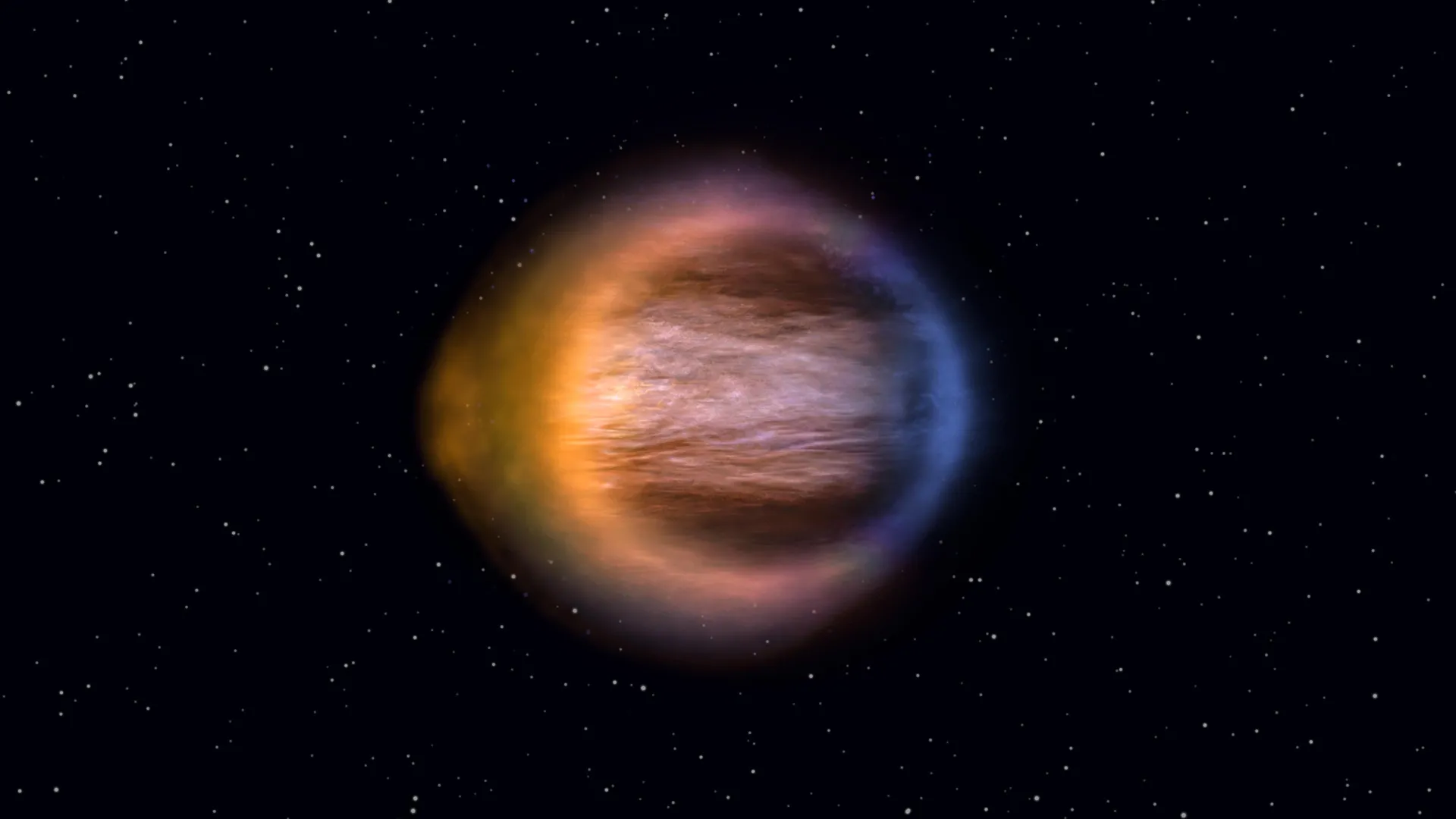
James Webb Telescope Reveals a Lopsided Atmosphere on Alien Planet WASP-17b
Astronomers have long depicted distant exoplanets as smooth, circular worlds. New observations from NASA’s James Webb Space Telescope (JWST), however, reveal that the atmospheres surrounding some scorching alien planets can be surprisingly uneven in shape.
Researchers discovered that one side of the atmosphere surrounding WASP-17b, a giant planet about 1,300 light-years from Earth, extends farther outward than the other. Although the planet’s overall outline remains roughly circular, its atmosphere is noticeably asymmetrical.
The finding provides new evidence of how extreme temperatures and powerful winds reshape the atmospheres of distant planets. The study was conducted jointly by Cornell University in the United States and the University of Bristol in the United Kingdom.
The researchers investigated WASP-17b’s atmosphere in unprecedented detail using an innovative technique called a transmission string, developed by Bristol astrophysicists Dr. David Grant and Dr. Hannah Wakeford.
James Webb reveals the 3D structure of an alien atmosphere
WASP-17b belongs to a class of planets known as “hot Jupiters”—large gas giants that orbit close to their host stars and experience intense heating. Its unusual atmospheric shape offers new insight into how heat moves through these extreme worlds.
Lead author Dr. Lili Alderson, a Claman postdoctoral fellow at Cornell University, began the research while attending the University of Bristol, where she earned a PhD in physics.
“This is a proof of concept that planets are actually 3D objects, and as they orbit around stars, what we predict should happen is consistently happening. Beyond a computational exercise, actually seeing it is another matter.”
The observations provide information about changes in the chemistry and temperature of WASP-17b’s atmosphere, differences between its equator and poles, and contrasts between its permanently illuminated and dark hemispheres.
The results are broadly consistent with earlier theoretical predictions and computer models. Together, they provide one of the most detailed three-dimensional views of an exoplanet’s atmosphere ever created and establish a useful reference point for studying the more than 6,000 exoplanets identified to date.
Co-author Dr. Hannah Wakeford, associate professor of astrophysics at the University of Bristol, said:
“Planets are fickle and their atmospheres are complex and chaotic. The fact that all these numbers came together to show us a highly structured and dynamic picture of this huge world more than 1,000 light-years away was really exciting.”
New JWST technique reveals hidden atmospheric features
James Webb’s extraordinary sensitivity has already enabled scientists to study alien atmospheres using a method called eclipse mapping. This approach examines subtle changes in light as a planet moves behind its parent star, helping researchers determine how conditions vary across the planet.
The new transmission string technique, also known as transit mapping, examines the opposite part of a planet’s orbit. When an exoplanet passes in front of its star, some of the star’s light travels through the outer edge of the planet’s atmosphere before reaching the telescope.
By analyzing that light from different angles, scientists can study the atmosphere’s composition and determine how far it extends in different regions. This outer atmospheric boundary is known as the rim.
Traditional methods typically combine light measurements from the entire limb of a planet into a single average spectrum. The new approach instead separates information from different regions, allowing researchers to identify atmospheric variations that would otherwise remain hidden.
“Rather than assuming that the atmosphere is a circle with the same radius all around, our technique allows us to derive different distances from the center of the planet to the edge,” Alderson said. “We were able to get around the edges, so to speak. We were able to understand from the ring where the gemstone was in the ring.”
Powerful winds create WASP-17b’s lopsided atmosphere
The new measurements reveal a particularly interesting feature near WASP-17b’s equator, exactly where previous models predicted it would appear.
The distortion occurs on the planet’s “evening” side. Powerful atmospheric winds permanently transport heat away from the hemisphere facing the star toward the hemisphere trapped in darkness.
This movement of hot gases causes the atmosphere on the evening side to expand farther outward than the cooler “morning” side. As a result, the contours of WASP-17b’s atmosphere are not perfectly symmetrical.
The finding supports predictions about temperature differences between the planet’s morning and evening regions. The transmission mapping measurements also support other previously identified properties of WASP-17b.
Dr. Alderson added:
“The theory is that there should be a large temperature difference between the morning and evening sides, and WASP-17b fits that trend very well, pretty much in line with what we expected.”
JWST technology could map weather on distant planets
The successful application of the transmission string technique to WASP-17b indicates that it could be used to study the atmospheres of many other exoplanets.
Until recently, much of what astronomers could determine about distant atmospheres came from measurements averaged over large areas. This new method offers a way to distinguish conditions at different latitudes and between the day and night sides of a planet.
Ultimately, the approach could help scientists probe smaller-scale atmospheric structures and bring them closer to mapping global weather patterns far beyond our solar system.
Dr. Wakeford said:
“It’s incredibly exciting to have such a robust mathematical model that can be applied to this cutting-edge data. The results really beautifully illustrate the dynamics that are happening in these multidimensional and multifaceted worlds.”
This study used observations collected by JWST scientists through the Deep Reconnaissance of Exoplanet Atmospheres by Multi-Instrument Spectroscopy (TST DREAMS) Guaranteed Time Observation program.
Funding was provided by NASA, the UK Research and Innovation (UKRI) Science and Technology Facilities Council (STFC), and a Klarman Fellowship.
Source: www.sciencedaily.com