


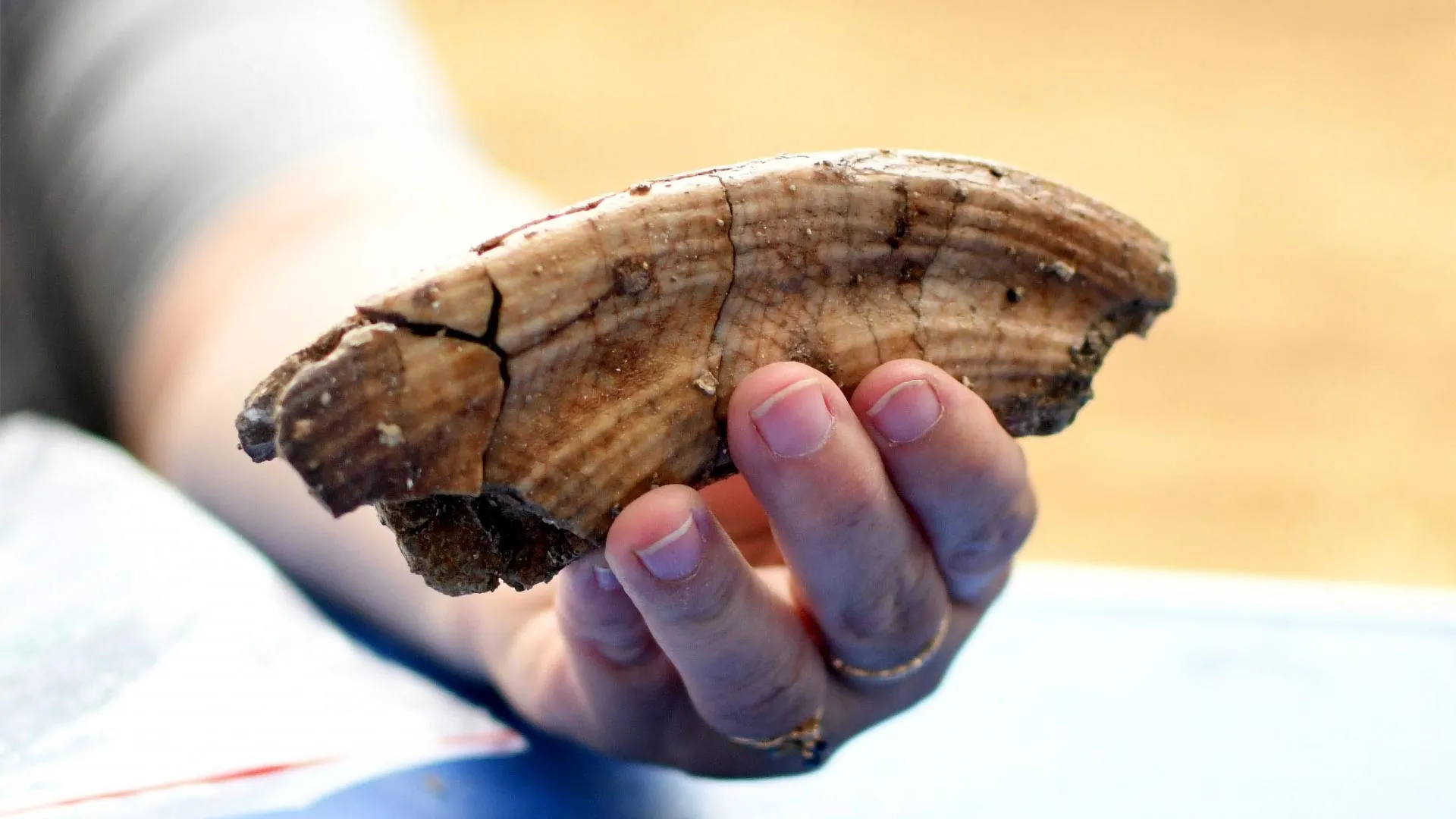
New dating of the Ubaydiya archaeological site in the Jordan Valley indicates that it is at least 1.9 million years old, hundreds of thousands of years older than previous estimates. The revised chronology places Ubaydiya among the oldest known sites of early human activity outside Africa, alongside Dmanisi in Georgia, and suggests that groups using different stone-tool traditions were already moving into the Levant during an important early phase of human expansion.
The study was led by Professor Ali Matmon of the Hebrew University of Jerusalem, Professor Omri Barzilai of the University of Haifa, and Professor Miriam Bellmaker of the University of Tulsa. The researchers combined three dating methods to establish a more reliable chronology for Ubaydiya, a site that has played an important role in the study of human evolution.
Stone tools and fossils record early human activity
The Ubaydiya Formation has attracted scientific attention for decades because it contains early evidence of the Acheulean stone-tool tradition. This technology is characterized by large, deliberately shaped tools with bilateral symmetry, including handaxes. The site also contains a rich collection of animal fossils representing species associated with Africa and Asia, some of which are now extinct.
Despite the site’s importance, researchers had struggled to determine when early humans occupied the area. Earlier estimates generally placed Ubaydiya between 1.2 million and 1.6 million years old, but those estimates were based on comparisons with other archaeological and geological evidence rather than direct measurements.
To address the uncertainty, the researchers collected new samples and analyzed them using three complementary dating techniques. Each method provided independent evidence about the age of the deposits.
The first method, cosmogenic isotope burial dating, relies on rare isotopes produced when cosmic rays interact with rocks exposed at Earth’s surface. Once a rock is buried, the isotopes decay at a known rate. Measuring the remaining isotopes allows scientists to estimate how long the rock has been underground.
The team also examined the record of Earth’s ancient magnetic field preserved in sediments deposited at the bottom of the lake. As the sediments accumulated, they recorded the direction of the magnetic field at that time. Comparing the record with known magnetic reversals indicated that the deposits formed during the Matsuyama period, which began more than 2 million years ago.
For the third method, the researchers analyzed fossilized shells of Melanopsis, a freshwater snail found in the sediments. Uranium-lead dating of the shells established a minimum age for the strata containing the stone tools.
Together, the methods indicated that Ubaydiya was substantially older than previous estimates suggested.
A revised timeline for migration beyond Africa
The combined evidence indicates that “Ubaydiya dates back at least 1.9 million years and significantly altered the timeline of early human settlements beyond Africa.”
This places the Jordan Valley site at approximately the same age as Dmanisi in Georgia, another important site for understanding early human migration. Their similar ages suggest that ancient human populations were expanding into different regions during the same broad period.
The findings also raise questions about how these migrations unfolded. Evidence from the two sites suggests that different groups of ancient humans may have carried distinct stone-tool technologies out of Africa during overlapping periods.
These technologies include the Oldowan tradition, associated with relatively simple stone tools, and the more sophisticated Acheulean tradition, known for carefully shaped tools such as handaxes. The different approaches may not have spread as a single technological sequence. Instead, they may have been transmitted across Africa at roughly the same time that separate groups of early humans entered new environments.
Explaining the 3-million-year-old dating signal
The researchers also had to account for an apparent conflict in the results. Initial cosmogenic-isotope measurements suggested that some rocks were about 3 million years old, significantly older than the ages indicated by the site’s magnetic, fossil, geological, and archaeological evidence.
Further investigation showed that the discrepancy resulted from the complex history of the sediments. Material in the area had been deposited, buried, exposed, and moved within the Dead Sea fissure and the surrounding landscape. Some of it had been buried long before it was transported and redeposited near the ancient lake at Ubaydiya.
This recycling meant that the geological history recorded by an individual rock extended much farther into the past than the archaeological layer itself.
The researchers explain:
“The exposure-build history revealed by the model suggests recycling of sediments that were previously deposited and buried in the rift valley and then redeposited along the Ubaydiya paleolake shoreline.”
Accounting for this complex depositional history allowed the team to reconcile the conflicting measurements and strengthened the evidence for Ubaydiya’s revised age.
The results establish Ubaydiya as one of the oldest known centers of early human activity outside Africa. They also indicate that the movement of ancient human relatives into new environments was already underway at least 1.9 million years ago and may have involved multiple groups with different tool-making traditions.
Source: www.sciencedaily.com