


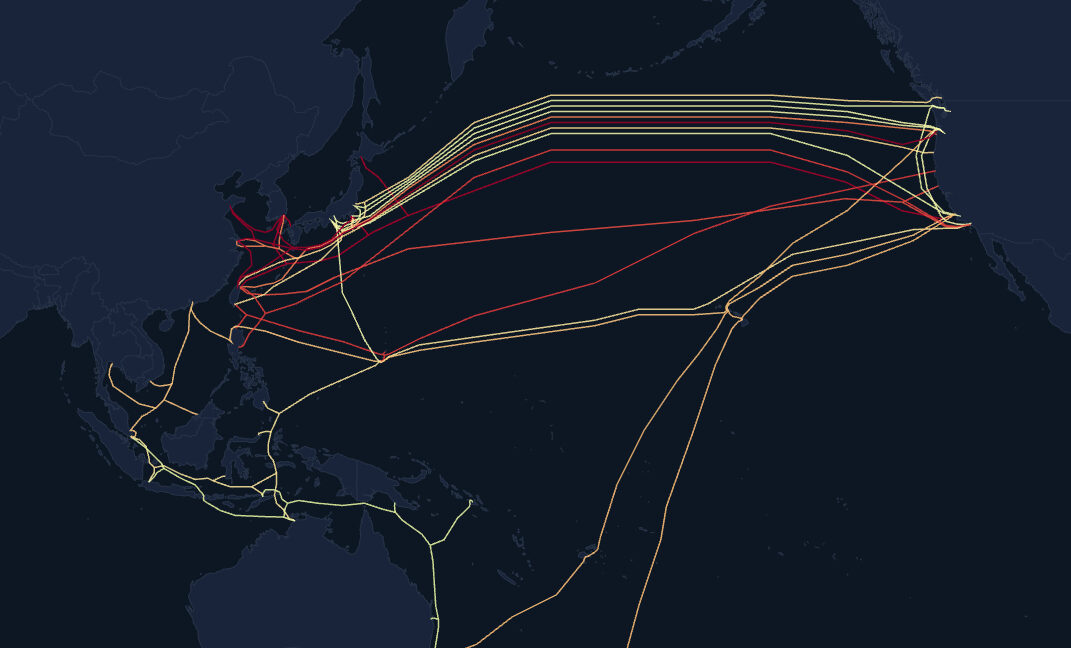
An index identifies undersea cables around Taiwan, Japan, and the Philippines as among the most vulnerable trans-Pacific links, with risks driven by geopolitical tensions, shallow waters, and heavy shipping traffic. The report warns that failure of one cable could severely reduce direct connectivity between the United States and the Indo-Pacific, while a broader disruption could overwhelm available trans-Pacific capacity and affect internet communications, cloud services, and financial transactions.
The risks are highest around Taiwan, Japan, and the Philippines. This is partly because of China’s sovereignty claims over Taiwan, but also because undersea cables linking the region to the United States must cross shallow waters along busy shipping lanes.
Several of the 10 trans-Pacific cables identified as most at risk are still under development and have significant ownership by US companies. They include the TPU project, owned by Google; the ORCA cable, owned by Meta; and the E2A cable, jointly owned by Verizon and companies from Japan, South Korea, and Taiwan. All three projects ranked among the five highest-risk systems in the index.
The report’s authors warned that a major failure involving a single trans-Pacific cable would “devastate the capacity currently available for direct routing between the United States, Taiwan, Japan, and the Philippines, and risk sending data down slower, less direct routes.”
A larger disruption involving multiple cables during a geopolitical crisis involving Taiwan could force communications between the United States and the Indo-Pacific region to travel through other cables around the world. That could “drastically reduc[e] headroom and even overwhelm[] the entire trans-Pacific capacity,” the authors said. The consequences could extend to internet communications, cloud services, and financial transactions.
Dual-use technology and research vessels
The findings come as major powers continue expanding their fleets of military submarines and undersea drones. They are also developing and deploying dual-use technologies, including undersea cable cutters that can be used for both repair and sabotage.
China has also deployed a research fleet equipped with undersea mapping technology near an undersea cable crossing the Pacific Ocean, according to one report.
A separate report from the Center for Strategic and International Studies (CSIS), a Washington, DC-based think tank, was published in October 2026.
Source: arstechnica.com