


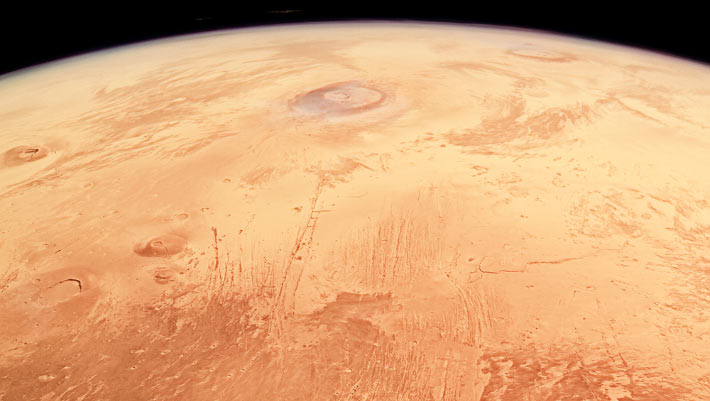
Hydrogen chloride (HCl) detected in Mars’ atmosphere during the planet’s cold aphelion season may be evidence that its interior is still geologically active. Researchers propose that volcanic or magmatic processes could be supplying chlorine to the atmosphere through fractures near the Alba Mountains, although the seasonal HCl release is not thought to come directly from the volcano.
Mars is widely thought to be volcanically quiet, but chemical signals in its thin atmosphere suggest that the planet’s interior may not be completely dormant.
“On Mars, as on Earth, the chlorine cycle started by volcanic degassing from the deep interior during planetary accretion is fed by subsequent volcanic eruptions, and due to its high mobility and solubility, chlorine is continuously recycled in water, sediments, permafrost, and ice clouds,” said University of Bern researcher Nicholas Thomas and colleagues.
“However, in contrast to Earth, the lack of recycling by plate tectonics means that the main inputs to Mars’ surface atmospheric system may be volcanic sources.”
“The question addressed here is whether volcanic activity still contributes to this cycle on Mars today.”
Hydrogen chloride near the Alba Mountains
The researchers analyzed data from the Atmospheric Chemistry Suite aboard ESA’s Trace Gas Explorer and detected hydrogen chloride at parts-per-billion concentrations in the Martian atmosphere.
Higher-than-expected concentrations were recorded during the cold aphelion season near the Alba Mountains. The team also examined high-resolution images from the HiRISE, CaSSIS, and CTX cameras covering the area below the detection site.
They identified narrow cracks, some only tens of centimeters wide, as well as clusters of cracks extending for tens of kilometers along topographic ridges. The researchers say these features have not previously been observed on Mars and are consistent with large-scale tectonic and volcanic activity in the region.
They propose that the cracks could provide pathways for hydrogen chloride to rise from deep magma bodies, potentially after interacting with ice-rich permafrost.
Such a system would not necessarily produce a substantial thermal signature, which could explain why heat-based searches for active volcanic activity have not detected it.
Possible volcanic source
Assuming that hydrogen chloride remains in the atmosphere for one sol, the authors estimate a permeation rate of less than 3 kilograms per second. This is comparable to the lower end of estimated surface volcanic fluxes, which range from a few kilograms per second to more than 100 kilograms per second.
The researchers estimate that the seasonal hydrogen chloride release at perihelion—approximately 180 kilograms per second—is not directly caused by the volcano. However, they suggest that some of the chlorine may ultimately have an igneous origin, cycling between the atmosphere and surface reservoirs such as perchlorates and ice.
“Overall, the presence and variability of hydrogen chloride in the Martian atmosphere appears to be controlled by interactions between episodic volcanic activity, atmospheric processing, and long-term sequestration in surface salts, perchlorates, and hydrogen chloride-containing ice,” the researchers said.
The study was published in Science Advances.
Alexander Trokhimovsky et al. 2026. “Mysterious HCl detection as a potential sign of Martian magmatism.” Science Advances 12(45). doi: 10.1126/sciadv.aeb9422
Source: www.sci.news