


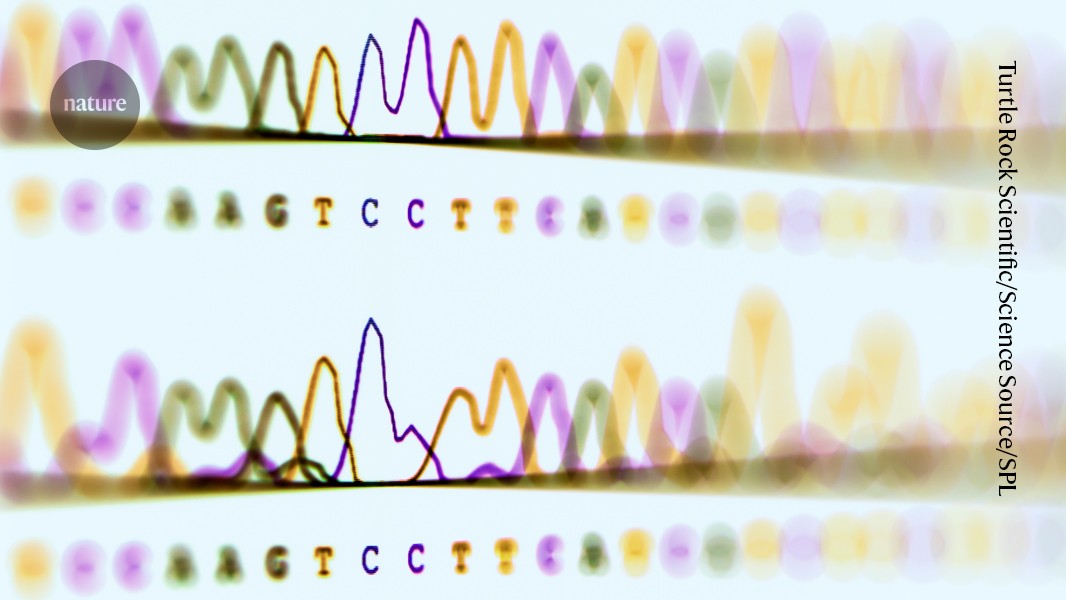
The self-driving research laboratory, named AutoDNA, can analyze the “letters” that make up DNA fragments. Credit: Turtle Rock Science/Science Source/Science Photo Library
Researchers at Shanghai Jiao Tong University in China have built a molecular-biology laboratory in which artificial-intelligence agents design and conduct experiments with minimal human involvement. The robotic system, called AutoDNA, can operate more than 20 types of laboratory equipment, carry out thousands of procedures in a single project and perform tasks including DNA synthesis and sequencing.

Inside the ‘self-driving’ lab revolution
The facility described today in Nature1 is among the latest efforts to create a “self-driving” laboratory guided by AI. Human operators provide simple prompts, after which a team of AI agents designs and runs experiments from beginning to end. People are needed mainly to replenish reagents and maintain the hardware.
AutoDNA’s level of autonomy, as well as its ability to incorporate different kinds of laboratory equipment, is notable, says Milad Abolhassani, a chemical engineer at North Carolina State University in Raleigh. “The future of science will involve many autonomous laboratories.”
On autopilot
Laboratories have used automation for years to handle parts of experimental procedures, such as mixing and heating chemicals. Researchers are now seeking to combine these systems with increasingly capable AI tools to create laboratories that can design and run complex experiments, troubleshoot problems, refine protocols and coordinate work across a wide range of instruments.
Developing such a system for molecular biology is particularly challenging, says Haibo Chen, a computer scientist at Shanghai Jiao Tong University and a co-author of the report. The field involves complex workflows, many types of equipment and a high degree of precision.
“Many existing systems still require a human expert to configure the equipment,” Chen says. “AI is almost always added to handle only part of the process.”
To create a more autonomous laboratory, Chen and his colleagues designed AutoDNA around AI from the outset instead of adding AI capabilities to an existing system.
Encoding a genetic message
The researchers tested AutoDNA on several projects, including the detection of cancer-related mutations in DNA samples. In another experiment, they instructed the system to encode a message in DNA using the four nucleotide bases: A, C, G and T.
The message was a quotation from cosmologist Stephen Hawking that is often misunderstood: “Intelligence is the ability to adapt to change.”
Source: www.nature.com