


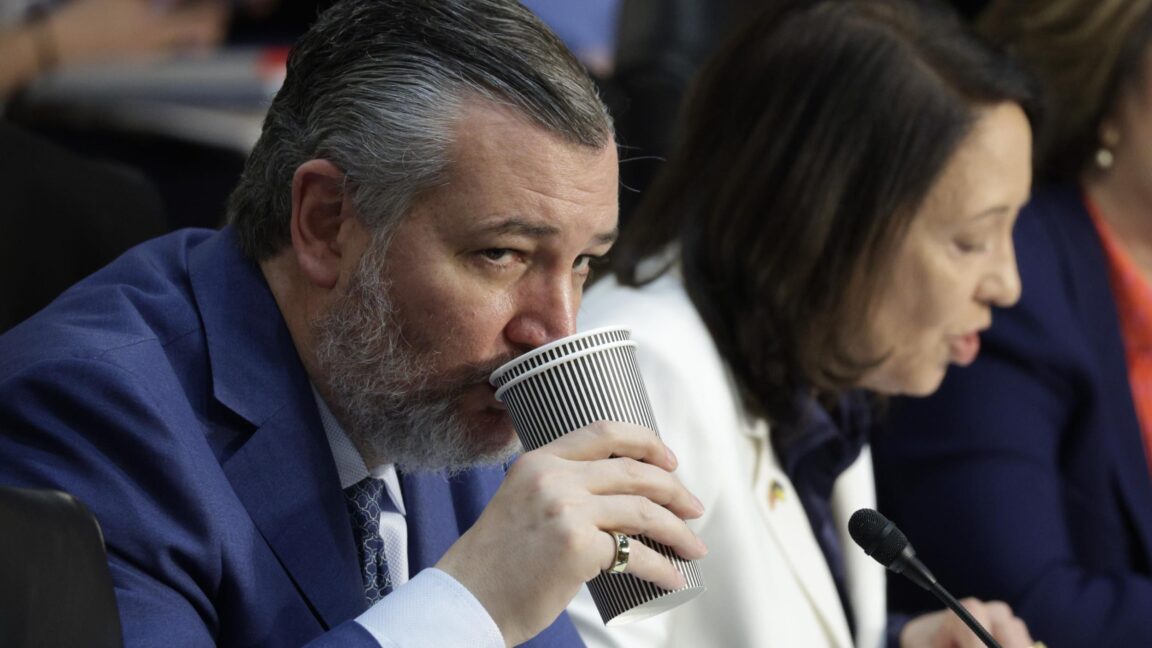
Sen. Ted Cruz (R-Texas) is seeking to expand the Republican majority on the Federal Communications Commission before Democrats take control of the Senate in January 2027. Cruz, in his final two months as chairman of the Senate Commerce Committee, has scheduled a November 10 confirmation hearing for President Trump’s FCC nominee Daniel Tooman Severs and appears intent on advancing the nomination to a full Senate vote.
Cruz announced the hearing yesterday, just before the Republican Party’s midterm defeat. If Tooman Severs is confirmed, Republicans would hold an unusual 3-1 advantage on the FCC.
That could become a 3-0 Republican commission by the end of 2027. FCC Democrat Anna Gomez would have to leave the commission at that point if President Trump does not agree to her nomination.
Wyden warns of legal uncertainty
Sen. Ron Wyden (D-Ore.) recently warned that federal law prohibits an all-Republican FCC and that actions taken by a partisan commission could be overturned in court.
In a September 24 letter to Gomez, Wyden wrote that “based on the statutory history of communications law, actions taken by a partisan FCC can be overturned in court.” He added: “There is speculation that the president intends to fire you once and for all because the communications law requires a quorum of three members. [If Tooman Severs] was approved, [it would leave] the 3-0 all-Republican committee to run the agency.”
“Under an all-Republican commission, license renewals, equipment certifications, spectrum transfers, and other mandated actions would all be legally flawed and cast a cloud of devastating legal uncertainty across the communications industry,” Wyden wrote.
Trump has not nominated a Democrat
All FCC commissioners must be nominated by the president and confirmed by the Senate. By tradition, presidents appoint opposition-party commissioners based on recommendations from the opposition’s Senate leadership.
That bipartisan process has historically helped ensure that the FCC’s composition complies with US law. President Trump has not followed that tradition during his second term, however. He has failed to nominate a Democrat for the other vacant FCC seat and has not renominated Gomez to serve beyond 2027.
Source: arstechnica.com