


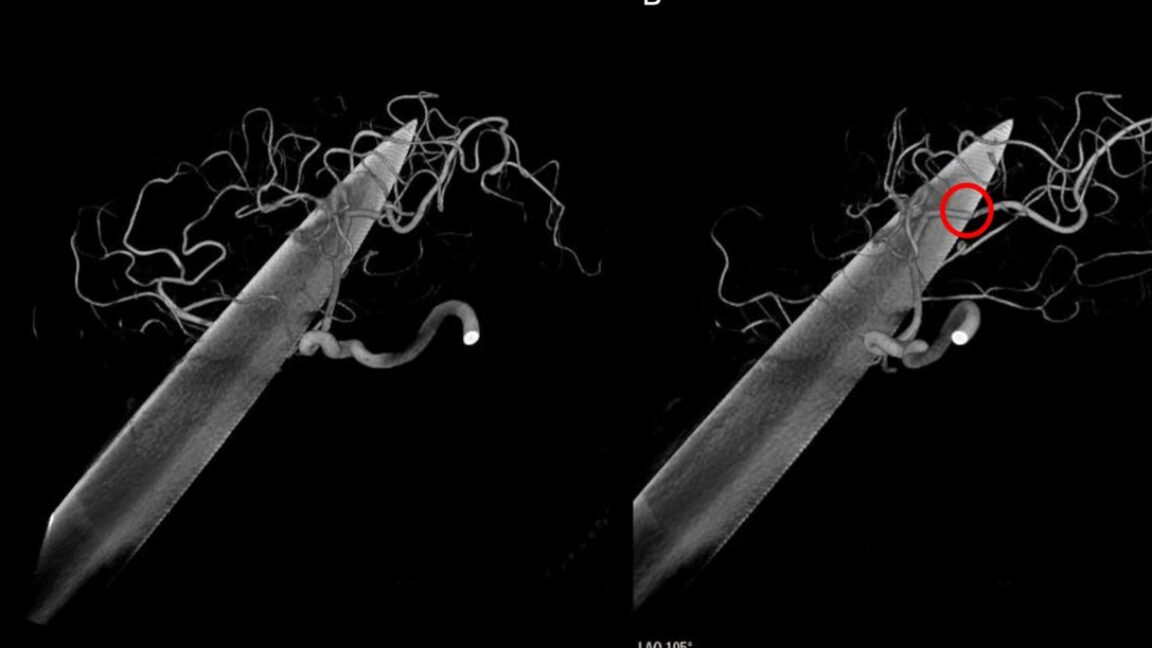
A man survived a rare penetrating brain injury in which a knife passed through his eye and into his brain, yet he made a strong neurological recovery after surgery. Although scans showed bleeding, swelling, and air along the knife’s path, he did not develop an infection or seizures, and his temporary right-sided weakness resolved within two days.
The man was transferred to intensive care after surgery and recovered rapidly. Doctors removed his breathing tube the following day. He developed weakness on his right side, but it resolved after two days.
Follow-up brain scans showed steady improvement. The images revealed some bleeding and swelling, as well as air remaining in the brain tissue along the surgical track. Otherwise, the injury appeared to be healing. He did not develop an infection or seizures.
Despite the “dramatic intracranial trajectory,” the man retained normal language function and did not lose movement or coordination, the researchers reported. He was discharged from the hospital in “good neurological condition.” At a follow-up appointment, doctors continued to monitor his eye and mental health.
An unexplained injury with an unusually favorable outcome
Doctors still do not know how the injury occurred. “The mechanism is unknown,” they wrote. They noted, however, that the man had a history of depression.
The researchers emphasized how unusual it was for someone to survive such an injury and recover so fully. Penetrating injuries involving the eye or brain are rare. When they do occur, they are more commonly caused by a “velocity mechanism,” such as gunfire or another ballistic injury. Knives, sticks, and nails are considered “slow mechanisms.”
“Such low-velocity penetrating brain injuries result in significant morbidity and mortality due to hemorrhage, vascular injury, abscesses, meningitis, cerebrospinal fluid leaks, seizures, and neurological deficits,” the researchers wrote.
Previous cases of unexpected brain-injury recovery
The researchers noted that the man’s recovery, while fortunate, was not unprecedented. They cited other reports of people recovering unexpectedly well from apparently catastrophic brain injuries, including the famous case of Phineas Gage.
Gage, a railroad superintendent, survived an 1848 accident in which a large iron rod passed into his head beneath his left cheekbone and exited through the top of his skull. He survived and recovered, although accounts say that his personality changed after the injury. The doctors who treated the knife-wound patient did not report a similar personality change.
The researchers also compared the case with modern reports of severe frontal-lobe penetration, including a nail-gun injury in which neurological function was unexpectedly preserved.
“This case highlights that the outcome may depend less on external severity and more on the precise trajectory in relation to important vascular, cortical and subcortical structures,” the doctors concluded.
Source: arstechnica.com