


Close Menu
HitechubHitechub
    What's Hot
    Technology

    Digger Review: Features, Performance, and Verdict

    Science

    Heisuke Hironaka Obituary: Renowned Mathematician Who Transformed Algebraic Geometry

    Science

    Next Generation of Planetary Scientists Develop Public Engagement Skills

    Important Pages:
    • About Us
    • Privacy Policy
    • Terms & Conditions
    Facebook X (Twitter) Instagram Pinterest
    Facebook X (Twitter) Instagram
    HitechubHitechub
    Wednesday, November 25
    • Shop
      • Fashion
        • Mens
        • Womens
        • Accessories
          • Handbags
          • Keychain
          • Masks
          • Money clicps
          • Neck Pillow
          • Rings
          • Towels
          • Wallets
        • Jewelry
        • Watches
        • T-shirts
        • Hawaiian shirts
        • Vests
        • Swim trunks
        • Swimsuits
      • Fun
        • Magic cubes
        • Magnifiers
        • Misc
        • Photo books
        • Puzzles
        • Toys
      • Home
        • Cleaning/Care
        • Mailbox covers
        • Mugs
        • Pot Holders
        • Spoon
      • Office and Electronics
        • Chairs
        • Office Supplies
        • IPad cases
        • Laptop stickers
        • Mouse pads
        • Notebooks
        • Pencil bags
        • Pens
        • Phone cases
      • Personalized
      • Pets
      • Sports
        • Cycling
          • Balaclava Mask
          • Bike Bell
          • Bike Computer
          • Bike Fender
          • Bike Grips
          • Bike Kickstand
          • Bike Light
          • Bike Locks
          • Bike Mitts
          • Bike Pumps
          • Bike Repair Stand
          • Bike Seat
          • Bike Trainer
          • Bike Wheels
          • BIKES
            • Folding Bikes
            • Road Bikes
          • Carbon Fiber Bike Products
          • Cycling Mask
          • Kid’ Bike Helmets
          • Inner Tube
          • Motorcycle Bag
          • Nylon Pedals
          • Adult Helmets
          • Photochromic Sunglasses
          • Soft Coolers
          • Suction Cup Bike Rack
          • Tool accessories
          • Winter Cloth
          • Heart Rate Monitor
        • Outdoors/Camping
          • Outdoor Bags
        • Sweatband
    • Technology
      1. AI
      2. Gadgets
      3. View All

      This is the most popular CEO in the world

      Sectors in which “Chat-GPT” is most often used

      Artificial intelligence has begun to “swallow” professions

      The unusual robot conductor of a concert in Seoul

      Here’s how you can tell if your phone is being tapped

      PlayStation 5 becomes a completely silent console and gets more space

      This is the first phone that can be used to park a car

      Best Gaming Laptops 2023: Powerful Portables for PC Games

      Huawei Found Guilty of Stealing Trade Secrets but Acquitted of Extortion

      New Inception Blackmail Group Launches Massive Vishing Campaign Against Victims

      11 Things Jensen Huang Actually Said at His First All-Hands Meeting at NVIDIA

      iRestore Elite Laser Hair Regrowth System Review: Effectiveness, Results, and Benefits

    • Science
      1. Space
      2. Wheels
      3. View All

      Space Perspective: A Journey to the Edge of Space

      5 Fascinating Facts About Space

      Space Exploration: Unveiling the Wonders of the Universe

      Toyota wants to make a new generation battery with a range of up to 1,200 km

      Meet Toyota’s lunar “baby” that could make exploring the Moon easier

      What does a night drive look like with one of the most beautiful cars in the world: the Rolls-Royce Ghost

      How Earth’s Ancient Oceans Misled Scientists About Oxygen’s History

      Who Created Figure 3? Why Scientists Need to Visualize Experimental Contributions

      Has Earth’s Next Ice Age Already Begun? How Global Warming May Have Delayed It

      Francis Halzen’s Bet on “Ghost Particles” Beneath the South Pole Wins the 2026 Nobel Prize in Physics

    HitechubHitechub
    Home » How Earth’s Ancient Oceans Misled Scientists About Oxygen’s History
    Science

    How Earth’s Ancient Oceans Misled Scientists About Oxygen’s History

    Share Facebook Twitter Pinterest WhatsApp
    Share
    Facebook Twitter LinkedIn Pinterest WhatsApp

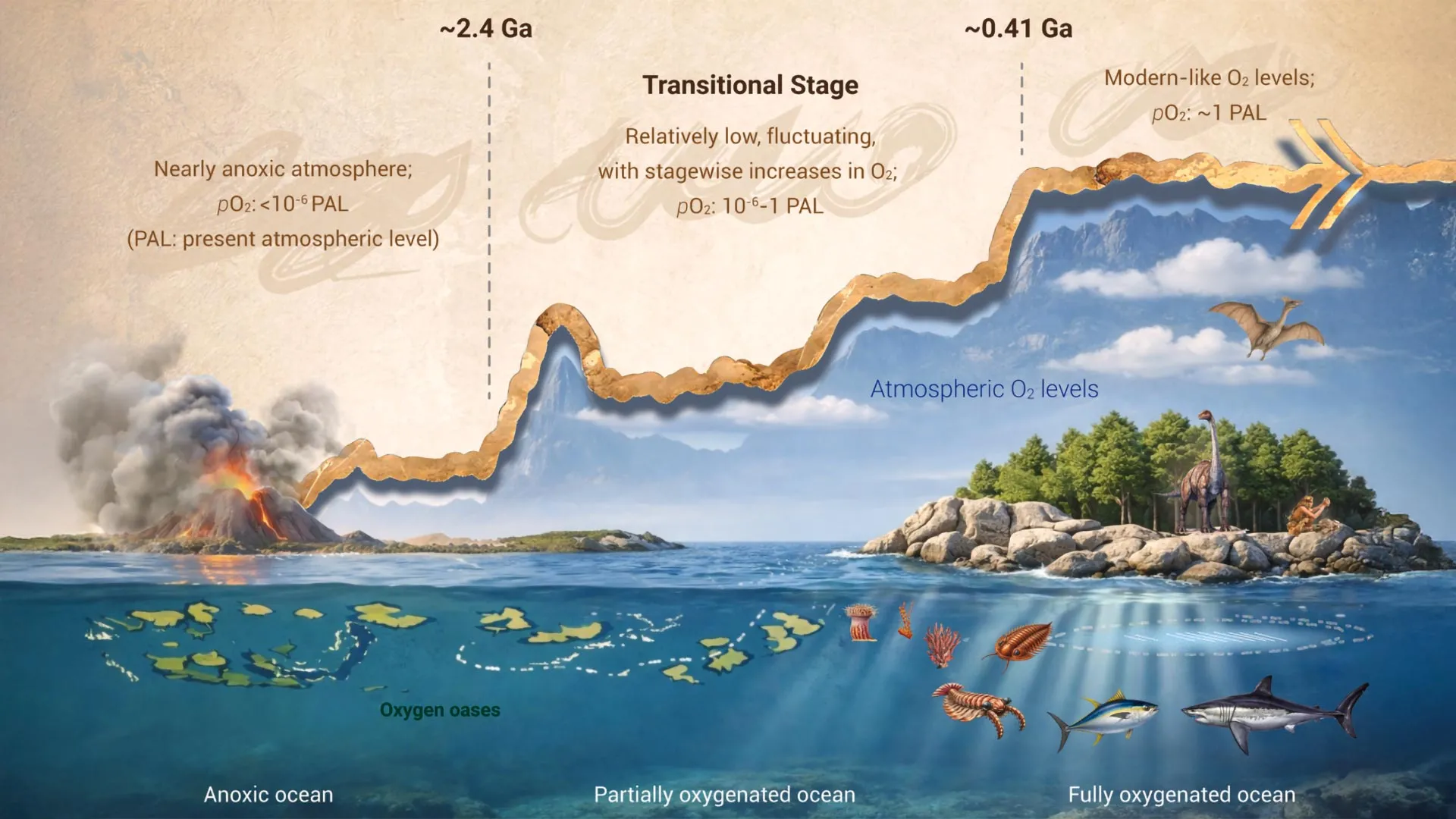
    Earth’s atmosphere and oceans did not become oxygen-rich at the same time, according to a new analysis by two geochemists from Chengdu University of Technology. Their revised timeline identifies three major stages of atmospheric oxygenation and suggests that the deep ocean lagged behind by hundreds of millions of years, with roughly 600 million years separating the final transitions.

    Ancient rocks reveal different oxygen timelines

    Scientists have traditionally reconstructed Earth’s atmospheric oxygen history using chemical clues preserved in ancient ocean sediments. However, seawater oxygen levels are affected by more than atmospheric conditions, including nutrient availability, biological productivity, ocean circulation and the shape of ocean basins. Ocean chemistry therefore provides an imperfect record of the atmosphere.

    The researchers instead examined sulfates, which can preserve distinctive signals of atmospheric oxygen. Reactions involving oxygen, ozone and carbon dioxide in the atmosphere create an unusual shortage of the oxygen isotope oxygen-17. When sulfide minerals weather, this chemical signature can be transferred to sulfates and eventually preserved in sedimentary rocks. These signatures offer a more direct indication of how atmospheric oxygen changed over time.

    The evidence suggests that Earth’s first major increase in oxygen occurred during the Great Oxidation Event, between 2.4 and 2.1 billion years ago. Atmospheric oxygen rose from less than one-millionth of today’s concentration to between 0.1% and 10% of modern levels.

    A second major increase occurred between about 1.3 billion and 1 billion years ago. A third followed between 440 million and 410 million years ago. Both increases occurred earlier than in the traditional timeline.

    Under this interpretation, the Neoproterozoic and Paleozoic oxygenation events, traditionally dated to approximately 800 million to 500 million years ago and 420 million to 360 million years ago, primarily record delayed changes in ocean oxygen levels. The oceans responded roughly 200 million years after the corresponding atmospheric increase in the first case and about 30 million years later in the second.

    Atmosphere and oceans did not change in lockstep

    Despite these major increases, oxygen remained scarce for most of Earth’s history. Models based on isotope evidence suggest that atmospheric oxygen during the mid-Proterozoic Era reached only about 0.1% to 1% of present-day levels.

    The fossil record of charcoal provides another clue. Charcoal formation requires atmospheric oxygen concentrations of about three-quarters of modern levels. The absence of charcoal in older rocks therefore suggests that oxygen concentrations were too low to support widespread combustion. Charcoal first appears in the geological record about 420 million years ago.

    The researchers also emphasize that atmospheric and oceanic oxygen could behave differently over shorter timescales. Over very long periods, the two generally increased together, but over timescales of about a million years they could move in opposite directions.

    When extra oxygen enters the ocean, it can react with accumulated organic carbon and sulfides. Those reactions consume oxygen and can reduce the amount remaining in the atmosphere.

    As a result, some chemical signals previously interpreted as evidence of increasing oxygen may instead record periods when atmospheric oxygen declined. This possibility could alter scientists’ interpretations of major fluctuations in Earth’s ancient oxygen record.

    Oxygen-rich oases existed billions of years ago

    Oxygen did not spread uniformly through the oceans. The researchers identify two main sources of oxygen in seawater: oxygen produced locally by photosynthetic microorganisms and oxygen absorbed from the atmosphere.

    The first process created isolated pockets of oxygen-rich water as early as 3 billion years ago, and possibly earlier. These small oxygenated environments existed during the Archean Era, when the atmosphere and most of the oceans contained little free oxygen.

    As atmospheric oxygen gradually increased, oxygen entering seawater from the air became more important. Atmospheric input eventually overtook local biological production as the main process driving widespread ocean oxygenation.

    Even so, the transition was slow. Under the proposed chronology, the deep ocean remained completely deoxygenated until about 410 million years ago, long after oxygen had begun accumulating in the atmosphere.

    How rising oxygen influenced the evolution of life

    The findings offer a different perspective on the relationship between oxygen and the evolution of complex organisms.

    When Earth’s atmosphere contained virtually no oxygen, oxygen-dependent life faced major limitations. During the Proterozoic Era, increasing oxygen availability gradually opened new environments, although oxygen concentrations continued to fluctuate as early animals evolved.

    Rather than acting as a single trigger for complex life, oxygen initially created opportunities for biological innovation. Only after the third atmospheric increase did higher oxygen levels become a powerful force supporting greater biological complexity.

    This later change helped establish conditions favorable to larger animals, more active predators and organisms capable of living in deeper marine environments.

    Remaining uncertainties

    The researchers acknowledge that substantial uncertainties remain. Existing isotope records do not capture every change in detail, and determining the absolute atmospheric oxygen concentration since a billion years ago remains difficult. Additional increases or declines may have occurred without leaving sufficiently clear chemical evidence.

    Nevertheless, the analysis suggests that the sequence that transformed Earth into an oxygen-rich planet may need to be revised. The evidence indicates that atmospheric oxygen increased long before the deep ocean responded, rather than the ocean oxygenating first and the atmosphere following.

    This prolonged delay may have helped shape the environmental conditions in which complex life emerged and evolved.

    Source: www.sciencedaily.com

    Share. Facebook Twitter Pinterest LinkedIn WhatsApp
    Previous ArticleHuawei Found Guilty of Stealing Trade Secrets but Acquitted of Extortion

    Related Posts

    Science

    Who Created Figure 3? Why Scientists Need to Visualize Experimental Contributions

    Science

    Has Earth’s Next Ice Age Already Begun? How Global Warming May Have Delayed It

    Science

    Francis Halzen’s Bet on “Ghost Particles” Beneath the South Pole Wins the 2026 Nobel Prize in Physics

    Science

    NASA’s Titan-Bound Dragonfly Rotorcraft Mission Draws Global Attention

    Science

    Ancient Rocks from the Moon’s Far Side Reveal the Solar System’s Violent Past

    Science

    New Report Warns Urgent Action Needed to Save Buttermere

    Science

    Menopause May Accelerate Brain Aging, but Hormone Therapy Could Help Prevent It

    Science

    2,200-Year-Old Roman Shipwreck Reveals Ancient Waterproofing Technique

    Add A Comment
    Leave A Reply Cancel Reply

    Stay In Touch
    • Facebook
    • Twitter
    • Instagram
    • Pinterest
    Top Picks
    Science

    Are Nuclear Weapons Hidden in Space? Why the 60-Year Ban on Space-Based Nuclear Weapons Was Never Enforced

    Could a Satellite Detect Nuclear Weapons in Space? The Outer Space Treaty, signed in 1967…

    The Secret Behind the US Spyware King and Its Surveillance Empire

    Scientists Uncover Missing Piece in How Folic Acid Supports Pregnancy

    3 Ways AI Agents Are Transforming Your Browser Already

    Industry Groups Scrutinize President Trump’s Push for 100% American-Made Technology

    Most Popular
    Technology

    Businesses Buy Software Upgrades Despite IT Concerns They Could Make Things Worse

    Technology

    NVIDIA RTX Spark Launch: Next-Generation Graphics Innovation

    Categories
    • AI (9)
    • Gadgets (6)
    • Science (3,564)
    • Space (3)
    • Technology (3,207)
    • Wheels (3)
    Our Picks
    Science

    Australia’s Extinction Crisis: How One Animal Offers Hope for Wildlife Conservation

    Science

    Astronomers Discover a Strange Universal Law Behind Black Hole Eruptions

    © 2026 Hitechub.
    • Home
    • About Us
    • Privacy Policy
    • Terms & Conditions

    Type above and press Enter to search. Press Esc to cancel.

    GDPR Cookie Banner

    We are using cookies to give you the best experience on our website.

    You can find out more about which cookies we are using or switch them off in .

    Ad Blocker Enabled!
    Ad Blocker Enabled!
    Our website is made possible by displaying online advertisements to our visitors. Please support us by disabling your Ad Blocker.