


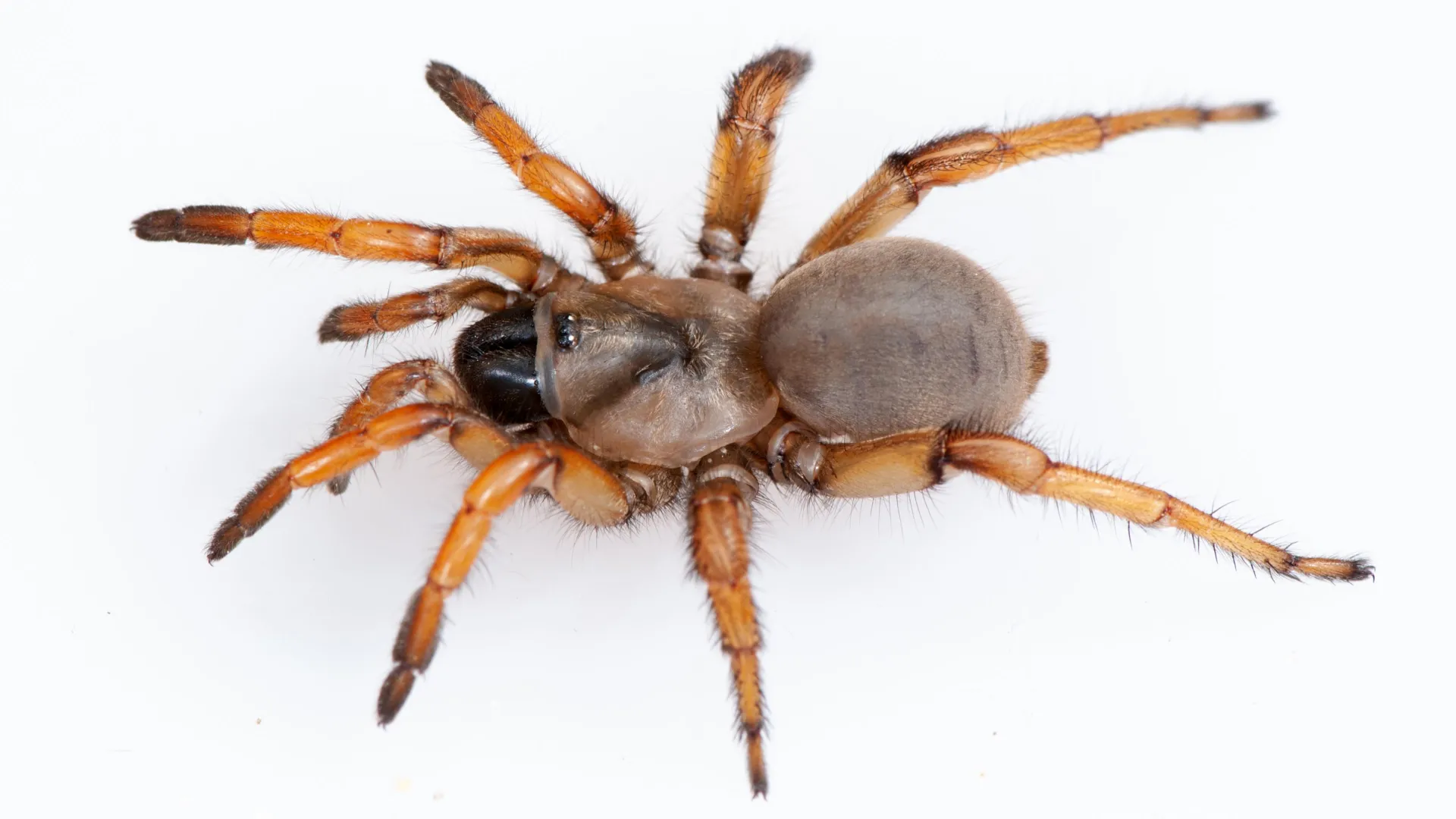
Aptostychus stephencolberti, a tiny trapdoor spider found in California’s coastal dunes, has a genome of about 4.6 billion DNA base pairs—roughly 50% larger than the human genome despite the spider being only about a quarter of the size. Researchers say the genome’s unusual structure could improve understanding of spider evolution, support conservation efforts, and reveal compounds in spider venom with potential medical and agricultural uses.
A secretive spider that hunts from underground
Aptostychus stephencolberti lives in the coastal dunes of California and spends most of its life hidden beneath the sand. Female trapdoor spiders remain underground in carefully constructed, silk-lined tunnels.
Each burrow has a hinged entrance that blends into the surrounding sand. From inside, the spider monitors activity above ground. When an insect or other prey animal approaches, vibrations alert the spider. At the right moment, it bursts through the concealed door and captures its prey.
These spiders are effective ambush predators, but their venom poses no known danger to humans. Jason Bond, a professor in the Department of Entomology and Nematology at the University of California, Davis, noted that only about 30 to 50 of the more than 50,000 known spider species have venom known to be toxic to humans.
A spider genome larger than the human genome
The spider’s genome contains 4.6 gigabases, or 4.6 billion DNA base pairs. “At 4.6 gigabases, or 4.6 billion DNA base pairs, this is not the largest genome in a spider, but it is significant,” said Bond, the study’s corresponding author.
Bond said the research marks the first time scientists have sequenced the genome of a spider from this family. The spider’s genome contains 52 chromosomes, compared with the 46 chromosomes typically found in human cells, arranged in 23 pairs.
A larger genome does not necessarily contain more genes. In this species, about 77% of the genome consists of repetitive DNA sequences that appear multiple times throughout the genetic material.
The study also identified unusual characteristics in the spider’s chromosomes. Spiders lack the traditional repetitive DNA sequences associated with telomeres, the protective structures at the ends of chromosomes. This difference could help explain why spider chromosomes appear to evolve more rapidly than those of vertebrates.
“This helps expand our understanding of the genome composition of spiders and, as a result, how genomes have evolved across the animal tree of life,” Bond said.
Why the spider was named after Stephen Colbert
The species’ unusual scientific name dates back to 2008, when Stephen Colbert learned that Bond had named a trapdoor spider after rock musician Neil Young.
During the “Who’s Not Honoring Me Now?” segment of The Colbert Report, Colbert jokingly asked Bond to name a spider in his honor. Bond agreed, and Aptostychus stephencolberti became Colbert’s namesake in the spider world. The “t” in Colbert is silent in the species name.
The species’ large genome also seemed fitting to researchers because of Colbert’s famously arrogant television persona on his former Comedy Central show.
Rising seas threaten California’s trapdoor spiders
The genome study could contribute to the species’ conservation as well as to research on spider evolution. The sequencing effort is part of the California Conservation Genomics Project, a state-funded initiative that is building a collection of genomic information to help guide conservation decisions.
Trapdoor spiders generally do not move far from their burrows, making it difficult for populations to spread between habitats. Their coastal-dune environment is already divided into isolated areas, so researchers hope genomic data will help identify populations that may require special protection.
“We Californians love our beaches, and trapdoor spiders share them with us,” Bond said. “We want to understand how things like climate change, fire, and urbanization are affecting the genetic diversity of species.”
Aptostychus stephencolberti is found only in coastal dunes across a limited stretch of central California, from the San Francisco Bay area to Monterey.
This restricted range makes the species especially vulnerable to environmental change. Rising sea levels could eliminate parts of its coastal habitat, while invasive species pose another significant threat.
“They’re going to be very sensitive to sea level rise, but they’re also going to be very sensitive to invasive species,” Bond said.
Spider venom could offer clues to new drugs
Studying the spider’s genome could have applications beyond conservation and evolutionary biology. Researchers also hope that understanding spider genetics will help them investigate the wide range of compounds found in spider venom.
Some substances identified in spider venoms could serve as the basis for painkillers, while others may help scientists develop new methods for controlling agricultural pests.
Because many spider species remain poorly understood at the genetic level, their venoms may contain valuable compounds that have not yet been discovered.
“We really have no idea what’s out there in terms of the diversity of untapped natural products that are toxic,” Bond said.
Researchers and funding
Additional authors of the study include Stephen Richards, Emma Jochim, Lacey Newton, James Starrett, Ruta Sahasrabudeh, and Oanh Nguyen of the University of California, Davis; Eric Belout, Colin Fairbairn, Samuel Sacco, William Seligman, and Marley Escalona of the University of California, Santa Cruz; Robert D. Cooper of Virginia Tech and State University; and H. Bradley Shaffer and Erin Toffelmier of UCLA.
The research was supported by the California Conservation Genomics Project and the National Science Foundation, with funding provided to the University of California through the 2019 California Budget Act.
Source: www.sciencedaily.com