


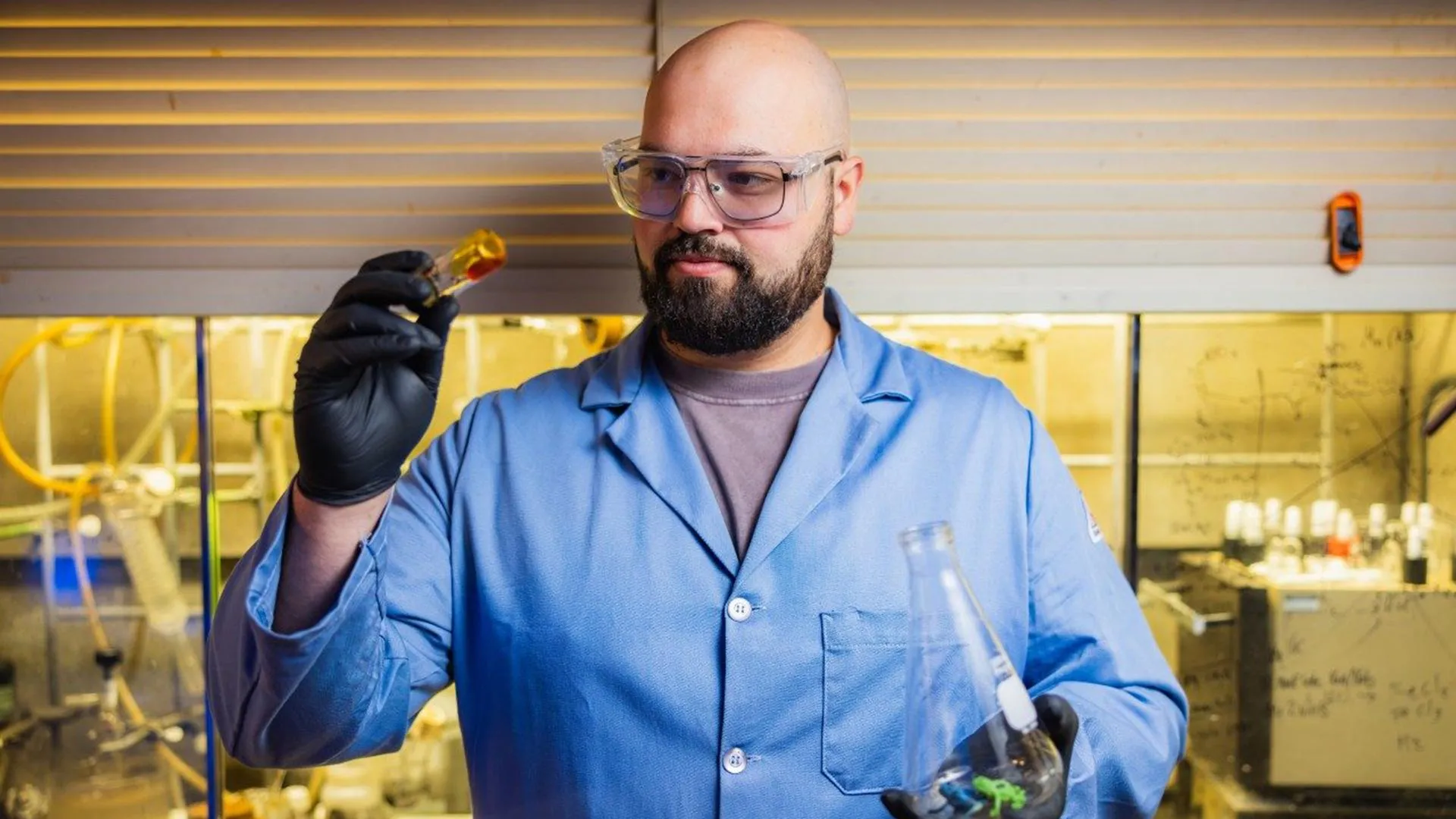
Virginia Tech researchers have developed a chemical process that converts polyvinyl chloride (PVC) waste from items such as plumbing pipes, window frames and credit cards into polyalphaolefins, a key ingredient in synthetic lubricants such as engine oil. The approach could address two environmental challenges at once: the accumulation of difficult-to-recycle plastic waste and the environmental cost of producing valuable industrial lubricants.
Led by chemist and chemical engineer Guoliang “Greg” Liu, the team reported its research in Nature. The process breaks PVC down and transforms it into a relatively thick lubricating oil with properties associated with high-performance synthetic base oils.
Turning PVC waste into lubricant
PVC is particularly difficult to recycle because it contains chlorine and because manufacturers use a wide range of additives to give it properties such as flexibility, stiffness and heat resistance. These factors complicate conventional recycling methods, and much of the world’s discarded PVC ends up in landfills.
At the same time, global demand for lubricants continues to grow, while producing these materials can carry significant environmental costs. Lubricants reduce friction and wear between moving components, help engines operate more efficiently and extend the life of mechanical equipment. Products ranging from lawn mowers and cars to jet engines depend on them.
Virginia Tech’s process could provide an alternative source of these essential materials while helping address plastic pollution. The researchers placed PVC—the type commonly used in household plumbing, window frames and credit cards—in a solvent. They then added aluminum trichloride and alpha olefins, a class of hydrocarbons used to make synthetic lubricants.
The mixture was heated to 158 degrees Fahrenheit for three hours. The researchers then extracted a relatively thick lubricating oil.
The resulting polyalphaolefins are part of a group of synthetic base oils valued for their stability, lubricating properties and performance across a wide temperature range. They are commonly used as the basis for high-performance synthetic engine oils.
“Firstly, we have proven that it is feasible to use plastic waste to produce high-performance lubricants. Second, these lubricants are environmentally friendly and can meet the emerging sustainability needs of the market,” Liu said.
Building on earlier plastic-recycling work
The discovery builds on previous work from Liu’s laboratory, including studies published in Science and Nature Sustainability. In those studies, researchers demonstrated that other types of plastic waste could be converted into surfactants.
Surfactants help water interact with oils and greases and are widely used in soaps and detergents. Encouraged by those results, the researchers decided to tackle the more difficult problem of PVC waste.
“We want to contribute to improving PVC recycling and upcycling,” Liu said.
Unlike traditional recycling, which generally seeks to recover and reuse materials, upcycling converts discarded materials into products with greater value or utility.
Liu recruited a group of graduate researchers to investigate the possibility. Eric Munyaneza Nwayo, who was completing the final year of his doctoral program, was selected to lead the project. After Liu suggested a change in direction, chemistry graduate student Connor S. Thompson, who had been working on a different research topic, joined the effort.
Abby Siviero, a first-year graduate student, also joined the team and quickly became a key contributor.
“I used to call them the Three Musketeers,” Liu said.
An unexpected direction in polymer chemistry
The researchers initially experimented with ways to alter PVC’s molecular structure and turn it into more useful materials.
Like other plastics, PVC is a polymer made from long molecular chains composed of repeating chemical units. The team initially hoped that changing the chemical groups attached to those chains would produce materials with desirable properties.
“The idea was simple: PVC is one of the most activated forms of polyethylene and should be easily converted into other molecules by replacing the chlorine atoms with other groups,” Liu said.
However, the early experiments consistently produced disappointing results. Instead of a functional material with useful performance characteristics, the researchers obtained a soft, sticky substance with little practical value.
Those results led Liu to reconsider the strategy. Rather than continuing to modify the long molecular chains, he thought that breaking them into smaller pieces might produce something more useful.
“One day, I realized: If this polymer is so sticky and soft, why don’t we just keep breaking the polymer chains into smaller segments?” Liu said.
As the researchers refined the chemical process and assessed the properties of the resulting materials, Liu realized that the work could have implications beyond plastic recycling. The team had identified a potential new route for producing valuable industrial lubricants.
Evaluating the technology’s potential
To better understand the new oil’s properties and commercial potential, Liu sought help from researchers at several institutions.
He provided samples to Ali Erdemir at Texas A&M University, where researchers evaluated the performance of the finished material. William Goddard of the California Institute of Technology contributed chemical calculations that helped investigate the chemistry behind the process.
At Virginia Tech, Xi Chen examined the technology’s economics and manufacturing requirements and developed a model exploring how the oil could be produced at scale.
The study confirmed that waste PVC can serve as a starting material for producing high-performance lubricants. Extending the process beyond the laboratory, however, remains an important next step.
Liu hopes to further improve the technology’s environmental sustainability and make the resulting lubricant more widely available. The approach could give one of the world’s most problematic plastics a valuable second life while providing industry with an alternative source of essential lubricating materials.
“Lubricants are the silent heroes of our world. We often don’t notice their existence, but they work quietly in our world. We want to be able to produce oil on a larger scale to reach more people around the world,” Liu said.
Source: www.sciencedaily.com