


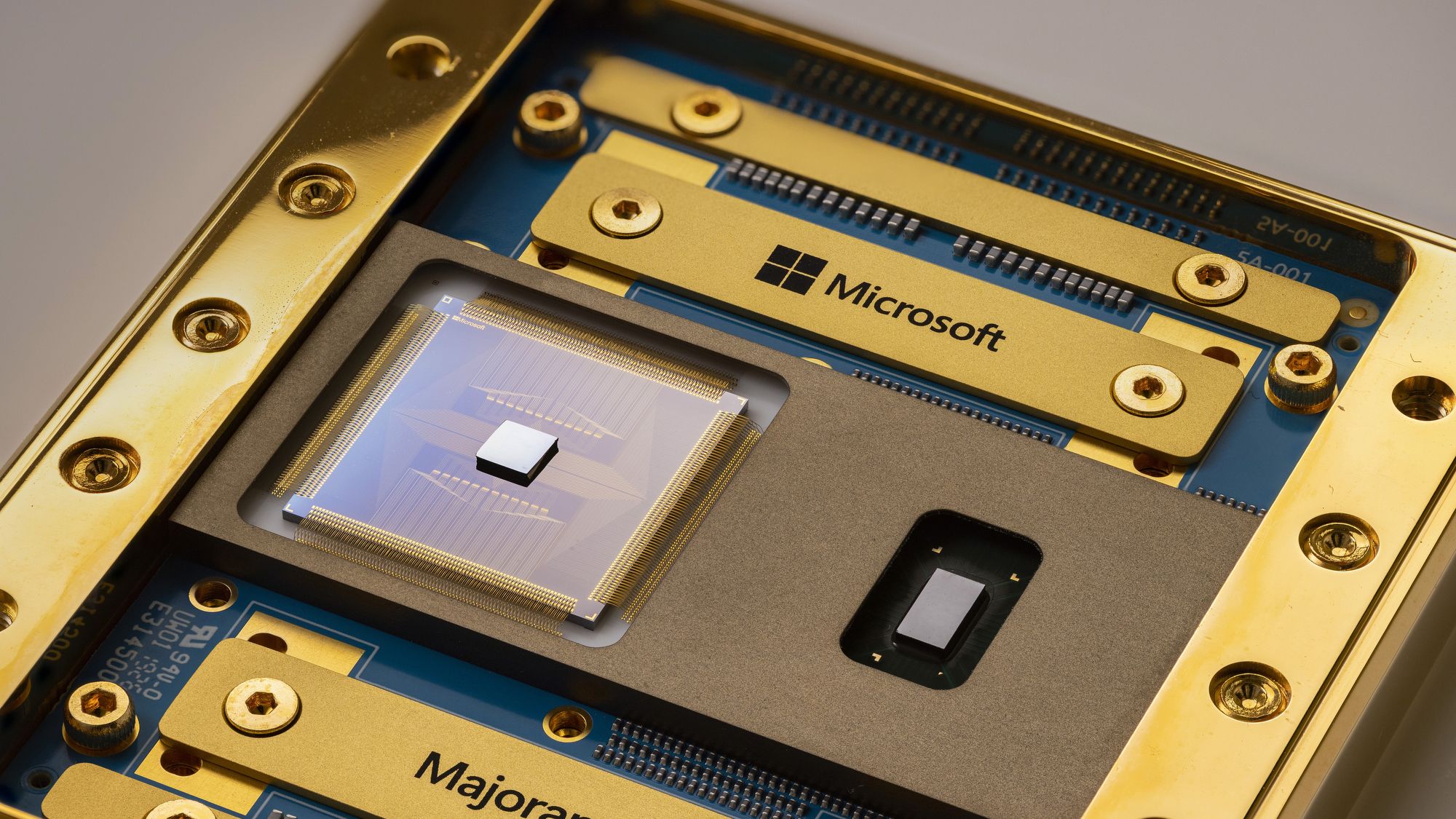
Microsoft is accelerating development of its controversial Majorana 2 quantum-computing platform after facing criticism over claims that its “topological qubits” rely on elusive subatomic particles. The company said in August 2025 that it could build scalable, fault-tolerant quantum computers by 2033, but after opening a new laboratory at the University of Maryland and partnering with the Defense Advanced Research Projects Agency (DARPA) to validate its hardware, it has moved that target to 2029.
Microsoft’s confidence is based on research suggesting that Majorana 2 could represent a major advance in quantum computing. The company first announced the new type of qubit in a Nature study published in February 2025, followed by the announcement of the Majorana 2 platform and preprint research published in June.
If the prototype performs as Microsoft claims, it could give the company a significant lead in the race to build a fault-tolerant, general-purpose quantum computer. Microsoft says the qubits can maintain a quantum state far longer than those used in competing platforms. However, some quantum physicists dispute the claims, arguing that the qubit technology remains highly experimental and had not previously been shown to operate in a quantum computer.
A different path to quantum computing
Microsoft launched its quantum-computing program in 2005 after mathematician Michael Friedman convinced company leaders that conventional quantum architectures would eventually encounter fundamental limits. Friedman proposed an approach based on topological quantum field theory, or TQFT.
TQFT is a theoretical field spanning physics and mathematics in which physical observables depend on the global topology of a system rather than on local properties such as distances, angles and curvature. In principle, the topology remains unchanged even when the local geometry shifts, which could make a qubit less vulnerable to disturbances such as noise and other perturbations. By contrast, conventional platforms, including superconducting qubits, are highly sensitive to such disturbances.
Microsoft explored this idea by developing a quantum-computing platform named after theoretical physicist Ettore Majorana. In 1937, Majorana hypothesized the existence of particles that act as their own antiparticles.
According to Microsoft’s internal research, Majorana 2 produces qubits that last between 20 seconds and one minute. Traditional qubits typically last only microseconds. Those figures, however, still need to withstand independent scrutiny.
Why Microsoft faced backlash
In 2018, a research team that included Microsoft researchers and Roman Latchin reported in Nature Reviews Materials that it had found convincing evidence of a Majorana “zero mode,” which would support the existence of the theoretical Majorana quasiparticle.
When the data was released to reviewers in 2019, prominent physicists raised concerns about data cropping, confirmation bias and the possibility that ordinary electrical noise had been mistaken for unusual physics. The paper was withdrawn in 2021 after the authors acknowledged that aspects of their methodology might have been flawed.
Microsoft’s claims were even more ambitious in a new study published in June. The authors wrote that they had observed physics indicating that qubits built on the Majorana platform could last “orders of magnitude longer than typical qubit operating times.”
The study was met with skepticism from many of the same critics who challenged the 2018 research. One criticism, reported in Nature, is that Microsoft’s researchers may not have manipulated a functioning qubit. Instead, they may have tracked how long an electron’s state remained undisturbed before a stray charge reversed its parity. Critics argue that measuring an electron’s parity state is not equivalent to measuring the reliability of a qubit.
Alex Khan, vice president of quantum research and development at physics accelerator BQP and a University of Maryland QLab fellow, dismissed some of the controversy surrounding the Majorana research. He compared Microsoft’s work with the Wright brothers’ early airplane tests: the first aircraft carried only a few people and flew only a short distance.
“And a lot of people could have sat there and said, ‘Look, this doesn’t actually do anything,’” Khan, who was not involved in the Majorana 2 research, told Live Science.
He took a pragmatic view of progress in quantum computing. “I’ve worked with quantum computers a lot, and in order to use a quantum computer, you have to have it available,” he said. “The most important thing for me is, do we have access to a computer? What algorithms can we run on it? What can we test? What can we benchmark? What capabilities does this provide? And does it start to show some of the quantum benefits that we get from quantum computers compared to simulators?”
How the claims will be tested
Determining whether Microsoft or its critics are correct will require more than repeating the company’s experiments on different systems. Microsoft is building Majorana 2 from the ground up, one engineering step at a time, according to Zulfi Alam, Microsoft’s corporate vice president of Azure Quantum.
“The secret sauce is that we build the device atom by atom, which dramatically reduces confusion,” Alam said in an interview with Live Science.
The question is whether Microsoft has moved ahead of its competitors in developing fault-tolerant and useful quantum machines. Khan said the field still needs answers about how topological information can be read and used.
But in the case of topological qubits, we may know how to read the topological state, but the question is: what do we read? Also, can quantum information be stored? Is it possible to construct a quantum state?
Alex Khan, vice president of quantum research and development at physics acceleration company BQP
DARPA may provide an independent test of Microsoft’s claims. The company is participating in DARPA’s Quantum Benchmarking Initiative, under which the government will evaluate Majorana and Microsoft’s timeline through 2029 while developing a framework for testing quantum-computing claims.
To support the effort, Microsoft is building a Quantum Computing Laboratory at the University of Maryland, where DARPA researchers will be able to conduct hands-on evaluations of the hardware.
Khan called the partnership “exciting” and said he hoped DARPA would help establish what the system can do. “Physics is already known now,” he said. “But in the case of topological qubits, they may know how to read the topological state. But the question is, what do they read? And can they store quantum information? Can they construct quantum states?”
If DARPA validates Majorana 2’s most significant claims, it would vindicate Microsoft and give the Quantum Benchmarking Initiative team a chance to demonstrate the system’s capabilities at the forefront of quantum-computing research.
Alam said Microsoft welcomed the challenge. He described the shift from theoretical science to the “productization” of results as a way to focus the program. DARPA has a team of about 50 engineers studying Microsoft’s results and operating the machines at the University of Maryland, he said.
“We have this artifact for DARPA, and every six months we dump a bunch of these artifacts and provide them to DARPA,” Alam said. “They know everything about our program.”
What Majorana 2 could change
Microsoft’s claims, if confirmed, would address several of quantum computing’s largest bottlenecks. Designing reliable qubits is often identified as the field’s biggest challenge, while useful applications in cryptography, chemistry and physics may require quantum computers capable of processing millions of qubits.
The first bottleneck is hardware. Scaling current systems, including those developed by IBM, Google and other quantum-computing laboratories, requires incremental expansion of complex infrastructure. Superconducting and spin qubits, for example, each require a dedicated analog microwave line, potentially resulting in millions of physical cables in a large computer.
If Majorana 2 works as Microsoft claims, its qubits could be controlled digitally through an integrated processor core that uses only a few connecting wires, eliminating the cable problem.
A second bottleneck is the enormous number of qubits required for useful calculations. Microsoft says Majorana 2 produces qubits that are exponentially more reliable than those on other platforms, potentially reducing the number of error-correcting qubits needed to build a stable quantum computer.
Alam said Microsoft’s internal team initially estimated that it would need 16 million qubits to run Shor’s algorithm, a quantum algorithm that could eventually break widely used encryption systems. Although sufficiently powerful quantum computers could crack those systems, classical computers would take years to do so. Microsoft has since refined its estimates and believes it may need between 400,000 and 600,000 additional qubits.
Joseph Carney, chief strategy officer and post-quantum cryptologist at Britain’s Quantum Future, said Microsoft’s Majorana 2 would revolutionize quantum computing and shorten the timeline for quantum advantage in complex research areas if its claims are validated. Carney was not involved in the research.
“If Microsoft had indeed resolved the error correction, the 2035 deadline would no longer be reliable,” he told Live Science via email. “This kind of breakthrough would lift our warning period. The clock is already ticking. Data intercepted today could be decrypted in the future, and if Microsoft’s claims are correct, that future will be much closer than most organizations plan for.”
Source: www.livescience.com