


Close Menu
HitechubHitechub
    What's Hot
    Science

    Why do bumblebees fly?

    Technology

    Should You Upgrade Your Laptop?

    Technology

    How Cell Phones and Screens Disrupt Your Child’s Sleep: Tips for Better Rest

    Important Pages:
    • About Us
    • Privacy Policy
    • Terms & Conditions
    Facebook X (Twitter) Instagram Pinterest
    Facebook X (Twitter) Instagram
    HitechubHitechub
    Friday, June 5
    • Technology
      1. AI
      2. Gadgets
      3. View All

      This is the most popular CEO in the world

      Sectors in which “Chat-GPT” is most often used

      AI Pioneer Expresses Concern About Potential for AI to Surpass Humanity

      Artificial intelligence has begun to “swallow” professions

      What’s new in Android 14

      Europeans have about 700 million old mobile phones in their drawers

      Here’s how you can tell if your phone is being tapped

      “Sneaker X” – computer case in the shape of a sneaker

      Russian Gamers Unite to Prevent Nuclear War: Join the Fight Online

      Challenges of Space Travel: Why Journeying to Space is So Difficult

      NASA Astronaut Casts Historic Vote from Space

      Discover the Future of Comfort: What If You Could Wear a Chair?

    • Science
      1. Space
      2. Wheels
      3. View All

      Galaxies in the universe are growing more slowly than they should

      “Espace” presented the new lander “Apex 1.0”

      The largest asteroid sample ever collected has arrived on Earth

      (VIDEO) Incredible flight of the Parker Solar Probe

      Toyota wants to make a new generation battery with a range of up to 1,200 km

      Meet Toyota’s lunar “baby” that could make exploring the Moon easier

      Microlino – Is this the perfect city car?

      Alfa Romeo 4C gets an electric successor

      AI Overload: How the Surge of Low-Quality Tools is Straining Open Source Developers

      Neil deGrasse Tyson Discusses New Book: Exploring Aliens on Earth and the Fascinating Science of Wormholes

      Red Stripes in Welsh Caves: Britain’s Oldest Art Finally Recognized After Natural Phenomenon Dismissal

      Timeless Math Memes That Have Captivated Mathematicians for Over a Century

    HitechubHitechub
    Home » Red Stripes in Welsh Caves: Britain’s Oldest Art Finally Recognized After Natural Phenomenon Dismissal
    Science

    Red Stripes in Welsh Caves: Britain’s Oldest Art Finally Recognized After Natural Phenomenon Dismissal

    Share Facebook Twitter Pinterest WhatsApp
    Share
    Facebook Twitter LinkedIn Pinterest WhatsApp

    LONDON — Red stripes discovered on rocks in Wales, long dismissed as a natural occurrence, have been identified in a new study as the oldest known prehistoric art in Britain and northwestern Europe. These remarkable markings were created by human hands approximately 17,100 years ago.

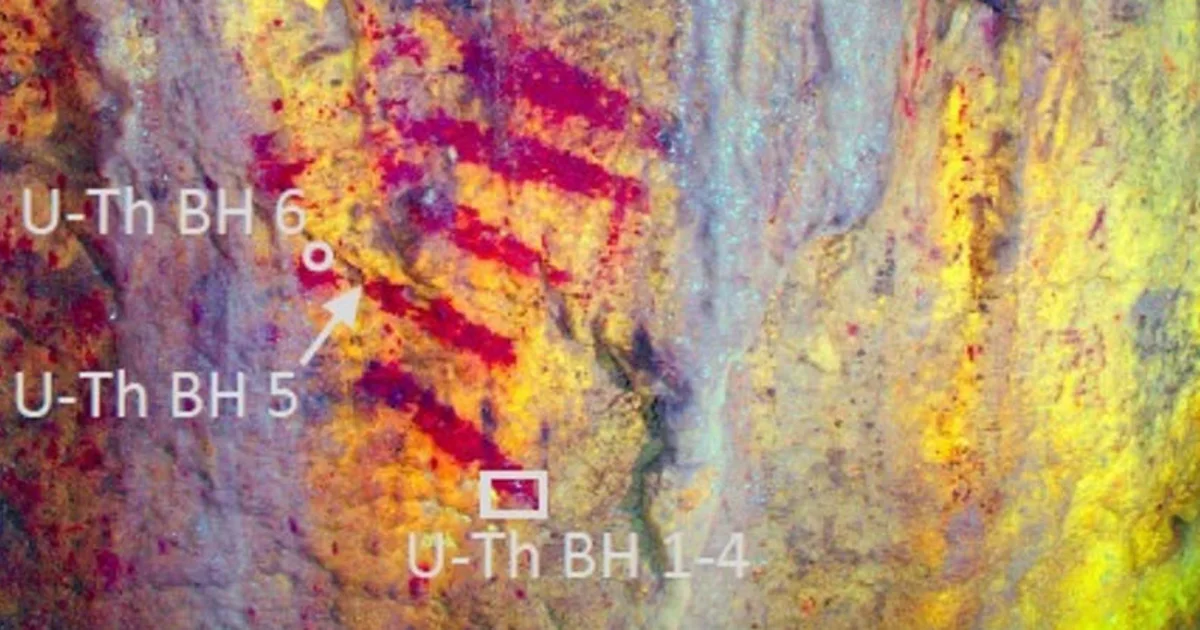
    An international team of scientists has thoroughly examined Bacon Hole, a cave near Mumbles in south Wales, focusing on a series of horizontal red stripe markings first discovered in 1912.

    While initially identified as prehistoric art by Professors William Sollas and Henri Breuil, these stripes were later dismissed as mere natural mineral deposits, according to the study.

    “This panel was overlooked and unrecognized, reducing it to an insignificant historical footnote within the archaeological community,” stated George Harold Nash, an archaeologist and prehistoric art expert who led the research.

    Entrance to Bacon Hall in Wales.
    Entrance to Bacon Hall in Wales.
    Provided by George Harold Nash

    More than 100 years later, the original interpretation has been validated.

    A study published in the journal Quaternary by Nash and the interdisciplinary First Art team concluded, “It’s evident the pigmentation lines do not stem from natural processes, but were intentionally crafted by humans.”

    This study asserts that the previously overlooked red stripes are the earliest known example of cave art in Britain and northwest Europe.

    Nash expressed his joy upon the team’s discovery, describing it as “exhilarating and profoundly moving.”

    “Standing before a painted panel discovered over a century ago, only to be forgotten and then re-acknowledged in its original context was truly extraordinary,” he wrote.

    A collaborative team of scientists from China, Germany, Italy, Portugal, Spain, and Wales employed advanced dating techniques to analyze pigment samples and correlate these findings with cave observations.

    The stripes of red pigment are uniformly spaced, indicating a “deliberate and structured pattern,” as highlighted by the study.

    Team members from the First Art team collect samples at Bacon Hall.
    First-Art team members collect samples for laboratory analysis at Bacon Hall.
    Provided by George Harold Nash

    Evidence suggests the pigment was applied using fingers, aligning with Breuil and Sollas’s initial findings.

    Nash emphasized that cave paintings across Europe are often linked to ritual practices, symbolic actions, and belief systems.

    The full significance of these markings was largely overlooked for years, partly due to graffiti from a local fisherman created in 1894 on another cave wall complicating interpretations.

    At the time these marks were made, approximately 17,100 years ago, the landscape was just emerging from an ice age, making it largely uninhabitable. Bacon Hole and other south Welsh caves would have been suitable habitats for hunter-gatherer tribes, according to the study authors.

    “These caves held more than just shelter; they were culturally significant,” Nash noted. He added that while we can never fully grasp the motivations of Ice Age artists, “the positioning of artworks deep within caves suggests these sites had meanings beyond ordinary domestic life.”

    Currently, Bacon Hole, a cave situated in a limestone cliff overlooking the Bristol Channel, is managed by the National Trust Wales, collaborating with the Bradshaw Foundation to support scientific research at the site.

    The National Trust for Wales expressed ongoing support to classify Bacon Hall as a “scheduled monument,” emphasizing its significance.

    Nash advocates for the highest level of legal protection for Bacon Hole, asserting, “Prehistoric art is an incredibly rare and delicate component of our archaeological heritage.”

    “Once damaged or destroyed, it cannot be replaced,” he concluded.

    Source: www.nbcnews.com

    Share. Facebook Twitter Pinterest LinkedIn WhatsApp
    Previous ArticleTimeless Math Memes That Have Captivated Mathematicians for Over a Century
    Next Article Neil deGrasse Tyson Discusses New Book: Exploring Aliens on Earth and the Fascinating Science of Wormholes

    Related Posts

    Science

    AI Overload: How the Surge of Low-Quality Tools is Straining Open Source Developers

    Science

    Neil deGrasse Tyson Discusses New Book: Exploring Aliens on Earth and the Fascinating Science of Wormholes

    Science

    Timeless Math Memes That Have Captivated Mathematicians for Over a Century

    Science

    Exploring Distant Galaxies: Uncovering New Planets – Sciworthy

    Science

    As Africa Splits in Two, Magma Surge Accelerates – Insights from Sciworthy

    Science

    Boost Your Mood Daily with a Glass of Fruit Juice: Study Insights

    Science

    Ancient Human Settlement Unearthed at 2,000 Meters in the Mountains: Experts in Awe

    Science

    Transforming Polystyrene with Sunlight and Sulfur: Innovative Upcycling Techniques – Sciworthy

    Add A Comment
    Leave A Reply Cancel Reply

    Stay In Touch
    • Facebook
    • Twitter
    • Instagram
    • Pinterest
    Top Picks
    Science

    Why do bumblebees fly?

    The bumblebee has a body shape and mass that, according to the laws of physics, make it unable to fly at all.

    Europeans have about 700 million old mobile phones in their drawers

    The first factory for humanoid robots opens in the United States

    Roborace Car Makes Historic Street Circuit Debut in Marrakech

    Microlino – Is this the perfect city car?

    Most Popular
    Science

    Why Restoring Pluto’s Planet Status Isn’t as Simple as It Seems

    Technology

    Test flight of an air taxi in Jerusalem

    Categories
    • AI (13)
    • Gadgets (10)
    • Science (71)
    • Space (9)
    • Technology (37)
    • Wheels (9)
    Our Picks
    Science

    Revolutionary Mathematics AI Solves Decades-Old Research Problems in Just Weeks

    Science

    Atlantic’s Mysterious Cold Mass: Implications for AMOC Weakening

    © 2026 Hitechub.
    • Home
    • About Us
    • Privacy Policy
    • Terms & Conditions

    Type above and press Enter to search. Press Esc to cancel.

    We are using cookies to give you the best experience on our website.

    You can find out more about which cookies we are using or switch them off in .

    Ad Blocker Enabled!
    Ad Blocker Enabled!
    Our website is made possible by displaying online advertisements to our visitors. Please support us by disabling your Ad Blocker.
    Go to mobile version
    Hitechub
    Powered by  GDPR Cookie Compliance
    Privacy Overview

    This website uses cookies so that we can provide you with the best user experience possible. Cookie information is stored in your browser and performs functions such as recognising you when you return to our website and helping our team to understand which sections of the website you find most interesting and useful.

    Strictly Necessary Cookies

    Strictly Necessary Cookie should be enabled at all times so that we can save your preferences for cookie settings.