


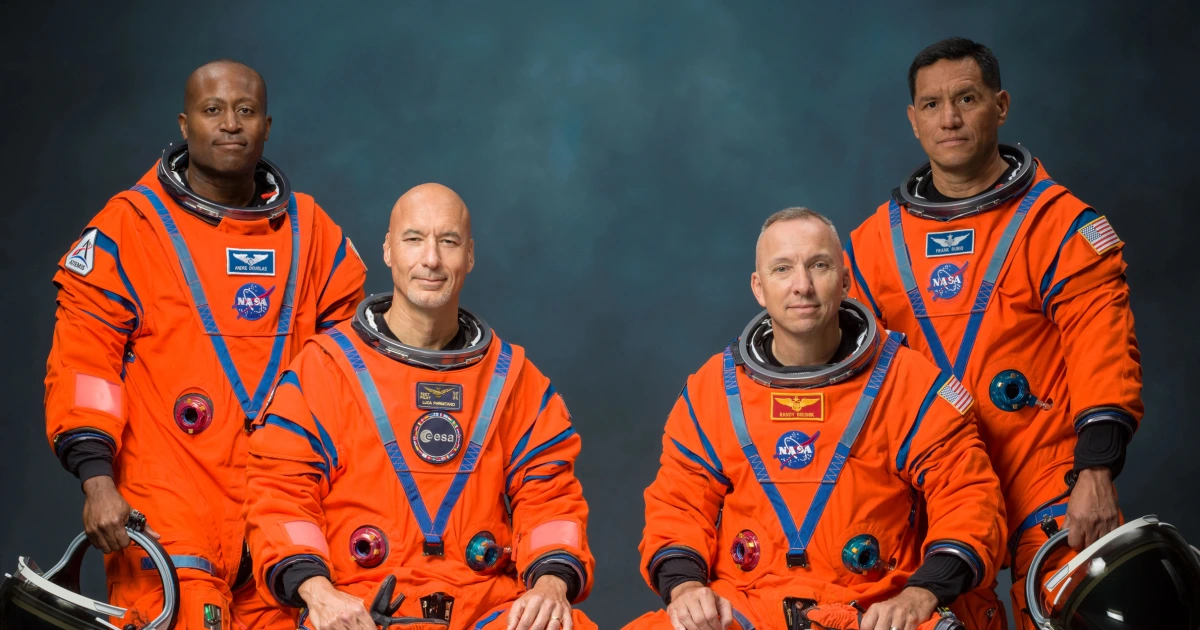
NASA has officially announced the four astronauts selected for the Artemis III mission, marking a vital step in its ambitious plan to return humans to the moon.
Subscribe to read this story without ads
Get unlimited access to ad-free articles and exclusive content.
The selected astronauts, Randy Bresnik, Luca Parmitano, Frank Rubio, and Andre Douglas, are set for launch into Earth orbit next year. Their mission includes testing two commercial lunar landers designed for transporting astronauts to the moon’s surface by 2028. Bresnik will co-lead this historic mission with European Space Agency astronaut Parmitano, while Douglas and Rubio will serve as mission specialists. In addition, Bob Hines will train alongside the crew as a backup member.
Elon Musk’s SpaceX and Jeff Bezos’ Blue Origin are fiercely competing to develop the lander that Artemis III intends to test. Both companies have reported that they expect their landers to be ready for the mission.

Bill Stafford/NASA
According to Jeremy Parsons, NASA’s Artemis program manager, “This test flight will showcase our ability to execute complex operations with partners in a high-stakes space environment, focusing on hardware interfaces, software propulsion systems, and life support for the crew.”
Bresnik, who hails from California, has previously been on two missions to the International Space Station, including one as commander in 2017. A retired U.S. Marine Corps colonel, he became a NASA astronaut in 2004 and oversaw the development and testing of the Artemis spacecraft as assistant director of the Astronaut Office.

Parmitano, a father of two and an accomplished astronaut, commanded the Space Station Expedition in 2019, completing six spacewalks and even hosting a live DJ set in orbit. Prior to his astronaut career, he served as a test pilot for the Italian Air Force.
Rubio’s Artemis II mission will be his second spaceflight. The physician and father of four has an extensive military background, having served in the U.S. Army for 28 years. From 2022 to 2023, he broke the record for the longest spaceflight by an American, spending a total of 371 days aboard the Space Station.
Douglas, an engineer focused on space exploration and robotics at the Johns Hopkins University Applied Physics Laboratory, is embarking on his first spaceflight with Artemis III. He became a NASA astronaut in 2022 and expressed his excitement, stating, “My brain is going a mile a minute right now, but my heart is so warm.”
Hines, who has previously spent 170 days in space across two missions as a U.S. Air Force pilot, will train with the Artemis III crew, ready to step in as needed.
Artemis III is projected to last approximately two weeks, slightly longer than the Artemis II mission. This mission serves as the final test before NASA launches its next crewed mission, Artemis IV, which aims to land astronauts on the moon.
“Every aspect of Artemis III aids us in refining our approach for Artemis IV,” Parsons noted. “We’ve designed this mission to take calculated risks, enhancing the safety and success of future crews as they prepare to land on the lunar surface.”
Ultimately, NASA’s Artemis program aims to establish a sustained human presence on the moon. The agency has announced plans to allocate $20 billion towards building a lunar base this year.
Although NASA initially planned to land astronauts on the moon with Artemis III, a restructured program introduced more missions and accelerated launch timelines, shifting the Artemis III focus toward orbital operations and testing with the lunar landers developed by SpaceX and Blue Origin.
The Artemis III crew will remain in close proximity to Earth, testing significant rendezvous and docking operations with the lunar landers. Such maneuvers are crucial to NASA’s plans, requiring a lander to rendezvous with the Orion spacecraft while in lunar orbit. Astronauts will then transition to the lander for their journey to the moon’s surface, where the spacecraft will serve as their living quarters. The lander must successfully return to Orion for a safe return to Earth.
If everything proceeds as planned, the United States could achieve lunar landings again before 2030, possibly ahead of China’s manned moon mission.
Parsons confirmed that vital components of the Artemis III program are on track. For instance, a redesigned heat shield for NASA’s Orion spacecraft has been constructed and tested. Some critics had raised concerns over the heat shield after it sustained damage during the Artemis I mission.
“Our enhanced heat shields are thoroughly inspected and prepared for installation,” Parsons explained.
However, uncertainties linger regarding Blue Origin’s readiness to launch a lunar lander for Artemis III. The company faced significant setbacks after an engine test resulted in one of its rockets exploding, damaging critical infrastructure.
Despite this, John Coulis, Blue Origin’s senior vice president, expressed optimism regarding their progress.
“Manufacturing of the Artemis III crew module and associated systems is advancing well. Our facilities are operating around the clock responsibly,” he reported. “We anticipate that the vehicle for Artemis III will be completed and ready for launch by 2027.”
Prior to the recent incident, NASA had contracted Blue Origin to deliver a payload to the moon via an unmanned mission later this year. This will kick off a series of robotic missions ushering in preparations for a human moon landing, scouting the lunar south pole and evaluating technologies that the Artemis astronauts could use. The feasibility of Blue Origin completing this mission on schedule remains in question following the incident.
For Artemis III’s launch, NASA plans to utilize the same configuration as Artemis II, deploying the newly selected crew aboard the Orion spacecraft, which will launch atop a Space Launch System rocket from Kennedy Space Center in Cape Canaveral, Florida.
“Every subsequent mission we undertake will be more challenging and complex,” Bresnik stated, emphasizing the crew’s essential role as a bridge between the Artemis II flight and the ambitious objectives of Artemis IV. “We will once again be the first to land humans on another celestial body.”
Source: www.nbcnews.com