


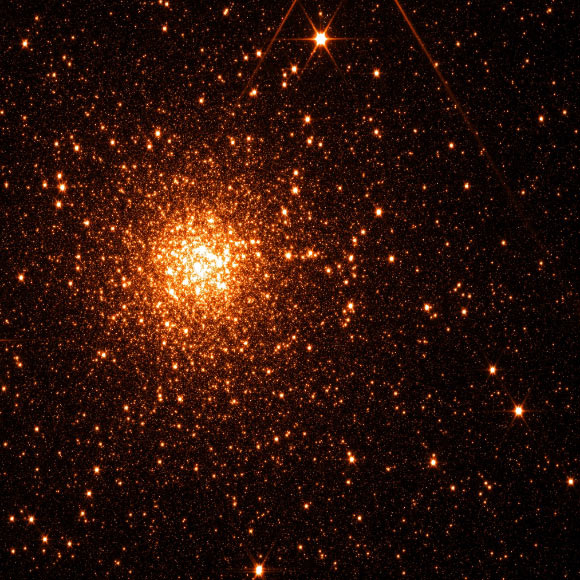
Globular clusters are traditionally thought to host a single, ancient population of stars. However, groundbreaking observations from the NASA/ESA/CSA James Webb Space Telescope and the Hubble Space Telescope have confirmed the existence of two distinct star populations in Terzan 5, an ancient star system previously categorized as a globular cluster. These findings also reveal evidence of two recent rounds of star formation.
Discovered in 1968 by Armenian-Turkish-French astronomer Agop Terzan, Terzan 5 is located approximately 19,000 light-years away in the constellation Sagittarius. Also referred to as ESO 520-27 and 2MASX J17480455-2446441, this stellar system is home to hundreds of thousands of various star types.
Situated in the Milky Way’s inner bulge, Terzan 5 bears similarities to traditional globular clusters. However, a significant discovery in 2009 revealed the presence of two distinct star populations within this system.
In 2016, Hubble’s observations provided initial age estimates of these populations, indicating one formed around 12 billion years ago, while the other formed approximately 5 billion years ago, just before the Earth’s formation. This complexity suggests a more intricate history than typical globular clusters.
As Dr. Giorgia Zullo, a student at the University of Bologna, noted, “Webb’s new near-infrared observations, combined with Hubble’s archival data, enhance our understanding of Terzan 5’s history.”
The study of Terzan 5 is challenging due to its location within a densely populated and dust-covered region of the galaxy. Luckily, Webb’s infrared abilities allowed astronomers to penetrate the dust, uncovering and cataloging more stars—including fainter ones—than previous research.
By analyzing the stars’ color and brightness, researchers can categorize them by age and chemical composition. Webb successfully measured these crucial properties for every star within its field of view, including both Terzan 5’s and unrelated foreground stars.
To isolate the stars unique to Terzan 5, researchers utilized Hubble’s long-term observational power. Hubble’s images taken over 12 years facilitated precise measurements of individual stars’ movements, known as proper motion, allowing scientists to differentiate between stars belonging to Terzan 5 and those from the Milky Way’s bulge.
The synthesis of data from both Webb and Hubble revealed strong evidence of two additional stellar populations, one emerging 3.8 billion years ago and another 2.5 billion years ago. Researchers also refined the ages of previously known populations, finding they formed between 12.5 billion and 4.7 billion years ago.
While the discovery of these multiple generations of stars raises questions, it does not rule out the possibility that Terzan 5 interacted with another significant cosmic body, such as a globular cluster or giant molecular cloud. Such interactions could have introduced new gas and dust, triggering additional star formation.
Stellar composition measurements taken using the W.M. Keck Observatory and ESO’s Very Large Telescope indicate that Terzan 5 has a notably different population from typical globular clusters. Dr. R. Michael Rich, an astronomer from UCLA, explained, “As these populations age, they preserve a fossil record of heavy element enrichment from supernovae.”
Terzan 5 managed to retain the raw materials necessary for forming multiple star generations, indicating a history of supernova events that generated heavier elements, which were subsequently dispersed by later star generations. In less massive systems, such explosions could result in the loss of residual gases and dust, as well as the crucial elements.
Terzan 5’s ancestor possessed sufficient mass to sustain a cycle of star ejections, allowing new stars to form over billions of years. These findings suggest that Terzan 5 is likely a remnant of a much more massive star system that originated around 12.5 billion years ago.
This star cluster is remarkable for its survival, having avoided merging or completely blending with the Milky Way’s bulge. Professor Francesco Ferraro from the University of Bologna stated, “For some reason, this unusual cluster formed independently of the bulge and was not obliterated during the bulge’s formation.”
Terzan 5 is now considered a “bulge fossil fragment” due to its resemblance to the primordial mass contributing to the bulge’s creation.
The survey results are documented in a research paper published in Astronomy and Astrophysics.
_____
G. Zulo et al. 2026. Terzan 5’s Multi-age Stellar Population Revealed by JWST. A&A 709, A212; doi: 10.1051/0004-6361/202659349
Source: www.sci.news