


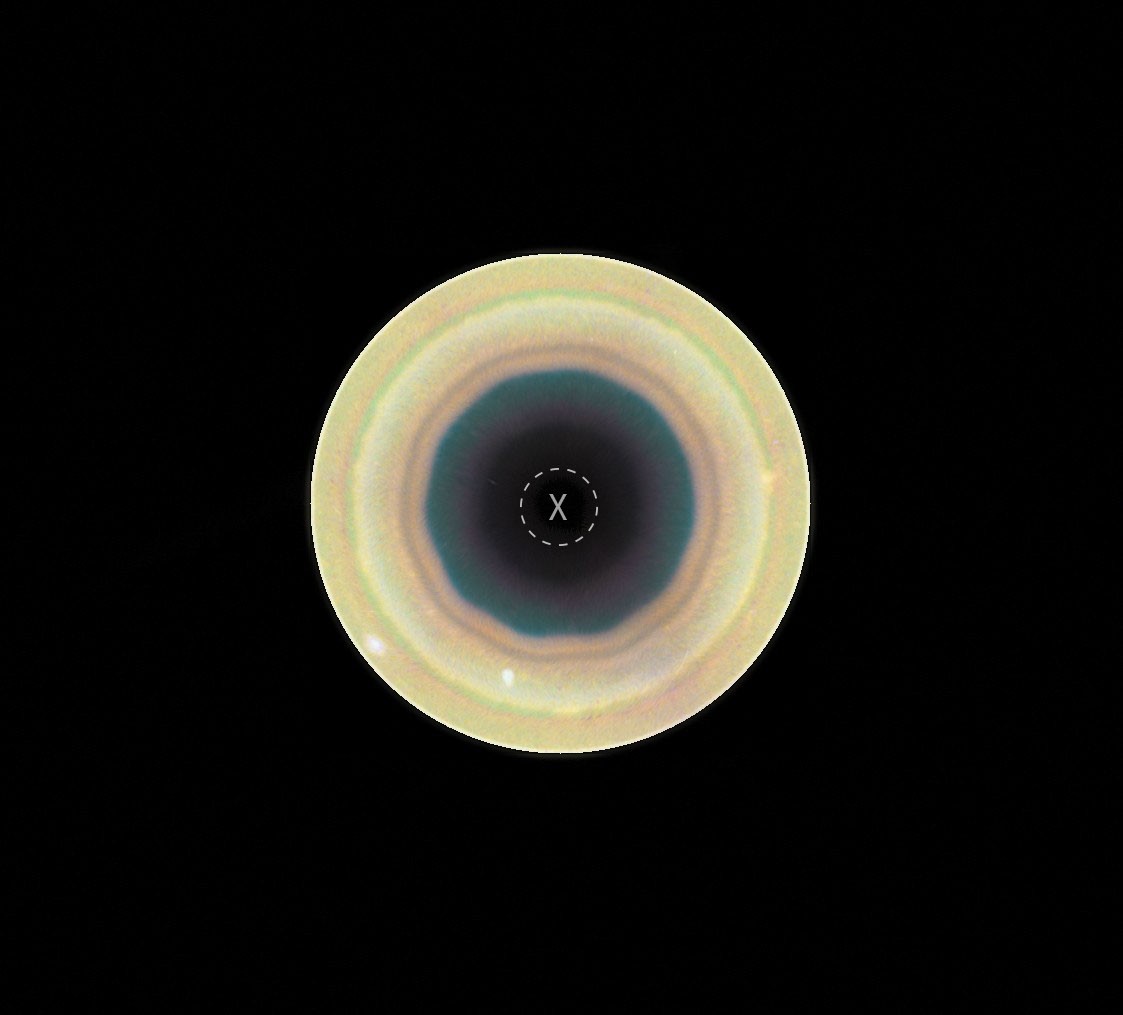
Why are Saturn’s poles geometric? Saturn’s north pole is famous for its enormous six-sided jet stream, known as the Saturn hexagon. This unusual cloud pattern was first identified in data collected by NASA’s Voyager spacecraft during its flybys of Saturn in the early 1980s and was formally reported in 1987. More recent observations from the Hubble Space Telescope have revealed a different geometric pattern around Saturn’s south pole: a decagon, or ten-sided cloud formation.
The exact cause of these geometric shapes is still being studied, but scientists believe they form when atmospheric waves develop as fast-moving gases near the poles interact with slower-moving winds at lower latitudes. Saturn’s south pole also contains a powerful storm system marked by a distinctive central vortex and surrounded by bands of circulating clouds. The southern decagon is especially visible in the darker regions of the atmosphere.
Saturn’s north-pole hexagon has remained remarkably stable for more than 40 years. Scientists expect the southern decagon may also persist for many years, offering valuable insight into Saturn’s powerful winds, atmospheric waves, and unusual polar weather. This enduring phenomenon remains a fascinating research subject.
NASA’s official APOD website is moving: Visit apod.nasa.gov and follow the link to science.nasa.gov/apod.
Tomorrow’s photo: open space
Source: science.nasa.gov