


Honey Bee Colonies May Be Mortal Superorganisms, Scientists Argue
A new review paper proposes that honey bee colonies are not immortal superorganisms, but lineages of related, mortal superorganisms with distinct life cycles. The researchers argue that a departing swarm represents a parent colony leaving with its queen, while subsequent afterswarms can produce multiple offspring.
Are honey bee colonies individual organisms?
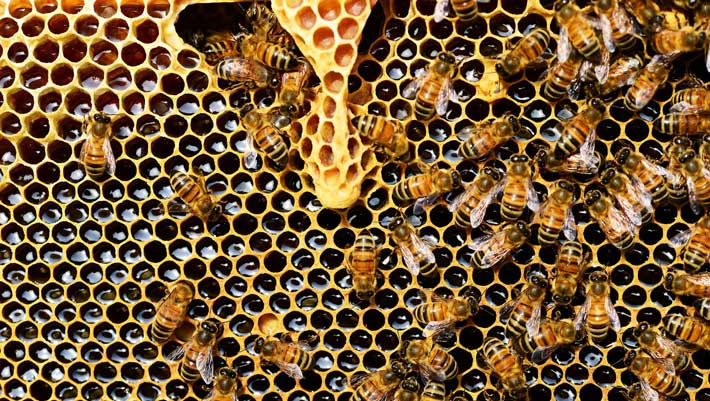
Scientists have long described honey bee colonies as superorganisms, a concept that dates back to the early 20th century. In this view, thousands of worker bees function much like cells in an animal body, while the queen performs a reproductive role.
The idea has also influenced how researchers interpret the continuity of a colony. If a new queen replaces an old queen, some scientists consider the colony to be the same biological entity. Others argue that a new queen has a different genetic makeup, meaning that a new colony has formed.
Dr. Hannes Bomhof of Lund University and Dr. Heikki Herrantela of the University of Oulu support the latter interpretation. They argue that queen replacement marks the emergence of a new biological individual: a genetically distinct honey bee superorganism.
Under this model, what appears to be one permanent colony is better understood as a lineage of related superorganisms that occupy the same nest over successive generations.
Honey bee colonies may have a life cycle
The researchers compare a honey bee colony with an individual mammal. Each colony develops through recognizable stages, from its formation to maturity and eventual decline.
“We analyzed what it means for a honey bee colony to be a single organism. This opens up new insights into the fascinating lives of honey bees,” Dr. Bomhof said.
According to the researchers, each generation of a honey bee colony originates from a single queen and progresses through stages comparable to those of a mammal, including development, juvenile growth and adulthood. The colony also undergoes an inevitable aging process and may die after a few years.
“Bee colonies, as superorganisms, can be likened to individual mammals that undergo a gestation period that involves extensive parental care,” the researchers said.
When a superorganism reproduces, its offspring are cared for by the parent colony. That care can continue at a cost to the parent, including the possible loss of workers and other members of the colony.
How swarming may produce new colonies
The review also challenges the traditional view that the first swarm itself represents reproduction.
The researchers argue that fertilization occurs before the swarm leaves, meaning that the new organisms do not yet exist at the time of departure. Instead, the main colony, including the old queen, is the parent colony that moves to a new nest.
From this perspective, swarming is a survival strategy that allows the mother colony to continue living beyond reproduction. Later swarms, known as afterswarms, carry young, unmated queens and may allow one colony to produce multiple offspring during a single reproductive cycle.
Comparisons with marine organisms
The authors compare this reproductive pattern with certain marine worms that separate reproductive body parts before mating.
“In preparation for reproduction, sexually immature worms called atoks produce gametes and detach the gamete-carrying part called epitokes,” the researchers wrote.
The epitokes temporarily function as autonomous reproductive units. They reproduce sexually, sometimes receive parental care, and die soon afterward. Meanwhile, the remaining atok becomes sexually immature again and regenerates its body, allowing the process to be repeated.
The researchers suggest that this pattern resembles the relationship between the adult superorganism remaining in the original nest and the afterswarm.
Workers, queens and drones as parts of a superorganism
The review proposes interpreting the roles within a honey bee colony using terms that parallel cell biology. Drones could be viewed as “sperm bees,” virgin queens as “egg bees,” egg-laying queens as “stalk bees,” and worker bees as “somatic bees.”
In this model, daughter colonies develop within the mother colony. Worker bees feed and protect the developing colony, while their nutritious secretions may be compared with uterine milk. As the mother’s workers die, they are replaced by daughter workers. Eventually, the offspring become completely independent.
The authors say this process is comparable to giving birth in animals.
Implications for beekeeping and colony health
The researchers argue that studies measuring the longevity of wild honey bee colonies may actually be measuring how long a nest site remains occupied by a succession of different superorganisms. This interpretation could also affect how scientists understand the impact of Varroa mites and other threats to honey bees.
“Modern beekeeping methods are based on the idea of keeping colonies young and healthy forever,” Dr. Bomhof said. “Our study shows that such interventions are fundamentally inconsistent with nature’s reproductive strategies and ability to cope with parasites.”
The authors specifically question requeening, a common beekeeping practice in which a colony’s queen is replaced with an unrelated queen. Under their interpretation, requeening does not rejuvenate the existing superorganism. Instead, it ends that superorganism and initiates a new one associated with the replacement queen.
“Queen restoration kills the colony rather than rejuvenating it,” the researchers said. “As a result, traditional practices designed to maximize pollination services and honey production can come at the expense of superorganism life.”
The review paper, About the Life History of the Honey Bee Superorganism, was published online on August 3, 2026, in Insectes Sociaux.
H.A. Bonhoff & H. Herantella. “About the life history of the honey bee superorganism.” Insectes Sociaux, published online August 3, 2026. doi: 10.1007/s00040-026-01124-7
Source: www.sci.news