


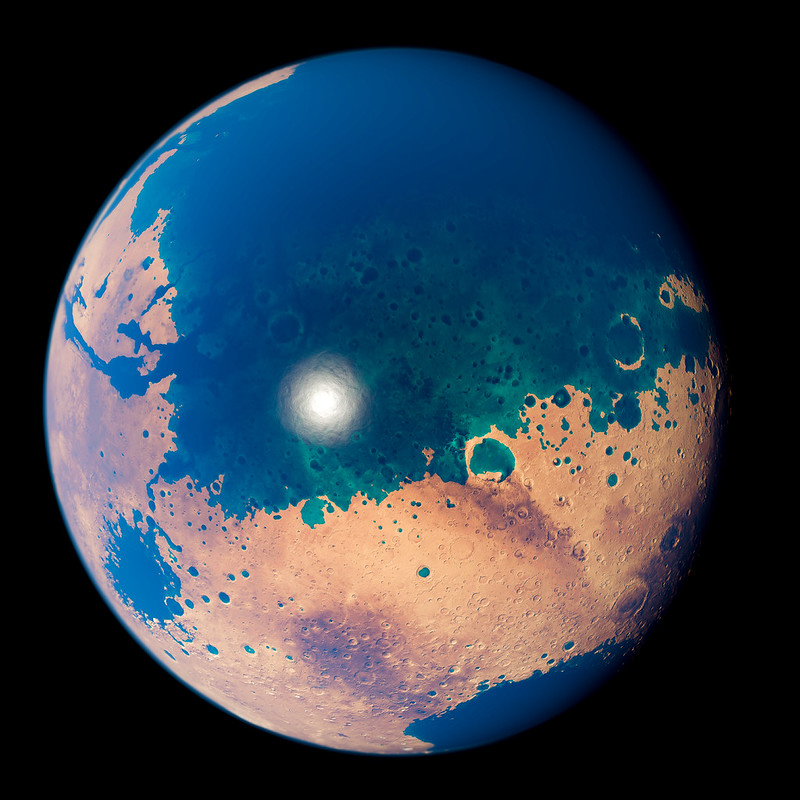
While many envision Mars as merely a dusty red ball, recent research has unveiled mineral deposits indicating that the planet was once warm and wet. A team utilized the
Compact Reconnaissance Imaging Spectrometer
aboard the
NASA Mars Reconnaissance Orbiter
to analyze specific wavelengths of visible and near-infrared light emitted by minerals on Mars’ surface, determining its chemical composition from afar.
Previous studies have identified layered silicate minerals, particularly
clay
, on Mars’ surface. Clay forms when water interacts with rock, capturing the amount and chemical composition of the water involved. This interaction allowed mobile elements like magnesium and iron to penetrate deeper into the Martian soil, while less mobile elements like aluminum remained in situ. This phenomenon is known as
leaching
, leading to the formation of two distinct clay layers in Martian rocks.
Scientists have proposed two main hypotheses for the origin of these layered clays on Mars. The first suggests they formed from underwater seepage in a lake or pool. The second posits a humid, widespread environment on the Martian surface that facilitated leaching.
To test these hypotheses, a team led by researchers at Purdue University estimated the “true” thickness of Mars’ clay layers using methods previously applied only on Earth. Due to the tilting of clay-rich rock layers, they appeared thicker or thinner than they truly are. To rectify this, the researchers conducted a high-resolution imaging science experiment (
HiRISE
) that generated high-resolution elevation maps of Mars using the Mars Reconnaissance Orbiter. These maps were subsequently integrated with compositional data from the Compact Reconnaissance Imaging Spectrometer to create detailed 3D composition maps.
Using the 3D compositional maps, the researchers pinpointed the locations where each clay layer was exposed on the surface and traced them underground to assess slope angles. Trigonometry was employed to calculate the actual thickness of each clay layer. The team analyzed 46 regions across Mars, revealing a combined thickness of both clay layers ranging from approximately 20 to 680 feet (6 to 200 meters), with an average of about 190 feet (60 meters) — comparable to the height of a 60-story building.
The researchers also investigated the extent of clay deposits in a significant valley on ancient Mars known as the Great Valley of Mars, specifically the
Maurus Valley region
. This area was chosen due to its considerable elevation variability and the availability of previously gathered high-resolution chemical composition and elevation data.
If the clay layers were confined to the valley’s bottom, where water once existed, and showed variable thickness and boundaries, it would strongly support the “aquatic seepage” hypothesis. Conversely, if the clay layers were more uniformly distributed, this would bolster the “surface seepage” hypothesis indicating a wetter surface environment.
The findings indicated that the clay layer extended beyond the valley’s lowest areas, maintaining consistent boundaries across over half a mile (approximately 1 kilometer) of elevation. Consequently, the researchers concluded that these clay layers were likely formed through surface leaching in a humid environment.
These results challenge earlier Martian climate models, which commonly suggested that temperatures rarely exceeded freezing on the Martian surface. To reconcile this discrepancy, the research team hypothesized that these deposits might have formed over an extensive period, indicating a discontinuously warm environment. In this scenario, if Mars’ surface remained frozen most of the time but occasionally surpassed the freezing point, the clay deposits could form over extended durations, aligning Martian climate models with the new findings.
The researchers acknowledged some limitations in their study, particularly about sparsely sampled areas. They provided compelling evidence for a widespread wet environment on early Mars, but further examination of sites like Maurus Valley could enhance understanding of the precise surface environmental conditions that led to clay formation, potentially linking these findings to Martian climate models.
Post views:
981
Source: sciworthy.com