


First Stars May Have Triggered Rocky Planet Formation Just 100 Million Years After the Big Bang
New simulations suggest that supernova explosions from the universe’s first stars scattered the raw materials needed to form rocky planets just 100 million years after the Big Bang. The simulations also indicate that water may already have been present in some early planet-forming disks.
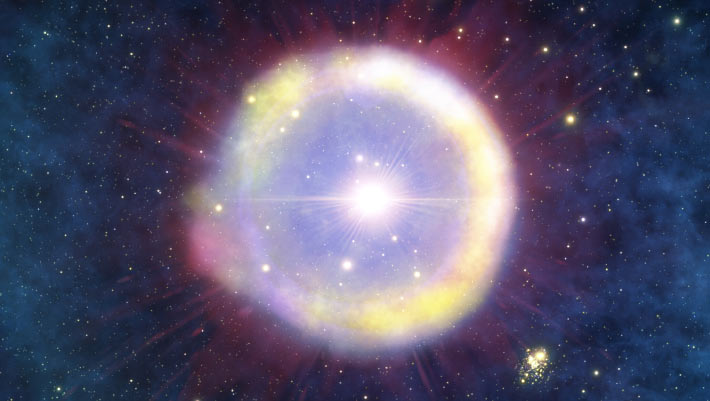
This artist’s impression shows a field of Population III stars that may have emerged about 100 million years after the Big Bang. Image credit: NOIRLab / NSF / AURA / J. da Silva / Spaceengine.
Some of the universe’s first stars, known as Population III stars, were enormous and ended their lives in extremely powerful explosions.
These Population III supernovae dispersed large quantities of heavy elements into the surrounding gas, including carbon, oxygen, and iron. These elements are essential ingredients in the formation of rocky planets.
“Our new paper shows that precursors of terrestrial planets could form around low-mass, long-lived stars in the debris of the first cosmic explosions, just 100 million years after the Big Bang,” said Dr Daniel Whalen, an astrophysicist at the University of Portsmouth.
“To put this into perspective, the universe is approximately 13.8 billion years old, so this represents an incredibly early stage in cosmic history.”
A particularly powerful type of Population III supernova, known as a pair-instability supernova, can eject more than 100 times the mass of the Sun in heavy elements during a single explosion.
This enriched material can mix with nearby gas clouds, producing regions with unexpectedly high concentrations of heavy elements.
Under the force of gravity, these clouds can collapse and form rotating disks of gas and dust around young stars. Such disks resemble the planet-forming disk from which our own Solar System developed.
“In computer simulations of the early universe, we found one such disk surrounding a young star with approximately 70% of the Sun’s mass,” Dr. Whalen said.
“The disk contained enough solid material to build the equivalent of several Earth masses of planets at roughly the same distance from the star as Earth is from the Sun.”
“Most surprisingly, the disk also contained a significant amount of water, although it held only a fraction of the water available during the formation of our Solar System.”
According to the researchers, any planets forming in this early disk could have acquired water in a way similar to Earth. Scientists believe that much of Earth’s water was delivered by material left over from the planet-forming process.
“Our findings suggest that the conditions required for planet formation may have existed much earlier than previously thought,” Dr. Whalen said.
“If so, this raises an intriguing question: Could potentially habitable worlds have formed even earlier in the history of the universe?”
The team’s paper is scheduled for publication in The Astrophysical Journal Letters.
_____
Eduard I. Vorobyov et al. 2026. Planet Formation at the Dawn of the Universe: Planetesimals of H2O-Rich Disk Around a Low-Mass Star. ApJL, in press. arXiv:2501.08375
Source: www.sci.news