


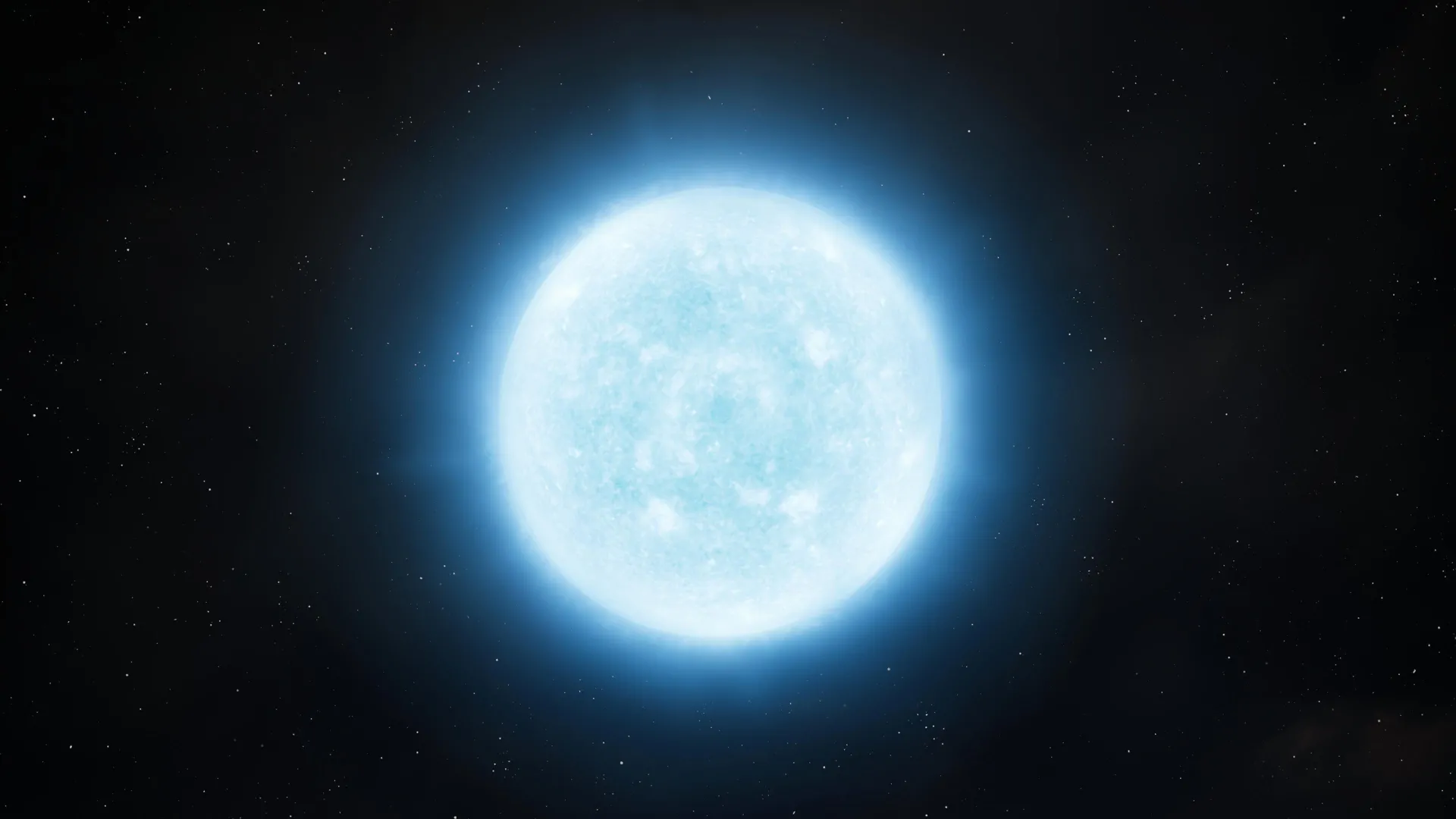
Computer simulations suggest that strong magnetic fields inside white dwarfs could allow some of these stellar remnants to exceed the long-standing Chandrasekhar limit of about 1.4 times the Sun’s mass. In one model, a magnetized white dwarf reached approximately 2.4 solar masses, offering a possible explanation for unusually bright Type Ia supernovae and for some white dwarfs that appear larger than conventional models predict.
Magnetic fields may overcome a famous cosmic limit
White dwarfs are the dense cores left behind when certain stars exhaust their nuclear fuel and shed their outer layers. They are roughly the size of Earth but can contain as much mass as, or more mass than, the Sun.
For white dwarfs without strong magnetic fields or rapid rotation, physicists have long recognized an upper mass limit of about 1.4 solar masses. Known as the Chandrasekhar limit, it is central to understanding how some stars end their lives in spectacular explosions.
When a white dwarf composed primarily of carbon and oxygen approaches this limit, the increasing pressure and density in its core can ignite carbon. The result can be a powerful thermonuclear explosion known as a Type Ia supernova.
New simulations by researchers in the Department of Physics at the Indian Institute of Science (IISc) and their collaborators suggest that this traditional limit may not apply to white dwarfs with sufficiently strong internal magnetic fields. In one simulation, a magnetized white dwarf reached about 2.4 times the mass of the Sun.
“The idea started in 2011, when a summer student came to me and I very casually gave him a problem: to see if Chandrasekhar’s limit is violated by a magnetic field,” explains Vanibrata Mukhopadhyay, a professor in the Department of Physics and corresponding author of the study published in the June 2006 issue of Astrophysical Journal Letters.
The possibility that white dwarfs could exceed the Chandrasekhar limit is not entirely new. Theoretical physicists have studied these objects, sometimes called “super-Chandrasekhar” white dwarfs, for decades.
Astronomers have also observed a Type Ia supernova that was far brighter than expected. Such unusually luminous explosions raise the possibility that some white dwarfs could reach as much as 2.8 solar masses before exploding.
However, showing that extremely massive white dwarfs can exist theoretically is only part of the problem. Researchers must also determine whether ordinary stars can naturally evolve into them.
Tracing stellar evolution from birth to death
“The key question was not just whether super-Chandrasekhar white dwarfs are possible, but whether stars can actually evolve into white dwarfs,” says Xenia Zureik, first author of the study and a doctoral student in the Department of Physics. “Our simulations allow us to trace an evolutionary path from a main-sequence star to a white dwarf and show that such a path is possible under certain conditions.”
To investigate this process, the researchers modified STARS, a stellar-evolution computer program originally developed at the University of Cambridge.
They expanded the software to include magnetic fields and the cooling of white dwarfs. The updated model can simulate how a magnetized star changes over time, beginning with the main-sequence phase, when it fuses hydrogen into helium and generates energy.
The simulation followed the star through later stages of evolution until it became a white dwarf. The researchers then modeled a binary system in which the white dwarf gradually draws material from a companion star.
This process, known as accretion, increases the white dwarf’s mass over time. The researchers wanted to determine whether a growing magnetic field could change the amount of additional material the star was able to support.
Magnetic pressure helps white dwarfs resist gravity
The simulations revealed that even a relatively weak initial magnetic field can become increasingly influential as the white dwarf accumulates matter.
As material builds up, the star becomes denser and contracts under its own gravity. This compression strengthens the internal magnetic field, providing additional pressure that helps counteract gravity.
That magnetic support allows a white dwarf to hold more mass than would otherwise be possible. The familiar relationship between a white dwarf’s mass and radius may also change, producing different maximum masses depending on how the magnetic field behaves inside the star.
One simulation illustrates the effect. The researchers modeled a carbon-oxygen white dwarf with an initial mass of 1.02 solar masses. It had originally formed from a main-sequence star with a mass of eight Suns.
In the simulation, the white dwarf gradually accreted material from its companion at a rate of 10−9 solar masses per year, equivalent to one-billionth of the Sun’s mass annually.
When magnetic effects were included, the white dwarf reached about 2.4 solar masses. Without those effects, comparable models reached the traditional limit of approximately 1.4 solar masses.
The results suggest that magnetic fields can fundamentally alter the possible masses of white dwarfs.
The same mechanism may help explain other astronomical puzzles. Some well-studied white dwarfs have unexpectedly large radii despite their relatively low masses. Magnetic pressure could explain why these stars appear larger than conventional models predict.
Implications for measuring the universe
The effects could extend beyond the evolution of dying stars. Type Ia supernovae are among astronomy’s most important tools for measuring cosmic distances. Because their peak brightness can be standardized, astronomers use them as reference points and sometimes call them standardizable candles.
By comparing the intrinsic brightness of an explosion with the brightness observed from Earth, researchers can estimate its distance. These measurements have helped scientists investigate the size, history and continuing expansion of the universe.
The Chandrasekhar limit has traditionally provided an important part of the physical framework for understanding Type Ia supernovae. If a white dwarf reaches a similar mass before exploding, its energy output and brightness are expected to follow a broadly predictable pattern.
The new simulations suggest, however, that the masses and internal magnetic fields of some exploding white dwarfs could vary considerably. Those differences could affect the properties and brightness of the resulting supernovae, potentially helping to explain why some Type Ia explosions are unusually bright.
Understanding how magnetic fields influence these stellar explosions could help astronomers refine their interpretation of supernova brightness and improve models of the universe’s expansion.
The finding comes from computer simulations rather than direct observations of white dwarfs growing to such extreme masses. Nevertheless, it suggests a possible evolutionary path for stars that exceeds the traditional Chandrasekhar limit, and indicates that strong magnetic fields could make some dead stars far more massive than previously expected.
Source: www.sciencedaily.com