


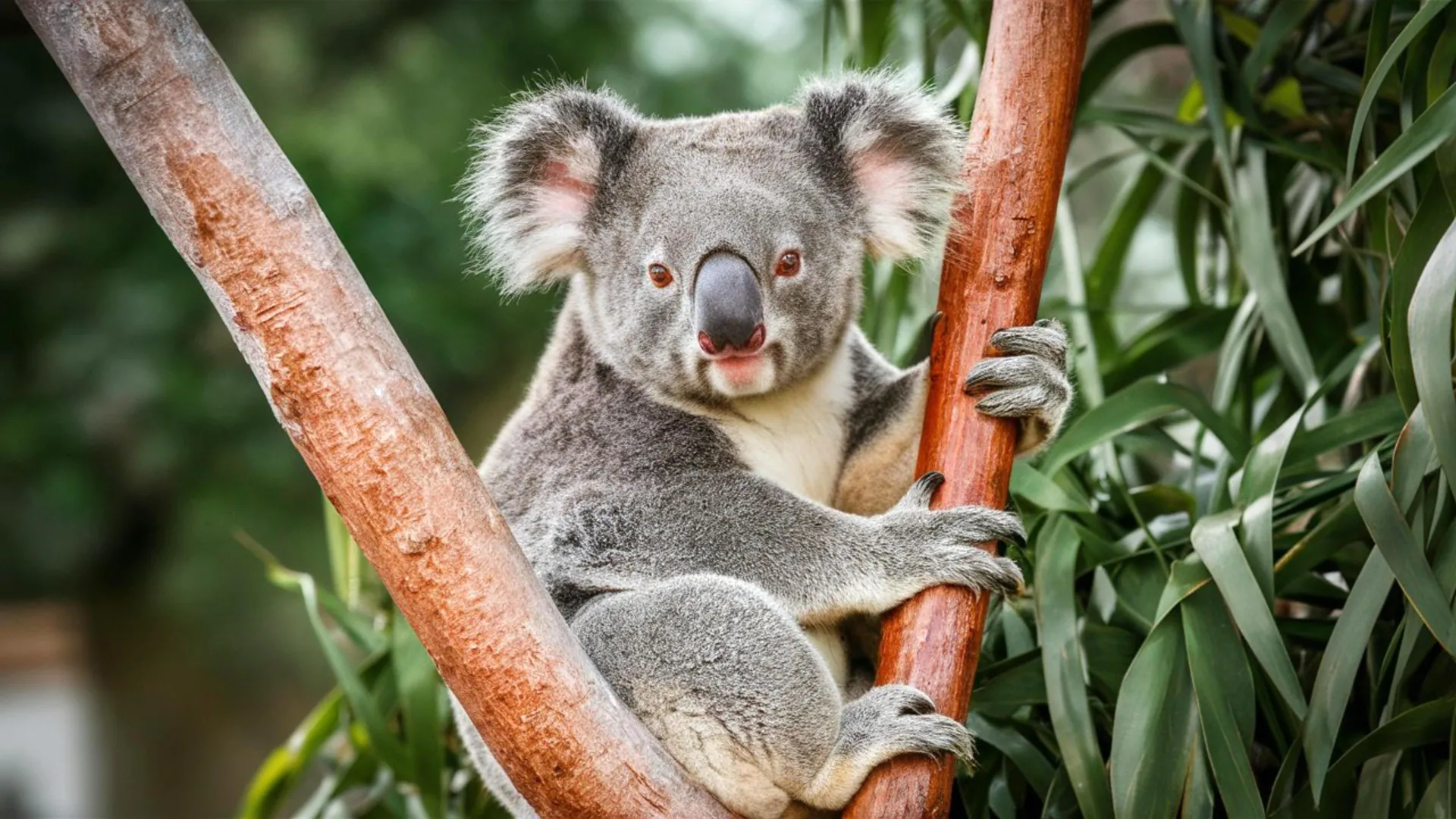
A comprehensive genome analysis is reshaping the scientific community’s knowledge of koala evolution. Recent research reveals that koalas (Phascolarctus cinereus) experienced a significant population decline approximately 100,000 years ago—long before the arrival of humans in Australia.
All current koalas are believed to have descended from a singular ancestral population that survived substantial environmental changes, including severe ice ages.
However, today’s koalas encounter a different array of threats, including hunting, extensive land clearing, wildfires, and various diseases.
The research team from the University of Sydney and Texas A&M University disputes previous findings that suggested koala populations began declining solely after human settlers arrived in Australia. Their study is detailed in Molecular Biology and Evolution, published by Oxford University Press.
“This research significantly alters the timeline of koalas’ genetic history in Australia,” stated PhD candidate Toby Kovacs, the study’s lead author.
“By determining the mutation rate in modern koala populations, we can reconstruct a genetic chronology going back 100,000 years, offering insights into ancient koala populations’ genetic diversity and size.”
Koala DNA Unveils Hidden Population History
Kovacs emphasized that fossil records are insufficient to accurately estimate the koala population in Australia 100,000 years ago. However, genomic data provide critical clues about shifts in population size and genetic diversity over time.
“Genome analysis indicates that koalas faced considerable population declines in the past due to climate fluctuations and habitat destruction. Fortunately, as environmental conditions improved, koala populations rebounded and expanded across much of eastern Australia.”
“It’s essential to recognize that many threats confronting modern koalas, such as habitat destruction and hunting, are primarily human-induced.”
By examining how koalas reacted to historical population declines and recoveries, scientists can develop enhanced conservation strategies to safeguard this species in the present.
How Scientists Reconstructed Koala Evolution
To trace the genetic history of koalas, researchers focused on the mutation rate within the species’ genome, which carries essential genetic information.
Mutation occurs naturally each time an organism reproduces, introducing new genetic changes. The mutation rate quantifies how frequently these changes arise in successive generations, varying from one species to another.
The research team analyzed genome sequences from four parent-child trios and cataloged newly emerged mutations. This data allowed them to calculate the mutation rate in koalas, which is approximately half that of humans.
Using these newly established rates, the researchers examined the genomes of 457 koalas. This approach enables a more accurate understanding of how koala populations have expanded, contracted, and diverged over millennia.
This study is groundbreaking as it is the first to directly estimate mutation rates in koalas or among marsupials like wombats, kangaroos, and possums.
Prior research inferred that koala populations only began to thin out following the arrival of modern humans in Australia around 65,000 years ago. However, these conclusions relied on mutation rates gleaned from more distantly related mammals, such as humans and mice.
Koalas Experienced Decline Before Human Arrival
New findings indicate that substantial declines in koala populations commenced around 100,000 years ago, with numbers plunging to a critical genetic bottleneck approximately 60,000 years ago.
This drastic decline coincided with widespread environmental degradation during the ice age of the Late Pleistocene, well before any human contact.
During the Paleogene period (23 to 66 million years ago), the Australian landmass was predominantly covered by lush forests. Changes began during the Miocene (5 to 23 million years ago) as the Australian tectonic plate gradually moved northward.
Throughout the Pleistocene (2.5 million to 11,700 years ago), Australia cycled between ice ages characterized by cold, dry conditions and warmer, wetter interglacial periods. These fluctuations continuously reshaped the continent, rendering its landscape drier and more fire-prone.
About 70,000 years ago, the expanding Nullarbor Plain transformed into vast semi-arid bushland, diminishing suitable habitats for koalas and isolating populations in eastern and western Australia.
Eventually, the western koala population vanished, while a small population in the east persevered through harsh glacial conditions.
A Small Group Revitalized the Species
In the current interglacial period, more favorable conditions allowed the eastern survivors to flourish. Between 16,500 and 6,000 years ago, they diverged into five genetically distinct populations.
These groups ultimately gave rise to the koala populations presently found along Australia’s eastern coast.
“Considering these results, we are eager to investigate whether other Australian species, including relatives of extinct megafauna, underwent similar population declines prior to human arrival,” said Kovacs.
The newly calculated mutation rates reveal more than just the koalas’ ancient lineage; they can also be employed to study recent changes in population sizes, thereby enhancing contemporary conservation efforts.
Current estimates suggest that koala populations in Queensland and New South Wales continue to decline, while those in Victoria appear to be recovering.
As of 2022, koalas are officially classified as endangered in Queensland, New South Wales, and the Australian Capital Territory.
Genomic Research Promotes Conservation
Kovacs stated, “Understanding the status of koala populations can enable conservationists to take preemptive measures, preventing genetic diversity loss and reducing risks associated with inbreeding.”
“Historically, koalas have faced significant population declines due to climate change and habitat loss. Today, surviving koalas are experiencing similar downturns, largely as a result of human land clearing, bushfires, hunting, and diseases.”
“Our team is creating a vast genomic repository for koalas, but to unlock the full potential of these datasets, we also need to ascertain the rate of new genetic changes within the species,” Kovacs concludes.
“Estimating mutation rates will enhance our capability to reconstruct koala population histories, comprehend their adaptive capacity, and inform more effective conservation strategies for the future.”
Source: www.sciencedaily.com