


Pablo Sobron Sanchez
SETI Institute
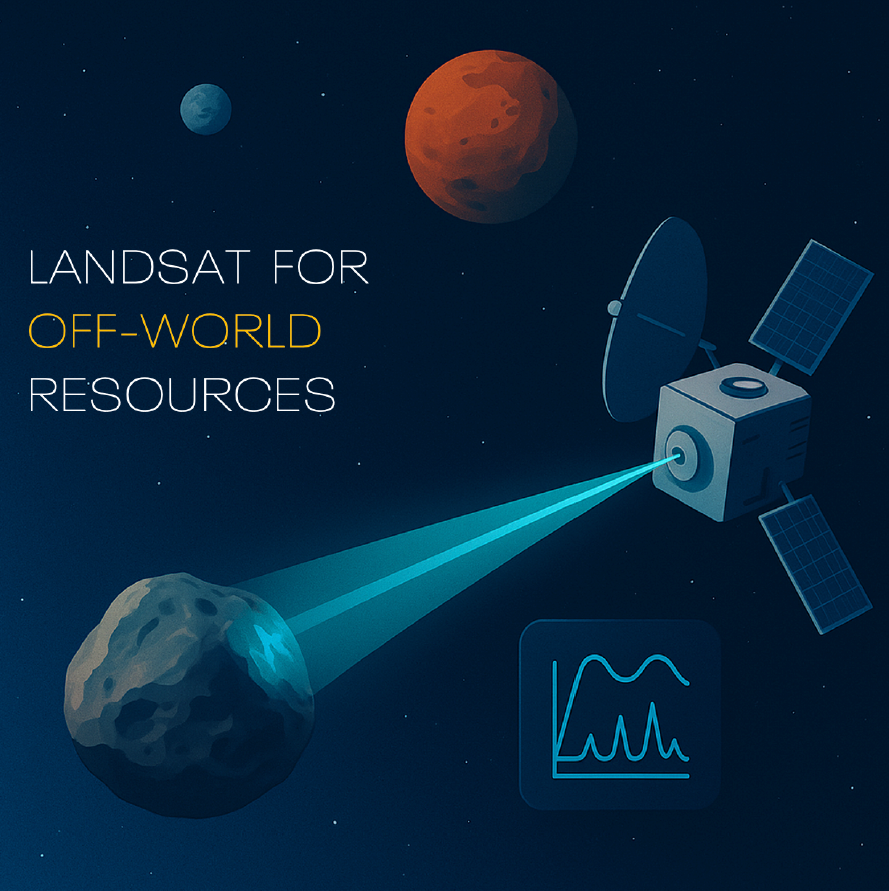
This innovative proposal explores a groundbreaking class of reconnaissance spacecraft designed to utilize Raman spectroscopy for mineral mapping in orbit during high-speed flybys. This method offers significant advantages by eliminating the need for landing, sample return, or extended missions. If validated, NASA will acquire the capability to assess lunar ice and ilmenite, evaluate asteroid ore content, and analyze volatile minerals on Mars’ moons—achieved with a single, compact 300 kg spacecraft. This mission aligns with NASA’s strategic objectives of establishing a sustainable presence on the Moon, assessing asteroid resources, and enhancing Mars logistics by addressing the essential question, “What is this material?”
A primary goal is to evaluate the feasibility of using Raman spectroscopy—an advanced technique that identifies minerals based on their molecular fingerprints—from distances of tens of kilometers during a flyby or orbital pass. Historically, the planet Raman technique has operated from mere meters onboard spacecraft. However, conducting Raman analysis from a distance of 30-50 km opens a new frontier in planetary science and space resource exploration, delivering specific compositional insights unattainable with passive reflection or neutron analysis methods.
The proposed mission concept involves a single solar-powered spacecraft executing three reconnaissance phases: (1) Mapping ice and ilmenite from a 50 km polar orbit around the Moon; (2) Conducting a 30 km flight past near-Earth asteroids to identify silicates, metals, and organic compounds; (3) Performing a 30-50 km orbital survey of Phobos or Deimos to detect volatile-rich materials critical for Mars mission logistics.
During each phase, high-energy pulsed lasers, time-gated photon-counting detectors, and radar-class beam steering systems will effectively isolate Raman signals emitted from the planetary surface. Current sensor technologies and mission frameworks do not possess this capability.
To assess the feasibility of this initiative, the NIAC Phase I study aims to answer three pivotal questions: (1) Can essential mineral Raman lines be reliably detected with sufficient signal-to-noise ratios from 50 km away? (2) Is it feasible to stabilize beam pointing and smear during high-speed flybys for optimal integration times? (3) Can a 300 kg spacecraft, equipped with realistic propulsion, power, and attitude control systems, successfully complete its mission across all three targeted destinations?
Methodologies implemented in the study include ab initio photon modeling based on known Raman cross-sections, spacecraft jitter analysis, and trajectory planning using NASA’s standard mission tools. The analysis is segmented into three technical work packages, complemented by synthesis and reporting phases. Sensitivity analyses and decision gates will be employed to evaluate how variations in photon return or pointing control may influence overall mission viability. Alternative mission architectures for each leg will also be assessed, including lower flyby altitudes and diverse propulsion strategies.
The research team consists of experts in Raman instrumentation, spaceborne lidar, and mission design. Principal Investigator Sobron has previously led the 120-meter range Raman system and contributed to the SuperCam and SHERLOC instruments on Mars missions. Co-investigators Lee and Yu from NASA Goddard bring extensive experience from ICESat-2 and other orbital laser systems. Co-Investigator Casell from NASA Ames will spearhead the early mission design, benefiting from previous NIAC projects. The collaborative effort is supported by SETI and commercial partner OffWorld.
If successful, this groundbreaking initiative will establish the first framework for on-orbit Raman mineral detection, demonstrating that high-resolution molecular mapping is achievable without the need for landings. Even partial success will push the boundaries of remote sensing physics and provide a validated framework to guide future NASA decisions on Artemis mission sites, asteroid mining, and the Mars ISRU program. This proposed architecture represents a cost-effective Discovery-class model that could ultimately enhance inner solar system reconnaissance efforts, delivering Landsat-like mineral intelligence for planetary exploration.
2026 Selection
Source: www.nasa.gov