


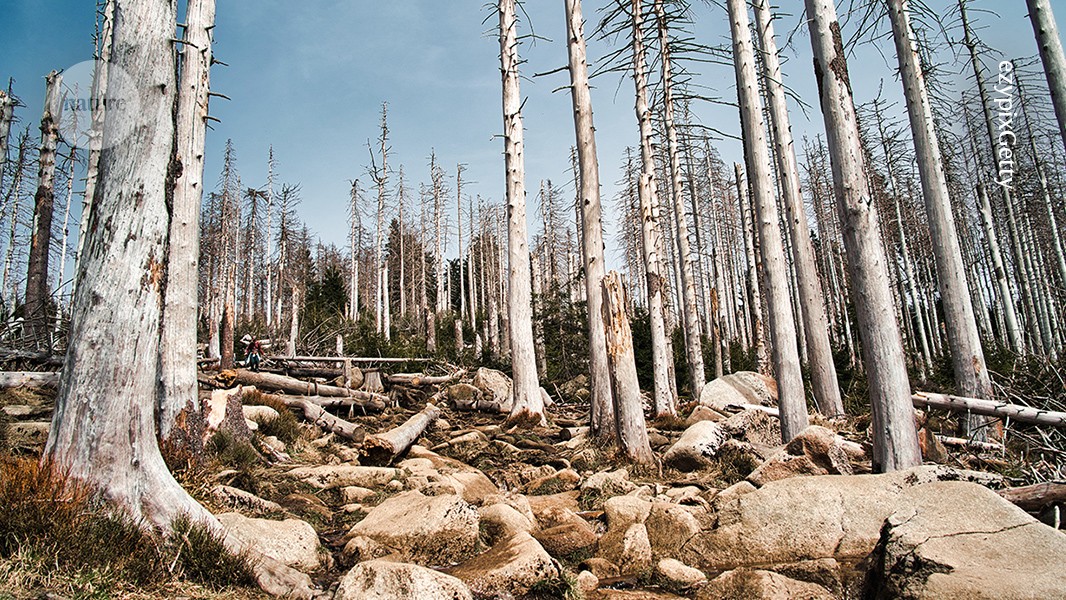
Satellite data shows a global browning trend since the beginning of this century. Credit: ezypix/Getty
Approximately 56 million years ago, a rapid rise in atmospheric carbon dioxide triggered severe global warming and transformed ecosystems worldwide. Detailed reconstructions of ancient environments suggest that the event caused widespread forest loss. The study1, published in Science, offers insights into how forests could respond to human-driven climate change.
“We’re seeing forest decline across the world right now,” says co-author Regan Dunn, a paleoclimatologist at the Natural History Museum of Los Angeles County in California.
This period of rapid warming, known as the Paleocene–Eocene Thermal Maximum (PETM), was one of the most significant climate shifts in Earth’s history. The amount of carbon dioxide released during the PETM may have been comparable to the total emissions expected by the end of the 21st century under a high-emissions scenario. The ancient carbon dioxide surge raised global temperatures by an estimated 5 to 9 degrees Celsius and altered the climate for more than 150,000 years.
By analyzing preserved fossils, sediments and geochemical evidence from the PETM, researchers are reconstructing how Earth’s ecosystems responded to rapid warming. Forest composition changed as broad-leaved trees at mid-latitudes were replaced by fern-dominated landscapes. Increased rainfall and flooding also caused rivers to transport more sediment, while soils stored less carbon.
Dunn and her colleagues investigated how these environmental changes affected the structure of ancient forest canopies. Understanding changes in canopy cover can reveal how carbon storage and other ecosystem functions were altered, Dunn says. “This really tells us how the forest is functioning.”
The study addresses a question that ecologists are also examining today: how will forests respond to rising atmospheric carbon dioxide?2 Higher greenhouse-gas concentrations trap more heat, raise temperatures and alter rainfall patterns, placing plants under increasing stress. At the same time, elevated CO2 can stimulate plant growth through fertilization. Researchers are still working to determine how these competing effects will shape the world’s forests.
Fossil leaves reveal how ancient forest canopies changed
To reconstruct the structure of PETM forests, the researchers examined the shapes of fossilized leaf cells preserved in sediment cores from Wyoming’s Hanna Basin. Because plants grow toward available light, the anatomy of their leaves can indicate how much of the forest canopy was shaded and how much was exposed to sunlight. “Even on the same plant, there are differences between sun and shade leaves,” Dunn says.
The researchers used fossil leaves to estimate how forest canopies changed as atmospheric CO2 concentrations and temperatures rose in Wyoming during the PETM. They measured forest “greenness” using the leaf area index, which describes the amount of leaf surface covering a given area of ground.
The results indicate that the forest initially became denser when the PETM began, but canopy cover then declined sharply. Leaf area fell by 61% over the following several thousand years. Canopy cover remained approximately 35% below its original level for tens of thousands of years, until the PETM ended.
The researchers say this pattern suggests that an initial pulse of CO2 stimulated forest growth, possibly because of major volcanic eruptions in the carbon-rich sediments of the North Atlantic Ocean. Over time, however, the growth benefits of additional carbon dioxide were outweighed by extreme heat. “Too much carbon dioxide raises temperatures beyond the limits at which plants can function,” Dunn says.
Source: www.nature.com