


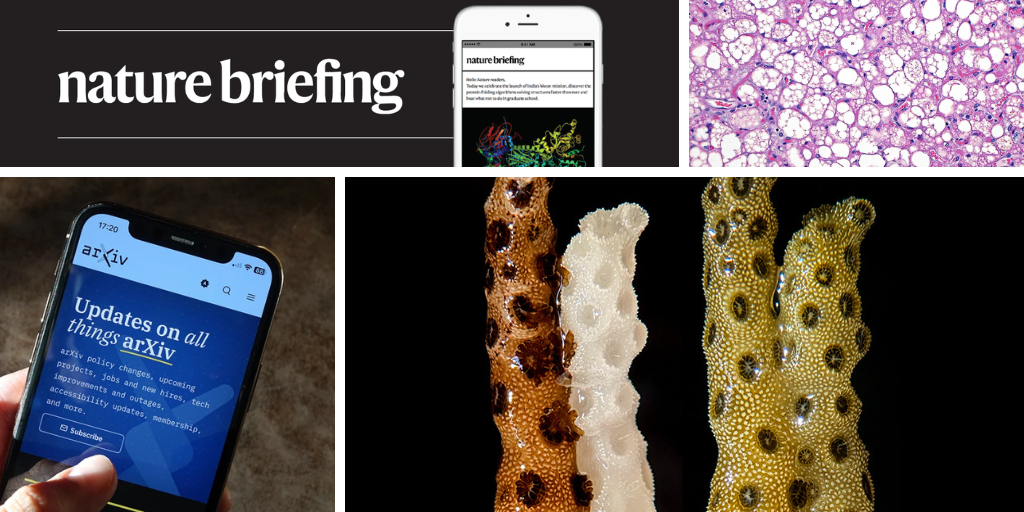
Nature Briefing: Bleached Corals Recover in Eight Weeks, Dogs Understand “Bouba” and “Kiki”
Would you like to receive this briefing free in your inbox every day? Sign up for Nature Briefing.
Top science stories
In stressful conditions, corals expel the symbiotic algae that give them their color. When bleached corals are brought into contact with healthy corals, they can return to full health within eight weeks.
Credit: Danny Collins
Healthy coral fragments help restore bleached coral
Scientists have restored bleached coral in the laboratory by placing healthy coral fragments in contact with damaged areas. Researchers used Pocillopora damicornis: the healthy coral was placed on top of the bleached area, and the two fused to form a bridge through which the coral’s algal symbionts could spread.
The bleached coral fully recovered within eight weeks, even though the healthy fragment was removed after one week. The findings “could ultimately yield scalable solutions” for reversing widespread coral decline, says marine ecologist and study co-author Fiorenza Micheli.
Nature | 5-minute read
Reference: Science Advances paper
arXiv limits submissions amid an AI-generated paper surge
Preprint server arXiv has introduced a limit of two papers per month for each submitting researcher in an effort to address a flood of submissions generated by artificial intelligence.
Astrophysicist Steinn Sigurðsson, arXiv’s scientific director, said the restriction was the latest measure to prevent volunteer moderators from becoming overwhelmed. Some researchers support the cap, while others argue that it does not solve the underlying problem. Natalie Kalil, founder of the AI-assisted peer-review platform Reviewer3, says AI failures “just go somewhere else and become someone else’s problem.”
Nature | 5-minute read
Active brown fat linked to better health
A study of more than 100,000 people has revealed potential health benefits associated with brown fat, which burns calories and generates heat. People with “active” brown fat were less likely to experience health problems including type 2 diabetes, depression and anxiety.
The study was retrospective, so it cannot establish that brown fat causes these benefits. Still, molecular biologist Irfan Lodhi calls it “a very interesting and surprising study.”
Nature | 5-minute read
Reference: Nature paper
Dogs appear to share humans’ “bouba” and “kiki” associations
When people are shown a pointed shape and a round shape and asked to label them “bouba” and “kiki,” they tend to associate “kiki” with the pointed shape. Dogs seem to make a similar association.
Researchers found that domestic dogs (Canis) were more likely to look at and move towards a round shape when they heard “bouba,” and towards a pointed shape when they heard “kiki.” The findings may suggest that dogs form connections between visual information and sounds in a way that resembles humans.
Reference: Proceedings of the Royal Society B paper
Features and noteworthy discoveries
The latest collection of Nature stories includes a newly discovered penguin species and news that Mauritius has become the first country in the world to reduce the number of people with type 2 diabetes—a remarkable achievement at a time when diabetes rates are rising globally, researchers say.
Nature | 5-minute read
Metagenomic testing could speed up diagnosis of serious infections
Metagenomic testing can screen a sample for all microorganisms that might be present instead of searching for specific pathogens. Hospitals are now trialling ways to perform these tests rapidly.
The approach could help determine whether acute illnesses causing neurological symptoms are bacterial, viral or autoimmune in origin, leading to more effective treatment. Interpreting metagenomic results can be difficult because the tests detect pathogens, harmless microorganisms and contaminants alike. Advances in artificial intelligence are helping researchers extract useful information from this noise more quickly.
National Academies updates its guide for scientists
The U.S. National Academies of Sciences, Engineering, and Medicine has updated On Being a Scientist, a guide to responsible and ethical behavior in research for graduate students and early-career researchers.
The guide was first published in 1989 and last updated in 2009. Engineer Mitul Ruhar, chemist and department chair Emily Penzer, and psychologist Alan Leshner, former president of the American Association for the Advancement of Science, say that research priorities and funding have changed, creating new expectations and pressures for scientists. “The people who feel the impact most acutely are young researchers,” they write.
Issues in Science and Technology | 9-minute read
Reference: On Being a Scientist: A Guide to Responsible and Ethical Behavior in Research
Good news from the animal world
Today I’m celebrating Sugias, a black Labrador named “Animal of the Year” by the International Fund for Animal Welfare.
Sugias, pronounced “ski-ah,” was bred as a mountain-rescue dog and is now trained to sniff out carpet squirts, or “sea vomit” (Didemnum vexillum). These marine organisms may outnumber native species in coastal ecosystems.
Source: www.nature.com